The Hybrid Comeback: Why Hybrids Are Surging as Pure-EV Growth Cools
Why are hybrids making a comeback? As pure-EV sales growth cools, buyers wary of price, range or charging are turning to hybrids as a no-compromise stepping stone. Regular hybrids need no plug and cut fuel use by a third or more, while plug-in hybrids cover short trips on electricity alone. They are a pragmatic bridge, though long term the industry still expects full electrification.
The technology everyone wrote off keeps winning
A few years ago, the hybrid was supposed to be a museum piece by now, a transitional gadget that bought the industry time until "real" electric cars took over. Somebody forgot to tell the buyers. In 2025 the hybrid quietly became the most reliable growth story in the car business, while pure-EV sales in the United States stalled and then dipped. Toyota alone moved roughly 4.4 million hybrids worldwide. That is not a rounding error. That is a verdict.
This is awkward for everyone who spent the last five years declaring the combustion engine dead and the battery-electric car its only successor. The reality turning up in showrooms is messier and a lot more interesting: the path to electrification is not one straight line, and a large share of buyers have decided the most sensible step right now has a gas tank and a plug-free badge.
The numbers that surprised the forecasters
Start with the US, where the divergence is sharpest. Through 2025 roughly 22 percent of new light vehicles were electrified in some form, up from about 20 percent the year before. But the mix inside that number flipped: conventional hybrids gained share while both battery-electric and plug-in hybrid sales slipped. Pure EVs settled at around 7.5 to 9 percent of new sales and stopped climbing. In the third quarter, analysts at PwC pegged conventional-hybrid sales up about 20 percent year on year, while plug-in hybrids managed a mere 3 percent.
One policy event amplified the split. US federal EV tax credits expired at the end of September 2025. Battery EVs and plug-in hybrids, which qualified, saw a buying rush followed by a sharp drop. Ordinary hybrids never qualified for those credits in the first place, so they had nothing to lose. When the subsidy went away, the cars that never depended on it kept selling.
Why buyers keep choosing the hybrid
Strip away the politics and the reasons are boringly practical.
- No charging homework. A hybrid never asks you to install a wall box, find a working public charger, or plan a road trip around kilowatts. You fill it like any other car and the electric side manages itself. For the millions of people who park on a street or in an apartment block, that removes the single biggest obstacle to going electric.
- The fuel savings are real and immediate. A modern hybrid can cut city fuel use by a third or more versus the same car with a plain engine, with none of the range or charging compromises. Buyers feel that at the pump from day one.
- It is cheaper to buy. A hybrid commands a small premium over a gas model, not the larger one an EV often still carries, and there is no anxiety about resale value or battery replacement on an unfamiliar platform.
- It feels familiar. No new habits, no apps, no range math. For a cautious mainstream buyer, "it just works like my old car but uses less fuel" is a powerful pitch.
| Hybrid (HEV) | Plug-in hybrid (PHEV) | Electric (BEV) | |
|---|---|---|---|
| Needs plugging in? | No | Optional, for electric miles | Yes |
| Electric-only range | A few km, low speed | ≈ 40–80 km | ≈ 300–600 km |
| Tailpipe emissions | Reduced | None on battery, then petrol | Zero |
| Up-front price | Small premium over petrol | Medium premium | Larger premium (falling) |
| Charging access | Not needed | Helpful | Essential |
| Best for | No home charging; lots of city miles | Short commutes, occasional long trips | Home/work charging; daily + highway |
The Toyota vindication
For years Toyota was the punching bag of the EV commentariat, scolded for clinging to hybrids while rivals promised all-electric line-ups. The company's argument was always that the world would electrify unevenly, and that a broad portfolio, hybrids included, would serve more customers than betting everything on one technology. 2025 read like a vindication. Toyota stayed the world's best-selling automaker with record global volume, electrified vehicles reached about 47 percent of its US sales, and it kept pouring money into hybrid production, including a roughly 912-million-dollar expansion in the US. Even Toyota saw a slight late-year cooling in electrified demand, so this is not a victory lap so much as a reminder that hedging your bets is not the same as being wrong.
Europe tells a different story
Here is the part that gets lost in the American headlines: the "hybrid moment" is not global. In Europe, both battery-electric and plug-in hybrid sales surged through 2025, with EV registrations up roughly a third over the year. Germany, the continent's largest EV market, saw electric sales jump about 50 percent to a record, helped by tighter CO2 rules taking effect and a wave of more affordable models finally arriving. The plug-in hybrid is booming there too, partly because Chinese brands, squeezed by EU tariffs on pure EVs, redirected a flood of competitively priced PHEVs into the market. So the same powertrain debate is producing opposite outcomes on two continents, shaped less by engineering than by incentives, charging access, and trade policy.
Bridge or detour?
The honest worry about hybrids, and especially plug-in hybrids, is that they can become an excuse. A PHEV only delivers its promised emissions if the owner actually plugs it in, and plenty do not, leaving an expensive battery to haul around as dead weight. Lean too hard on hybrids and an automaker can talk itself out of the harder, necessary work of building compelling EVs and the charging network they need. That is a real risk, not a hypothetical one.
The opposite mistake is just as costly: forcing buyers into pure EVs before the charging infrastructure, the prices, and the used-car market are ready, then watching them walk back to gasoline entirely. A hybrid that halves someone's fuel use today is a better climate outcome than an EV they decline to buy.
The EV-Global Verdict
The destination is not in question. Long term, the electric car wins on cost, simplicity and driving experience, and we have said so repeatedly. What 2025 proved is that the timeline is far less tidy than the slogans suggested, and that it differs wildly by region. Hybrids are not a betrayal of electrification. They are a rational bridge for the large group of buyers who cannot yet charge easily or stomach the price, and writing them off was always more ideology than analysis.
The mistake is treating this as either-or. The smart automaker sells hybrids to fund and de-risk the EV transition, not to dodge it, and keeps shipping better electric cars while the bridge does its job. Watch the two levers that actually set the pace: charging access and purchase incentives. Engineering solved the car years ago. Whether the next buyer goes hybrid or fully electric is being decided by policy and infrastructure, not by the badge on the back.
Hybrids: frequently asked questions
Why are hybrids becoming popular again?
Buyers like that hybrids cut fuel use without any charging, plugging in or change of habit, and they cost less than many EVs. As pure-EV growth cooled, hybrids became the easy middle step.
What is the difference between a hybrid and a plug-in hybrid?
A regular hybrid recharges its small battery itself and never plugs in, helping mainly in town. A plug-in hybrid has a bigger battery you charge for 20 to 50 miles of electric driving before the engine takes over.
Is a hybrid better than a full electric car?
It depends on your situation. A hybrid suits people without easy charging or who drive long distances often, while a full EV is cheaper to run and cleaner if you can charge at home. Hybrids are a bridge, not the end point.
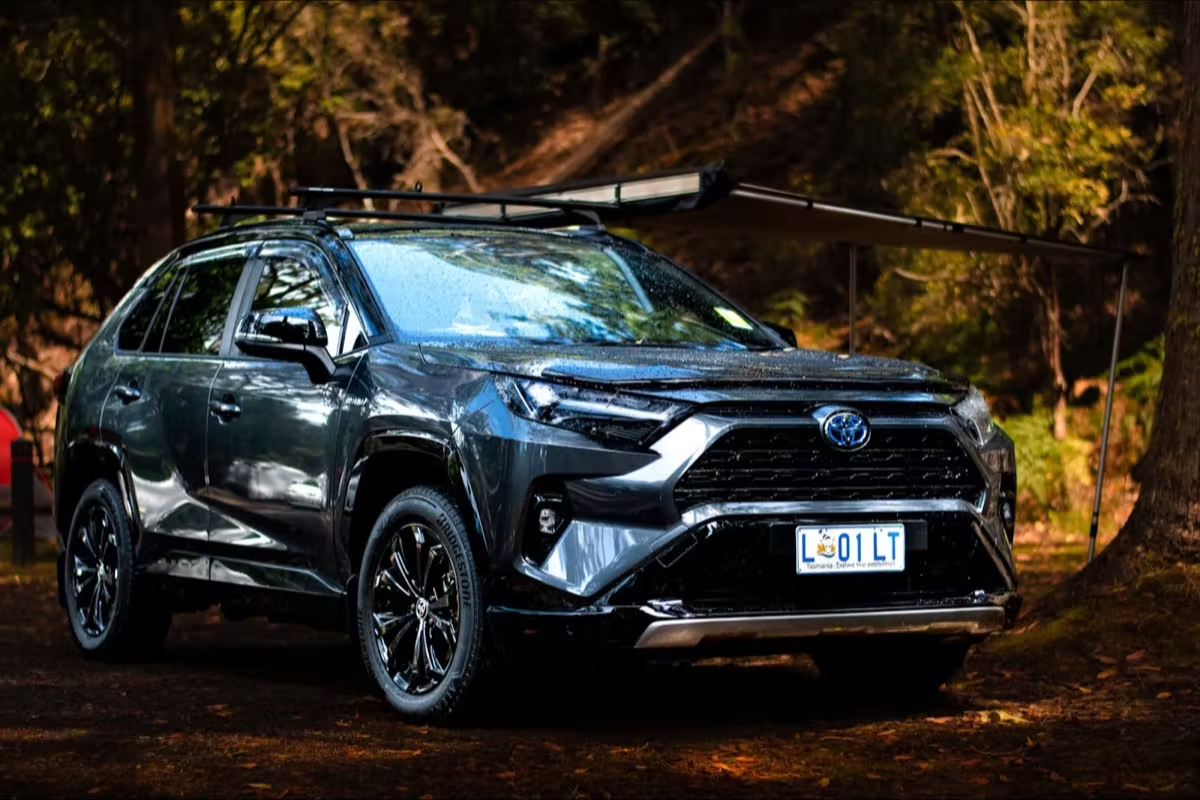
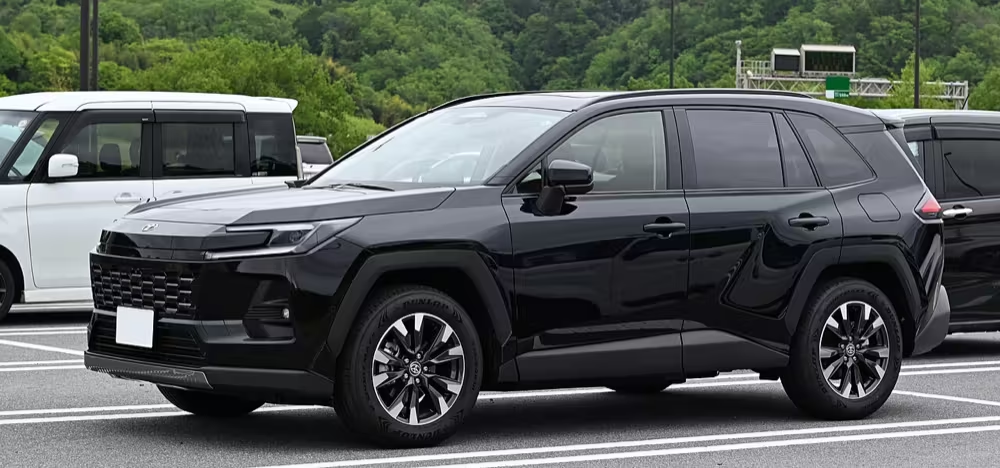
Photos: Toyota RAV4 Hybrid via Unsplash and Wikimedia Commons by TTTNIS (CC0). Resized and converted to AVIF.