Tesla Robotaxi vs Waymo: One Has the Hype, the Other Has the Miles
Who is winning, Tesla or Waymo? In July 2026 Waymo leads on deployed scale and published safety evidence. By May it had served more than 20 million fully autonomous rides; its Safety Impact dashboard reports 220.6 million rider-only miles through March and 94% fewer serious-injury-or-worse crashes than its human benchmark. Tesla's robotaxi deployment is far smaller and uses a different camera-based approach.
Both companies charge for rides without a human at the wheel, but they start from very different systems. Waymo operates a bounded Level 4 service using lidar, radar, cameras and maps. Tesla is developing its robotaxi from a camera-based stack connected to a large consumer fleet. A useful comparison therefore separates technology, responsibility, safety evidence and deployed scale.
October 2026 update. Tesla now carries passengers without a safety monitor in Austin, Dallas, Houston and Miami and says it will reach about a dozen states by year-end; Cybercab production started at Giga Texas on April 21. Waymo passed 500,000 paid rides a week earlier this year, opened Las Vegas in July and is heading to Denver, San Diego and Tampa. The city gap in the chart below has narrowed; the gap in published driverless miles has not.
That gap is the real story of the driverless race in 2026, and it is more interesting than the usual "Elon versus everyone" framing. Because the two companies did not just build different cars. They made opposite bets on what a self-driving car even is.
Two bets on the same future
Waymo's car is a sensor fortress. The sixth-generation Waymo Driver carries 13 cameras, 4 lidar units, and 6 radars, all feeding a system that cross-checks every object three different ways and leans on high-definition maps it has built street by street. It is expensive, it is heavy, and it works in the rain.
Tesla threw all of that out. The Cybercab and the Model Ys running in Austin use cameras only. No lidar, no radar, no pre-built maps. Tesla's argument is that humans drive with two eyes and a brain, so a neural network with eight cameras should manage too, and that the moment it does, every Tesla already on the road becomes a potential robotaxi overnight. The hardware on a Cybercab costs a rounding error next to Waymo's sensor stack. That is the whole point.
One bet is "make it work perfectly, then make it cheaper." The other is "make it cheap, then make it work." In 2026 we are finally watching both collide with reality.
Where they actually operate today
This is where the hype meets the map. Waymo said in May 2026 that its service would cover more than 1,400 square miles across 11 US cities. Its current rider fleet uses Jaguar I-PACE vehicles and the new Ojai, while Hyundai IONIQ 5 vehicles are in validation for future service.
Tesla's current Robotaxi page lists limited service in four cities: Miami, Austin, Dallas and Houston. Its first-quarter 2026 update said paid Robotaxi miles nearly doubled from the previous quarter and that unsupervised rides began in Dallas and Houston in April. Tesla does not publish a live fleet total that can be compared cleanly with Waymo's vehicles.
Waymo reported 220.6 million rider-only miles through March 2026. Tesla's first-quarter chart shows about 1.8 million cumulative paid Robotaxi miles. The definitions differ, but the published scale gap is still large.
The safety record nobody can spin
Waymo's June 2026 analysis covers more than 220 million fully autonomous miles. Compared with human drivers in the same areas, it reports 94% fewer crashes causing serious or fatal injuries, 82% fewer airbag-deployment crashes and 82% fewer crashes involving any reported injury. The comparison includes every collision regardless of fault and publishes its methodology.
Tesla publishes cumulative paid Robotaxi miles, but it has not published a matched crash-rate analysis using the same geography, severity thresholds and exposure method. That makes a responsible company-to-company safety percentage impossible today. Waymo has the stronger public evidence; that is not the same as proving every Waymo trip is safer than every Tesla trip.
Waymo vs Tesla at a glance
Strip out the noise and put the two side by side. One of these columns is a scaled-up business; the other is an experiment with enormous potential.
| Measure | Waymo | Tesla Robotaxi |
|---|---|---|
| First paid service | October 2020 (Phoenix) | June 2025 (Austin) |
| Cities listed | 11 US cities | 4 (Miami, Austin, Dallas, Houston) |
| Published scale | 20M+ rides; 220.6M rider-only miles | About 1.8M cumulative paid miles at Q1 2026 |
| Vehicles | Jaguar I-PACE and Ojai; IONIQ 5 in validation | Model Y; Cybercab volume production scheduled for 2026 |
| Sensors | Lidar + radar + cameras | Cameras only |
| Supervision | Fully driverless in service areas | Unsupervised in Texas; limited service also listed in Miami |
| Vehicle cost | Not disclosed | Not disclosed |
| Safety evidence | 94% fewer serious or fatal crashes than human benchmark | No directly comparable large-scale analysis published |
The Cybercab wildcard
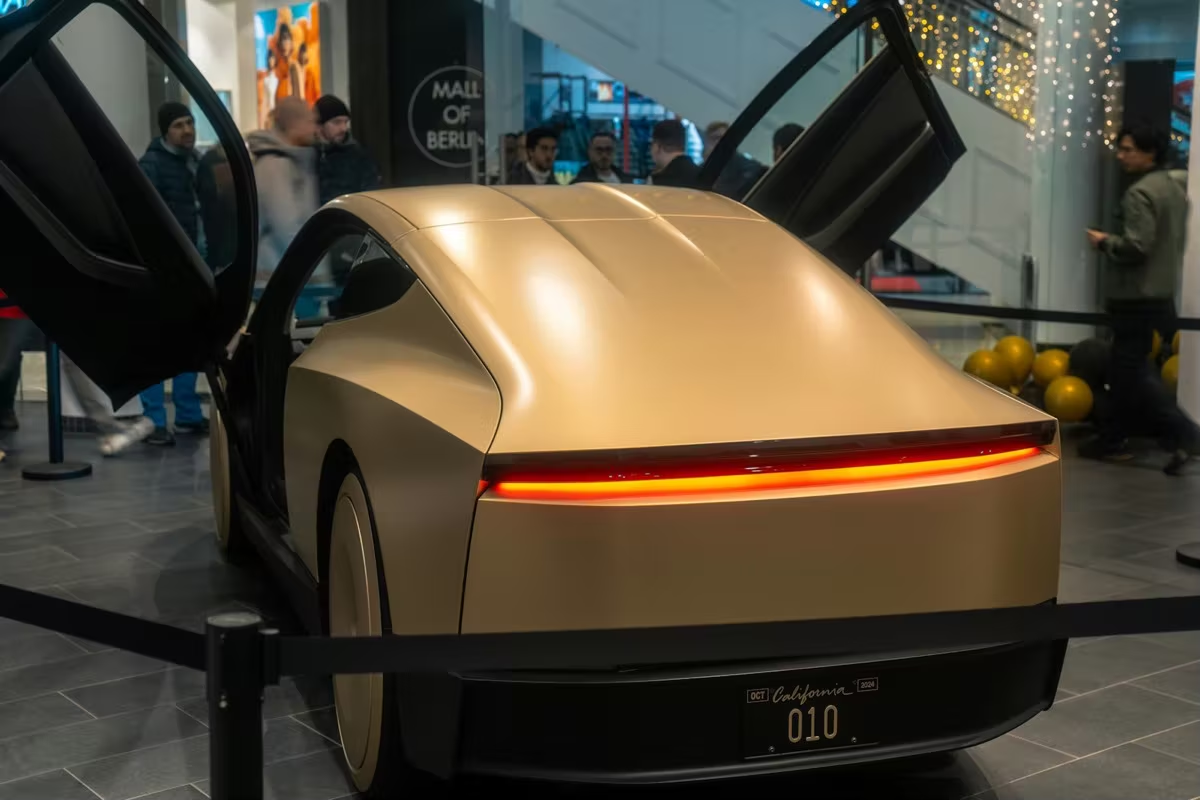
Cybercab is Tesla's purpose-built two-seat robotaxi without a steering wheel or pedals. In its first-quarter 2026 update, Tesla said the vehicle remained scheduled for volume production during 2026 and would replace Model Y vehicles in the fleet over time once production begins. That is a manufacturing plan, not evidence of a paid Cybercab service.
Tesla's scalability case rests on a camera-based system, common software and an existing manufacturing base. The open questions are production rate, regulatory approval, service reliability and the safety evidence needed to expand. Tesla's own Robotaxi page still describes Cybercab rides as a future offering.
How the robotaxi race got here
The two companies arrived at the same June 2026 moment from completely different directions and speeds.
Tesla unveils the Cybercab at its "We, Robot" event and promises a roughly $30,000 price.
Waymo opens paid rides in Austin, its fifth city, while still expanding on the West Coast.
Tesla launches its robotaxi in Austin, with safety monitors riding along at first.
Tesla removes the safety monitor in parts of Austin: its first genuinely driverless rides.
Waymo passes 200 million driverless miles, starts its sixth-gen rollout, and raises at a $126B valuation.
Tesla opens Dallas and Houston and mass-produces the Cybercab; Waymo's first purpose-built Zeekr robotaxi takes paying riders.
So who is winning?
If winning means a paid driverless business operating at scale with a published safety record, Waymo leads. Tesla has proved that it can launch paid unsupervised Model Y service in several cities and expand its mileage, but its operating scale and public safety evidence remain much smaller.
The next useful evidence is not a demo or a prediction. Watch whether Cybercab begins paid service, whether Tesla publishes a comparable crash-rate denominator, and whether both companies expand without narrowing their operating conditions.
The EV-Global Verdict
Waymo wins the present comparison on published miles, service footprint and safety evidence. Tesla's case is potential scale through simpler vehicle hardware and its manufacturing base, but Cybercab service and comparable safety data are still pending. Track deployed miles, operating areas and matched crash rates, not promises.
Follow the robotaxi engineering stack
Start with how Waymo works and the complete SAE automation-level framework. The Level 2 vs Level 3 boundary explains why supervised assistance is not a robotaxi, while Nvidia's automotive platform shows what a compute supplier does and does not provide.
Under that driving stack sit the software-defined vehicle, its E/E architecture and the mechanical systems that still steer, brake and move the car. The automotive engineering hub connects those layers without treating autonomy as one piece of software.
Sources, checked July 22, 2026: Waymo's Ojai and 20-million-ride update, its 11-city expansion update and the Safety Impact dashboard. Tesla's Q1 2026 update reports paid Robotaxi miles, unsupervised Texas launches and the Cybercab production schedule; its Robotaxi page lists current service cities.
Tesla Robotaxi vs Waymo: frequently asked questions
Is Tesla's robotaxi fully driverless?
Tesla says its Texas service operates unsupervised and that Dallas and Houston launched unsupervised rides in April 2026. Its current Robotaxi page also lists limited service in Miami. Availability and operating areas remain restricted.
How is Waymo so far ahead of Tesla?
Waymo reached paid driverless service years earlier and reported more than 20 million fully autonomous rides by May 2026. Its lead comes from a bounded Level 4 service, redundant sensors, maps and years of operational validation.
What is the Tesla Cybercab?
Cybercab is Tesla's purpose-built two-seat robotaxi without a steering wheel or pedals. Tesla's first-quarter 2026 update scheduled volume production during 2026, but its public Robotaxi page still describes Cybercab rides as a future offering.
Is Waymo or Tesla safer?
Waymo publishes the stronger large-scale evidence. Its dashboard reports 94% fewer serious-injury-or-worse crashes than its human benchmark over 220.6 million rider-only miles through March 2026. The two deployments are not yet comparable in scale.
Why does Tesla use cameras only?
Tesla uses a camera-based neural-network stack to reduce sensor complexity and reuse its software and vehicle manufacturing base. The approach still needs operational evidence across weather, roads and edge cases as the service expands.
Can I buy a Tesla Cybercab?
Tesla has not announced general consumer availability. It presents Cybercab as a future purpose-built vehicle for Robotaxi service, with volume production scheduled during 2026.
Photo: Maxim / Unsplash. Resized and converted to AVIF.