The 800-Volt Revolution: Why Voltage Became the EV Charging Battleground
What does an 800-volt EV architecture actually do? Doubling the system voltage from the usual 400V to 800V lets an EV draw the same charging power with half the current, which means less heat, thinner and lighter cables, and very fast charging (10 to 80% in around 18 minutes on cars like the Hyundai Ioniq 5 and Porsche Taycan). What matters is the whole charging curve, not just the headline peak kilowatts.
The spec that finally matters
For a decade, EV bragging rights came down to two numbers: range and 0-60. Both are close to solved. A long-range EV now clears 300 miles without drama, and even a sensible family crossover will out-sprint a hot hatch from a stoplight. So the argument moved to the one number that still ruins road trips: how long you stand at the charger. That is where 800-volt architecture comes in, and it is quietly becoming the spec sheet line that separates a genuinely fast car from one that just claims to be.
Most EVs on the road today run a roughly 400-volt system, the same ballpark Tesla popularized. A growing club runs at 800 volts, give or take. The difference sounds like a minor electrical detail. It is not. It reshapes how quickly a battery can take energy, how much the car weighs, and how hot everything gets while you wait.
The physics, in one breath
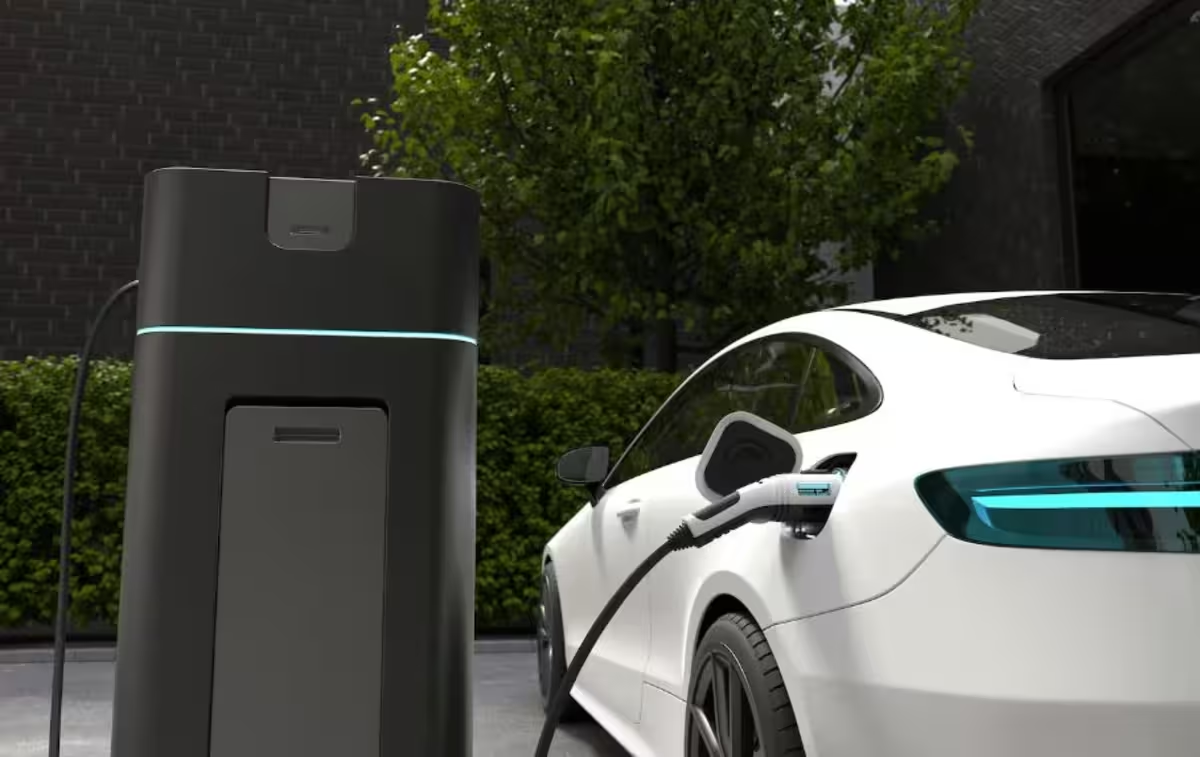
Charging power is voltage multiplied by current. Want 350 kilowatts? You can get there with high current at 400 volts, or with half the current at 800 volts. The catch is heat: losses in a cable or a battery rise with the square of the current, so halving the current cuts those losses to a quarter. Run at 800 volts and the same charging power generates far less waste heat. That buys three things at once: thinner, lighter copper cabling; less aggressive cooling; and a charging curve that can hold near its peak for longer instead of tapering early to protect the pack. The headline peak gets the attention, but the flatter curve is what actually shaves minutes off a stop.
Porsche went first, Hyundai made it normal
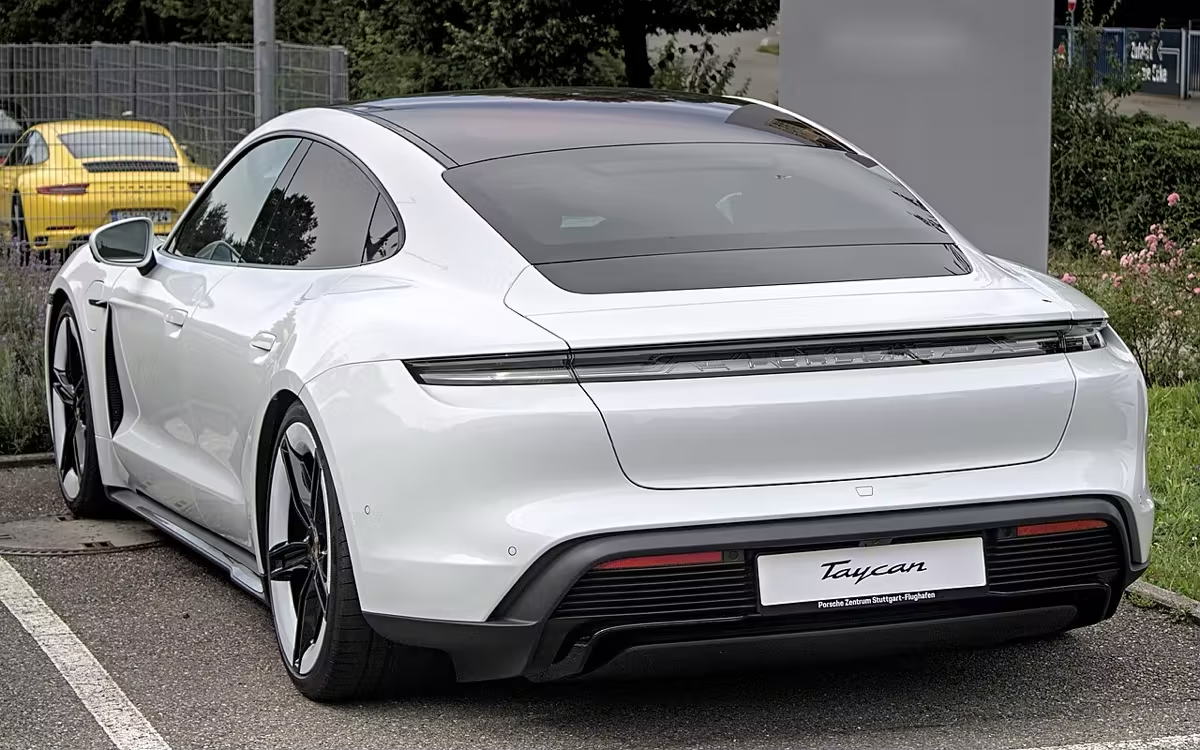
The Porsche Taycan was the first production car to use an 800-volt system, arriving in 2019 with technology Porsche developed partly through its stake in Rimac. It charges at up to 270 kW, and to stay compatible with older 400-volt chargers it carries an extra component, a charge booster, that adds cost and complexity. Classic Porsche: brilliant, and expensive about it.
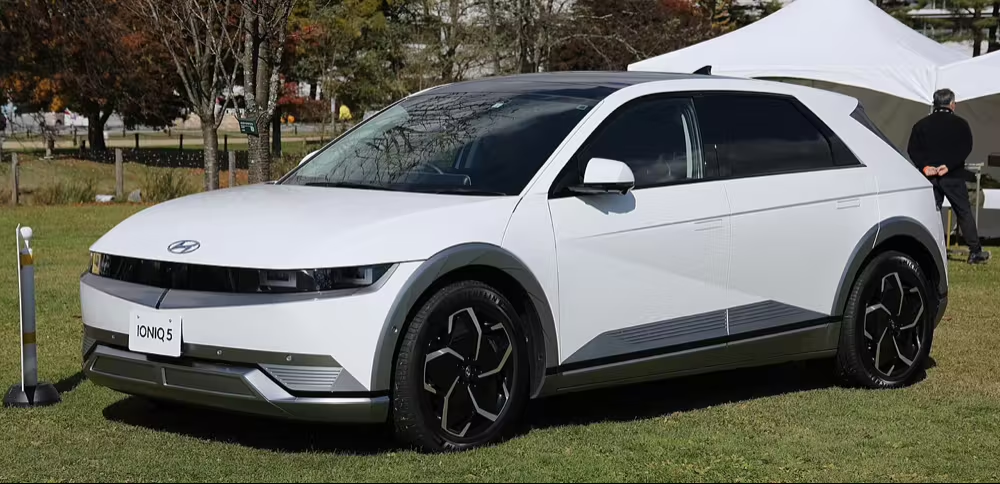
Hyundai Motor Group did the more important thing. It made 800 volts ordinary. The E-GMP platform launched in 2021 and now underpins everything from the Hyundai Ioniq 5 to the Kia EV6, the three-row EV9 and the Ioniq 9. On a powerful enough charger, an E-GMP car can refill the usable middle of its battery in well under twenty minutes. Hyundai's trick for 400-volt chargers is more elegant than Porsche's: instead of a dedicated booster, it borrows the rear motor and its inverter to step the voltage up. Fewer parts, same result.
 Free calculatorHow long will a charge take?Enter the battery size, charger power and your start and target percent to get the time.
Lucid went higher, and the club keeps growing
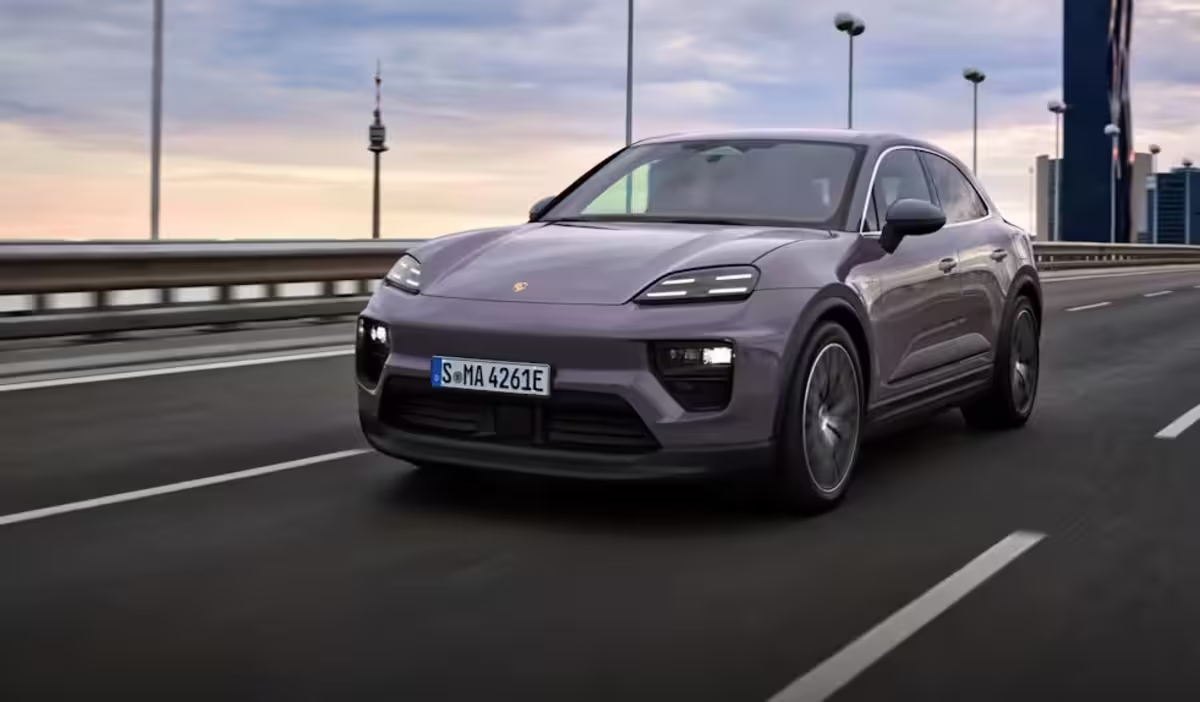
If Porsche proved the concept and Hyundai scaled it, Lucid pushed it further. The Air and the Gravity SUV run an in-house platform that climbs to roughly 900 volts, which is a big reason the Air is so absurdly efficient and can be specified with class-leading range. The roster now reaches well beyond the pioneers: China's XPeng put 800 volts in the G9, Lotus built a proprietary high-voltage platform for the Eletre, and within the Volkswagen Group the new PPE platform brings 800 volts to the Porsche Macan EV and the Audi A6 and Q6 e-tron. Even American electric trucks joined in, with GM's high-voltage architecture underpinning the GMC Hummer EV and Silverado EV.
Tap a metric. Notice how the Tesla's higher peak power still loses on 10–80% time, the flatter 800V curve is what shaves off the minutes. Manufacturer figures on a high-power charger in ideal conditions; real-world times run longer.
Silicon carbide: the quiet hero
None of this works cleanly without a change in the power electronics. The semiconductor that switches current inside the inverter has to cope with higher voltage without melting, and ordinary silicon struggles. The answer is silicon carbide (SiC), which handles high voltages efficiently and conducts heat far better than the silicon it replaces. Hyundai's E-GMP, for instance, uses SiC in the rear inverter. SiC is more expensive to make, which is part of why 800-volt cars have tended to sit higher up the price ladder. As SiC supply scales and costs fall, that premium shrinks, and the technology trickles down into cheaper cars.
The fine print every buyer should read
800 volts is real, but the marketing around it is slippery. Three things are worth knowing before you pay for the badge.
- The advertised peak is often the charger's number, not the car's. An Ioniq 5 quoted at "350 kW" is describing the station it can plug into, not a speed it sustains. Real-world peaks land lower and only briefly. Judge a car by independent charging-curve tests, not the brochure.
- You need an 800-volt-capable charger to feel the difference. On a slow or busy charger, an 800-volt car and a good 400-volt car arrive at the same place at the same time. The advantage shows up only when the hardware on both ends can actually deliver.
- Ironically, some 800-volt cars charge slower on Tesla's older Superchargers, which were built around 400 volts. As we covered in our piece on the charging-standard shift, that gap is closing with newer hardware, but for now an 800-volt car can be quicker on a high-power CCS unit than on an older Supercharger.
The EV-Global Verdict
800 volts is the right direction, and not because of the giant number on the spec sheet. The genuine benefits are quieter: a charging curve that holds longer, cabling that saves weight, and an efficiency edge that stretches range without a bigger battery. Those are the things you feel on a real road trip, even when the peak figure looks similar to a rival's.
For now it remains mostly a premium feature, gated by the cost of silicon carbide and high-voltage components. That will not last. As SiC gets cheaper and platforms like E-GMP and PPE spread, 800 volts will quietly become the default for any car that wants to be taken seriously on charging. Our advice: ignore the peak-kW chest-thumping and look at how long a car holds its speed from 10 to 80 percent. That curve, not the number on the poster, is the real battleground.
800V charging: frequently asked questions
Is an 800V EV architecture worth it?
For frequent long-distance drivers, yes. The real benefit is not the headline kilowatts but a charging curve that stays high for longer, so a 10 to 80 percent top-up finishes sooner. You also get lighter cabling and a small efficiency gain that adds range without a bigger battery. If you rarely fast-charge, the advantage is marginal for now.
Can you charge an 800V car at a normal 400V charger?
Yes. Every 800V EV still works at standard 400V CCS stations. The car either boosts the incoming voltage with a converter, as Hyundai's E-GMP platform does, or briefly reconfigures its battery pack, so you simply charge a little slower than at a true high-power station. You are never stranded by voltage.
Does 800V actually charge faster than 400V?
Higher voltage lets the same power flow with less current, which means less heat in the cables and battery. That lets the car hold a high charging rate for longer instead of tapering early, and on 350 kW chargers it can also reach higher peaks. The gain shows up in the 10 to 80 percent time, not just the poster number.
Which EVs use an 800V architecture?
The list keeps growing. It started with the Porsche Taycan and Audi e-tron GT, went mainstream with Hyundai's Ioniq 5 and 6, the Kia EV6 and EV9, and the Genesis GV60, and now includes the Porsche Macan EV and Audi A6 e-tron on the PPE platform. The Lucid Air goes even higher, at around 900 volts.
Photos: Porsche Taycan via Unsplash; Hyundai Ioniq 5 by TTTNIS (CC0). Resized and converted to AVIF.