Vehicle-to-Grid: How Your EV Can Power Your Home and Pay You Back
This article contains affiliate links. As an Amazon Associate, EV-Global earns from qualifying purchases.
What is vehicle-to-grid (V2G)? V2G lets your EV send electricity back out of its battery, to your home during an outage, or to the power grid for money. A typical EV holds 60 to 100 kWh, enough to run an average home for several days, so a parked car becomes a backup battery and a small power plant. In 2026, V2G earns drivers roughly 420 to 780 dollars a year in pilot programs, with the best schemes paying far more. The catches: you need a compatible car and a bidirectional charger, and availability still depends heavily on where you live.
Your electric car spends about 95% of its life parked, doing nothing, while sitting on one of the largest batteries you will ever own. Vehicle-to-grid is the idea that this is a waste, and that the same 60 to 100 kilowatt-hours you use to drive could also keep your lights on during a blackout, cut your power bill, and even earn you money by selling electricity back to the grid when it is most valuable. In 2026, after a decade of pilots and promises, that idea finally became a product you can actually buy.
It is one of the most genuinely exciting things happening in EVs, and also one of the most confusing, because the industry insists on describing it with three nearly identical acronyms. So let us start by making those simple.
Three letters that change everything: V2L, V2H, V2G
They sound the same. They are not.
V2L (vehicle-to-load ↗) is the simplest. Your car becomes a giant power outlet. Plug a tool, a fridge, a coffee machine, or a campsite into a socket on the car and it just works, typically up to 3.6 kW, or as much as 9.6 kW on a Ford F-150 Lightning. No special equipment needed. This is already common on Hyundai, Kia, and many new EVs.
V2H (vehicle-to-home) is bigger. Through a bidirectional charger and a transfer switch, the car powers your whole house, either as backup during an outage or to dodge expensive peak-rate electricity. An F-150 Lightning can run a typical home for about three days; a big-battery Chevy Silverado EV can stretch to six or seven. This is the feature that turns your driveway into a backup generator that also happens to drive to work.
V2G (vehicle-to-grid) is the full vision. V2H plus a contract with your energy company, so the car exports power back to the public grid when demand spikes, and the utility pays you. Your car becomes a tiny, mobile power plant that earns while it sits. It needs the most plumbing, and offers the biggest upside. The mental model: V2L powers your stuff, V2H powers your house, V2G powers your wallet.
How it actually works
The magic ingredient is an inverter, the device that converts the battery's DC electricity into the AC that homes and grids use, and back again. Two designs are fighting it out. In DC bidirectional systems, like the Wallbox Quasar 2, the inverter lives in the wall box; these are powerful (12 to 15 kW) but pricey and bulky. In AC bidirectional systems, like Nissan's new approach, the inverter is built into the car, so the home hardware is simpler and cheaper. Nissan's bet is that putting the smarts in the car is how you make V2G affordable enough for normal people.
The other crucial piece is a software handshake called ISO 15118-20. A plug fitting the socket is not enough; the car and charger have to negotiate, securely, exactly how much energy can flow back safely. Without that protocol, bidirectional charging simply does not happen, which is why "compatible connector" and "actually does V2G" are two very different claims. Once they are talking, the car can do real grid work: smoothing frequency, shaving peak demand, storing cheap overnight power to use at dinnertime, and soaking up solar that would otherwise be wasted.
Bidirectional charging needs a bidirectional wallbox, which is a different animal from the Level 2 unit most people install; the home EV charger cost guide covers the standard kind and what the panel side of the installation costs.
Recommended gear
Advertising / affiliate links: as an Amazon Associate, EV-Global earns from qualifying purchases. Prices and availability are set by Amazon; links open in a new tab.
True V2G hardware is still rolling out, but you can put your battery to work today: a V2L adapter turns the car into a power source, and an energy monitor shows where your kWh go.
On AmazonVehicle-to-load (V2L) adaptersRun tools and appliances straight from your EV battery. On AmazonHome energy monitorsTrack usage and shift charging to the cheapest hours.Which cars can actually do it in 2026
This is where the dream meets the fine print, because capability is uneven and very region-dependent. In the United States, the leaders are trucks and SUVs: the Ford F-150 Lightning pioneered home backup, GM made V2H standard across its Ultium lineup, and the Kia EV9 is one of the few doing true residential V2G. In Europe, the action is in smaller cars and is moving faster, pushed by regulation, with the Renault 5, the new Nissan Leaf, VW's ID. family, and BMW's iX3 all live or launching.
| Model | Market | V2L | V2H | V2G |
|---|---|---|---|---|
| Ford F-150 Lightning | US | Yes | Yes | Pilot |
| GM Silverado EV | US | No | Yes | Pilot |
| Tesla Cybertruck | US | Yes | Yes | Yes (TX) |
| Kia EV9 | US / EU | Yes | Yes | Yes |
| Renault 5 E-Tech | EU | Yes | Yes | Yes |
| VW ID.4 / ID.7 | EU | Limited | Yes | Late 2026 |
| BMW iX3 (Neue Klasse) | EU / US | Yes | Yes | Yes (DE) |
| Nissan Leaf (new gen) | UK / EU | Yes | Yes | Yes |
| Hyundai Ioniq 5 | US / EU | Yes | Yes | Pilot |
What it actually earns you
Here is the part that makes people lean in. In US residential pilots, V2G has been paying drivers roughly 420 to 780 dollars a year in combined grid payments and bill savings. The best programs go much higher, and in Germany VW projects 700 to 900 euros a year, roughly enough free electricity for 10,000 km of driving.
Annual earnings or savings reported across V2G programs, in US dollars. The spread is huge because it depends on your electricity tariff, how much of the battery you let the grid use, and how generous the local scheme is. Treat the low end as realistic today and the high end as a best case.
Even if you never sell a single kilowatt-hour, the backup-power math is compelling on its own. A home battery like a Tesla Powerwall costs many thousands of dollars and stores around 13.5 kWh. Your EV already holds five to seven times that. V2H lets you use the battery you already paid for, instead of buying a second one to bolt on the wall.
Set the earnings against what you pay to charge: the EV charging cost breakdown has the home and public rates, and the charging cost calculator gives your own number per month.
The catches: cost, hardware, and your battery
Three honest caveats, because this is not free money yet.
It costs real money up front. A bidirectional charger runs 3,000 to 8,000 dollars more than a normal Level 2 unit; the popular Wallbox Quasar 2 lists around 7,188 euros before installation. Add a smart meter, a home energy gateway, and sometimes panel work, and a full setup can land anywhere from 5,000 to 15,000 dollars. At a few hundred dollars of earnings a year, the payback is measured in years, so today V2G makes the most sense if you also want blackout protection or have time-of-use rates to arbitrage.
It is region-dependent and fiddly. Features get added and removed mid-model-year, programs are limited to certain states and countries, and a car that does V2G in Germany may only do V2H in the US. Always confirm current capability for your exact market before you buy hardware.
Does it wear out your battery? The fear is real, the data is reassuring. Normal EV batteries degrade around 2% a year. Studies put the extra wear from moderate, smart V2G use at roughly 0.3% a year, because the systems keep the battery in a gentle 20 to 80% band. A University of Delaware pilot found no measurable health loss after a full year at residential power levels, and major automakers honor the battery warranty when you use certified hardware. If battery wear in general worries you, our piece on how long EV batteries really last is worth a read.
The battery worry is smaller than it sounds. Shallow daily cycles are what packs are good at, as the EV battery lifespan data shows, and iron-phosphate packs with 3,000-plus cycles, explained in LFP vs NMC, barely notice a few kWh of grid service a day.
Europe is quietly pulling ahead
If V2G has a capital, it is Germany. Two 2026 changes flipped it from science project to viable product. First, a reform of the Energy Industry Act stopped electricity stored in a car and fed back from being hit with double grid fees, the rule that had quietly killed the economics for years. Second, the regulator's new MiSpeL framework, live since April 2026, removed the need for a second expensive meter. On top of that, the EU's AFIR rules will require every new private and public charger to support the bidirectional ISO 15118-20 standard from January 2027, effectively building V2G into the continent's charging backbone by default.
That regulatory tailwind is why Volkswagen, BMW, Mercedes, and Renault are all launching real V2G products in Europe right now, while the US moves one utility pilot at a time. For once, the most interesting EV story is not in California or China. It is in a German parliament removing a fee.
Grid-friendly charging also feeds the incentives: the 2026 EV tax credit guide explains what happened to the US charger credit, and the state of the charging network shows how fast the hardware side is moving.
Nissan launches "Leaf-to-Home" in Japan, the first commercial way to power a house from a car, after the Fukushima blackouts.
The CHAdeMO standard publishes a V2G protocol, making early Nissan Leafs grid-capable out of the box.
General Motors makes V2H a standard feature across its Ultium trucks and SUVs, taking it mainstream in the US.
Renault launches a full V2G service around the Renault 5 in France: car, charger, tariff, and software in one bundle.
BMW launches Germany's first commercial V2G with E.ON, and Germany's MiSpeL rules make home V2G economically viable.
EU rules make the bidirectional ISO 15118-20 standard mandatory on new chargers, baking V2G into Europe's grid.
The EV-Global Verdict
Vehicle-to-grid is no longer a lab demo; in 2026 it is a product, and a genuinely exciting one. The case for V2H is already strong: you own a massive battery, so using it to ride out a blackout instead of buying a separate wall unit is just common sense. The case for full V2G, where the car pays you, is real but still early. The hardware is expensive, the best earnings are locked to specific programs, and the rules are only now catching up, fastest in Germany and the EU. If you are buying an EV today and you live somewhere with outages, time-of-use rates, or a V2G scheme, prioritize a car and charger that support bidirectional charging. Within a few years, an EV that can only take power, and never give it back, is going to look like it is missing a feature everyone else has.
Vehicle-to-grid: frequently asked questions
What is the difference between V2L, V2H, and V2G?
V2L powers devices from a socket on the car, V2H powers your whole home, and V2G sells power back to the grid for money. Each one needs progressively more hardware.
How much can vehicle-to-grid earn me?
Roughly 420 to 780 dollars a year in typical pilot programs, with the best schemes paying 1,350 to 2,700 dollars and some projections higher. It depends on your tariff and program.
Which cars support vehicle-to-grid in 2026?
Notably the Ford F-150 Lightning, Kia EV9, Tesla Cybertruck, Renault 5, BMW iX3, the new Nissan Leaf, and VW's ID. family from late 2026, among a growing list.
Does V2G damage the battery?
Only minimally with smart residential use, around 0.3% extra degradation a year, because the system keeps the battery in a gentle band. Automakers honor the warranty with certified hardware.
What hardware do I need for V2G?
A compatible car, a bidirectional charger that costs 3,000 to 8,000 dollars more than a standard unit, a smart meter, and an energy contract or program that supports exporting power.
How long can an EV power a house?
Typically about 3 days for a roughly 100 kWh truck like the F-150 Lightning, and up to 6 or 7 days for a big-battery EV such as the Silverado EV, depending on usage.
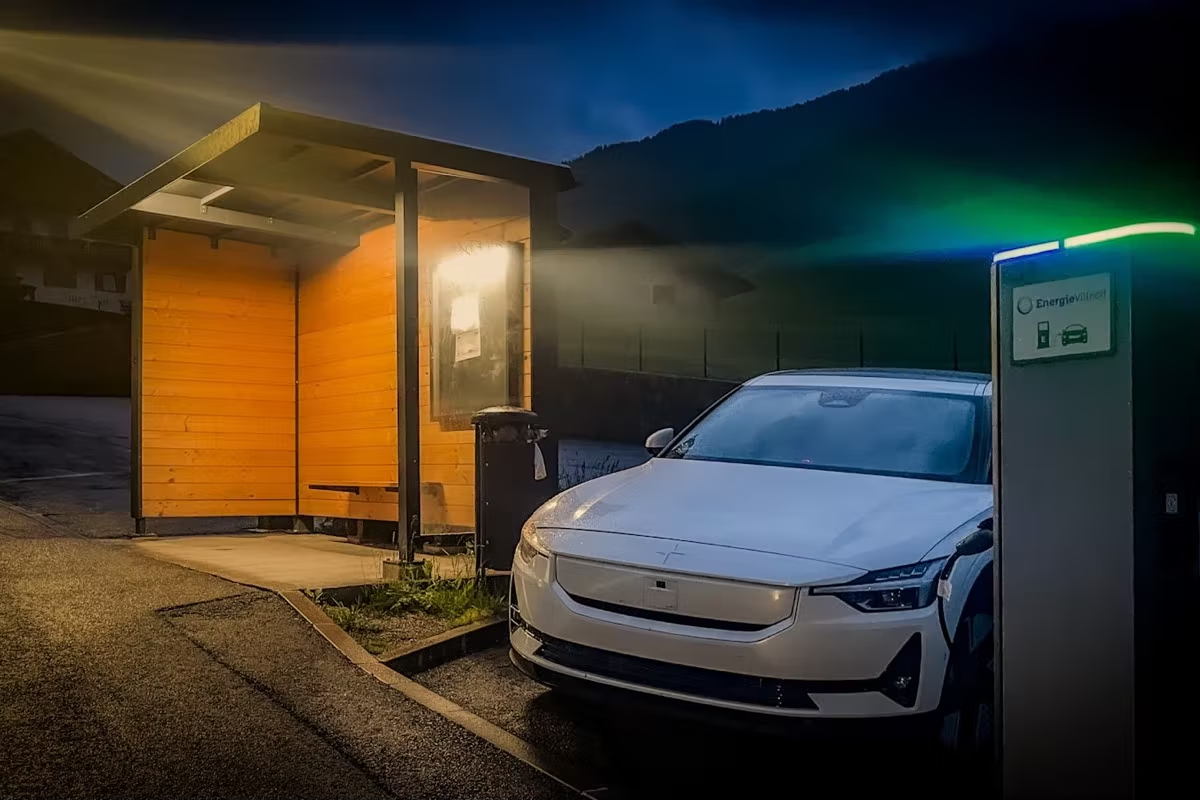
Photo: Bernd Dittrich / Unsplash. Resized and converted to AVIF.