The $7,500 EV Tax Credit Is Gone. Here Is What Is Left in 2026
Is there still a federal EV tax credit in 2026? Not for buying a car. The $7,500 new-EV credit and the $4,000 used-EV credit both ended for vehicles delivered after September 30, 2025. What survived into 2026 was a 30% home-charger credit, and that one expired on June 30, 2026. What is left is a new deduction on car-loan interest and a state-by-state patchwork of rebates. The purchase incentive that shaped the last decade of EV buying is simply no longer there.
For ten years, the math on a new EV started with a number in your favor: $7,500 off, courtesy of the federal government. That number is now zero. The One Big Beautiful Bill Act, signed on July 4, 2025, killed the clean-vehicle credits, and the door shut for good on September 30, 2025. If you are shopping in 2026 and still budgeting for that rebate, stop. Here is what actually changed, the one narrow exception, and the incentives that are still worth claiming.
What actually changed
Three federal credits died at once. The new-clean-vehicle credit (worth up to $7,500), the used-clean-vehicle credit (up to $4,000), and the commercial clean-vehicle credit (also up to $7,500) all terminated for vehicles acquired after September 30, 2025. That last one matters more than it sounds, because the commercial credit was the engine behind the "leasing loophole." Automakers had been passing that $7,500 into lease deals on cars that did not otherwise qualify, which is why leasing an EV often beat buying one. That loophole is closed too.
The reasoning was budget, not policy sentiment. The credits were expensive, and the bill that removed them was a broad tax-and-spending package, not an EV-specific move. For a buyer, the intent does not matter. The line item is gone.
The one exception worth knowing
There is a single carve-out. If you signed a binding written purchase contract and made a payment (even a nominal deposit) on or before September 30, 2025, you can still claim the credit when the car is finally placed in service, even if delivery slips into 2026. This was written for people who ordered a build-to-order EV months in advance. If that is not you, it does not apply, and no dealer paperwork dated October or later will change that.
What still exists at the federal level
The purchase credit is gone. One federal benefit is still live in 2026, and the other closed at mid-year.
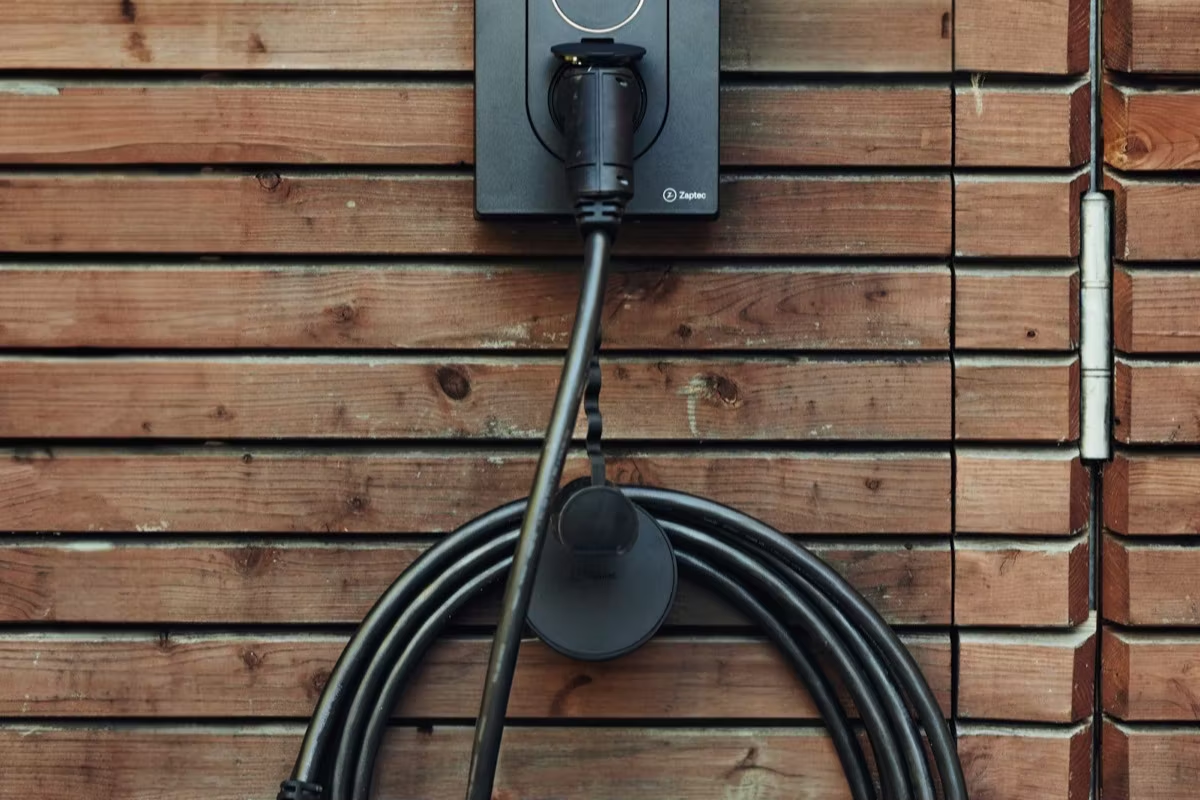
The home-charger credit (Section 30C). It covered 30% of the cost of a home EV charger and its installation, capped at $1,000, for homes in eligible census tracts (broadly, lower-income or non-urban areas), and it expired on June 30, 2026. If your charger was installed and placed in service by that date, you can still claim it on your 2026 return, so keep the invoice and the permit. A charger installed after that date gets no federal help, which makes your utility's rebate the one to chase. Our guide to what a home EV charger really costs to install walks through the numbers and how to document them.
The car-loan interest deduction. New for 2025 through 2028: you can deduct up to $10,000 per year of interest paid on a qualifying new-vehicle loan. The catch is that the car must have had its final assembly in the United States, and the deduction phases out at higher incomes. It is not EV-specific, so a US-built gas car qualifies too, but a US-assembled EV (a Tesla, a Rivian, a Lucid, a Chevy) fits neatly.
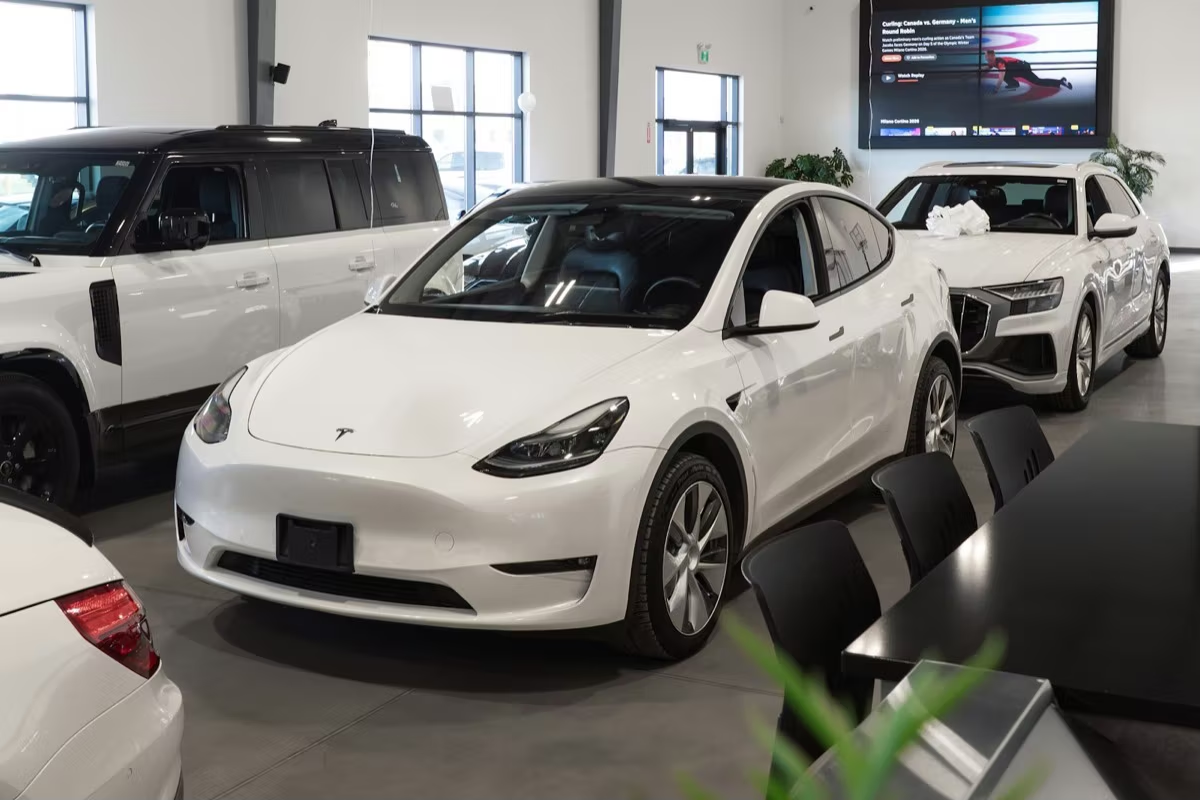
Without the $7,500 discount, a new EV now competes on sticker price alone. Photo: Vadym Kudriavtsev / Unsplash.
State and local incentives are still alive
Washington took its foot off the pedal. Several states did not. California, New York, Massachusetts, Colorado, Oregon, and Washington all still run their own EV rebates, tax credits, or sales-tax exemptions, some worth $1,000 to $7,500 depending on your income and the price of the car. Many utilities layer on their own rebates for a Level 2 charger or for signing up to charge overnight. These programs change constantly and often run out of money mid-year, so check your state energy office and your utility before you assume anything. This is also the one area where a lower-income buyer can still come out well ahead.
For our European readers, the picture is the opposite
While the US pulled its incentive, Europe is adding one. Germany launched a new purchase premium on January 1, 2026, a revived Umweltbonus aimed at low- and middle-income households, with applications open since May: a base of about 3,000 euros for battery-electric cars (1,500 for plug-in hybrids) at incomes up to 80,000 euros a year, rising to as much as 6,000 euros for families with children and lower income. On top of that, the THG-Quote still pays EV owners an annual bonus, and the two can be combined. A buyer in Germany in 2026 has more support than one in the US, not less. Our German-language guide to the E-Auto-Förderung 2026 covers the European programs in detail.
What this means for your next EV
The honest takeaway: a new EV in the US just got about $7,500 more expensive overnight, and the leasing shortcut that softened that is gone. That does not make an EV a bad buy, but it does change the calculation. The running-cost advantage is untouched, an EV is still far cheaper per mile than a gas car, and you can see exactly how much you would save with our EV savings calculator. If the sticker shock is real, this is also the moment hybrids look smart again, which we covered in why hybrids are surging. And if you were counting on the credit to make a used EV affordable, remember the $4,000 used credit is gone too, so shop on price and battery health instead. The old buy-versus-lease math has changed as well, which we walk through in buying vs leasing an EV.
None of this is tax advice for your specific situation. Incentives depend on your income, your state, and the exact car, so confirm the details with a tax professional before you file.
Recommended charging gear
Advertising / affiliate links: as an Amazon Associate, EV-Global earns from qualifying purchases. Prices and availability are set by Amazon; links open in a new tab.
The federal charger credit is gone since July 2026, so shop on price: a good Level 2 charger still pays for itself quickly against public fast-charging rates.
On AmazonHome Level 2 chargersCharge overnight at the cheap home rate. Browse current top-rated wallboxes.EV tax credit 2026: frequently asked questions
Can I still get the $7,500 EV tax credit in 2026?
No. It ended for vehicles delivered after September 30, 2025. The only exception is a binding written contract with a payment made on or before that date.
Is there a used EV tax credit in 2026?
No. The $4,000 used clean vehicle credit ended on the same date as the new-car credit, September 30, 2025.
Did leasing an EV still get the credit?
No. The commercial credit that funded the leasing loophole was terminated too, so lease deals no longer carry that $7,500 discount.
What EV incentive is still worth claiming in 2026?
The car-loan interest deduction, if your EV was assembled in the US, plus state and utility rebates. The 30% home-charger credit expired on June 30, 2026; a charger placed in service before that date can still be claimed on your 2026 return.
Are there still state EV incentives?
Yes. California, New York, Colorado, Massachusetts, Oregon, Washington and others run their own programs, often with income and price caps. They change often and can run out of funding, so check before you buy.
Does the car-loan interest deduction help EV buyers?
It can. From 2025 to 2028 you can deduct up to $10,000 a year of interest on a loan for a new, US-assembled vehicle, subject to income limits. Many EVs qualify because they are built in the US.
Photo: Wesley Shen / Unsplash. Resized and converted to AVIF. This article is general information, not tax advice.