
APQP and PPAP in Automotive: Process, Documents, SOP
What are APQP and PPAP in automotive? APQP, Advanced Product Quality Planning, is the structured process used to turn customer requirements into a controlled product and manufacturing launch. PPAP, Production Part Approval Process, is the evidence submitted to show that the production-intent process can repeatedly build conforming parts. PPAP is one output within APQP, normally required before regular customer shipments around SOP.
A car programme can pass its design reviews and still fail in the plant. APQP connects the drawing, risks, tooling, measurements and production controls before volume exposes the gaps. PPAP is the customer's formal checkpoint that the evidence agrees.
What is APQP in automotive?
Advanced Product Quality Planning is the cross-functional system used to plan quality into a new or changed product and its manufacturing process. The current AIAG third edition strengthens gated programme management, sourcing, change control, metrics, risk mitigation and traceability. APQP is not one document and it does not belong only to the quality department. Engineering, manufacturing, purchasing, suppliers and programme management all create evidence.
The five APQP phases
| Phase | Main question | Typical evidence |
|---|---|---|
| 1. Plan and define | What must the product achieve? | Customer inputs, targets, timing and initial risks |
| 2. Product design | Can the design meet those requirements? | Design reviews, DFMEA, verification and special characteristics |
| 3. Process design | Can the plant build it repeatedly? | Flow, PFMEA, control plan, tooling and work instructions |
| 4. Product and process validation | Do production-intent parts and processes work? | Trials, capability, measurement studies, testing and PPAP |
| 5. Feedback and improvement | Is the launch stable in series production? | Launch data, corrective action, lessons and control-plan updates |
The phases overlap. A late design change can reopen process risk, measurement planning and validation. Treating APQP as a one-way checklist hides exactly the feedback loops that prevent launch failures.
What is PPAP?
Production Part Approval Process is the evidence package and customer decision used to show that the supplier understands the design record and that its production process can repeatedly make conforming parts at the quoted rate. PPAP is normally produced during APQP validation. It is not the same as APQP, and approval does not remove the obligation to control later changes.
APQP vs PPAP vs SOP
| Term | What it is | Decision it supports |
|---|---|---|
| APQP | The planning and evidence-building process | Whether product and process risks are controlled |
| PPAP | A defined submission from production-intent conditions | Whether the customer approves the production part and process |
| SOP | Start of Production, a programme milestone | Whether regular series production begins |
PPAP should be approved before normal customer shipments, but timing and interim approvals depend on the customer-specific requirements. SOP is not a universal guarantee that every open issue vanished. A disciplined launch has documented containment, owners and exit criteria for anything still open.
Which PPAP documents matter most?
The exact submission level and customer requirements govern what is sent. Common evidence includes the design record and authorised changes, design and process FMEAs where applicable, the process flow, control plan, measurement-system studies, dimensional and material or performance results, initial process studies, qualified-laboratory evidence, sample parts and the Part Submission Warrant. The point is consistency: risks in the FMEA must drive controls, controls must appear in the process and results must demonstrate that the process works.
A worked APQP example: the battery cooling plate
Suppose a battery cooling plate has a critical leak-rate requirement. The drawing defines the requirement, but APQP turns it into a chain of evidence. The DFMEA asks how coolant loss could affect insulation, cell temperature and vehicle availability. The process flow identifies forming, cleaning, joining and leak-test stations. The PFMEA asks how contamination, tool wear or a poor joint could create the leak. The control plan then states what is measured, how often, with which gauge, and what happens when a result fails.
The measurement-system study must show that the leak tester can separate good parts from bad ones. Capability data must come from production-intent equipment, operators, material and cycle time. The sample result, FMEA, process flow, control plan and Part Submission Warrant should all describe the same product and process revision. That connected chain is the value of APQP. A folder containing every named document can still be weak if the documents tell five different stories.
Why APQP and PPAP fail in practice
- Documents disagree. A special characteristic appears in the drawing but not the PFMEA or control plan.
- Evidence comes from a friendly process. Samples are hand-built instead of made with production tooling, operators, cycle time and material.
- Changes arrive without propagation. A late design update does not reopen affected risks and tests.
- Capability is mistaken for control. A good short run says little if the measurement system or long-term process drifts.
- PPAP becomes the finish line. Teams stop watching the first weeks of series data.
Where APQP sits in vehicle development
Start with the complete automotive product development process from concept to SOP. Then connect the evidence to the systems that make a car work, the E/E architecture and the software-defined vehicle, where hardware and software changes must be controlled together.
That control chain also reaches an 800-volt EV architecture, the battery supplier landscape and the safety evidence behind SAE driving automation. The automotive engineering hub links those product and process views.
Primary sources, checked July 24, 2026: AIAG's APQP third edition, its APQP and Control Plan FAQ, and its overview of how the Quality Core Tools work together. This guide explains the system but does not reproduce the copyrighted manuals or replace customer-specific requirements.
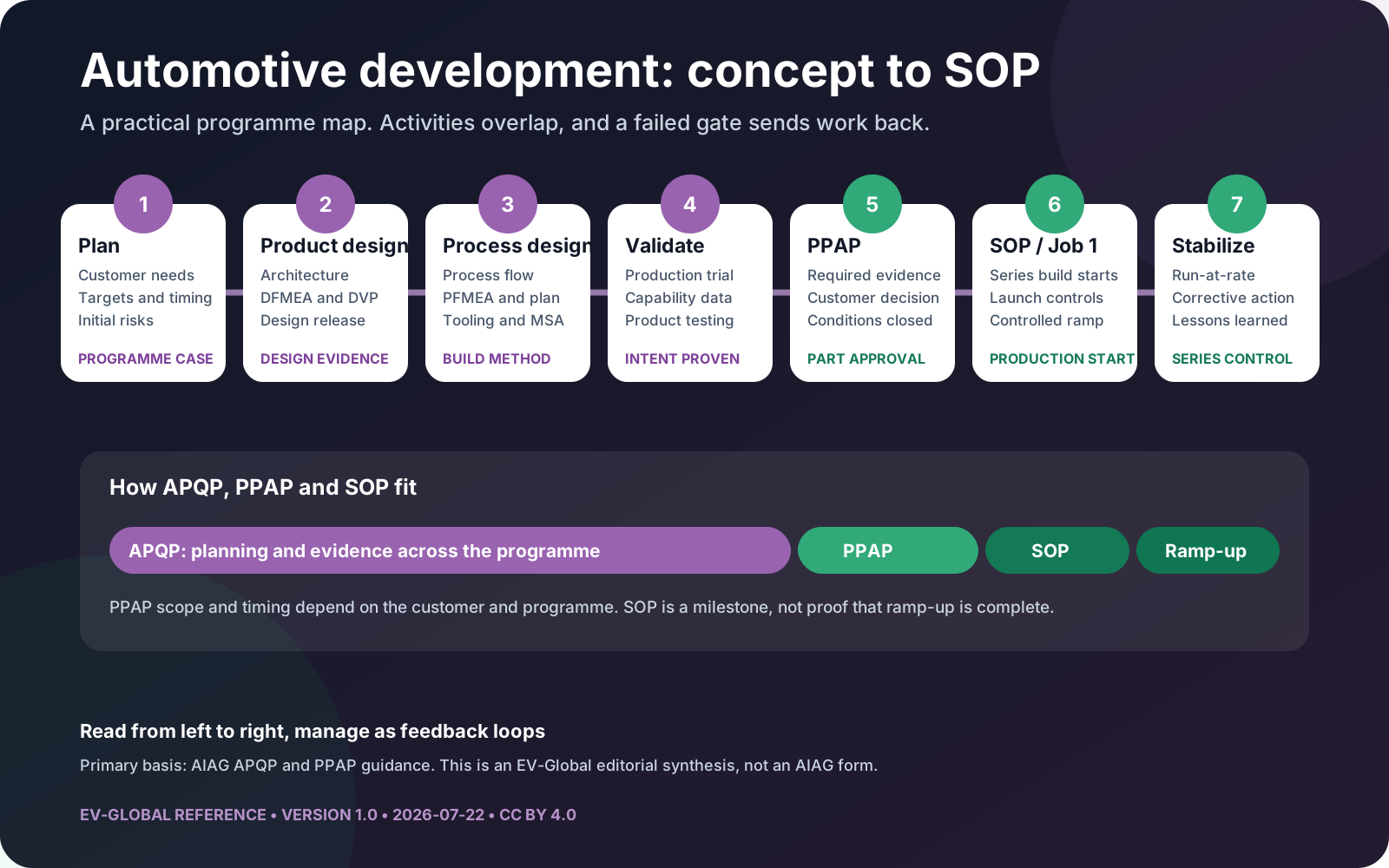
The downloadable concept-to-SOP process map and CSV place APQP, PPAP and launch evidence in one programme view, with customer-specific timing called out explicitly.
APQP and PPAP: frequently asked questions
What is APQP in automotive?
Advanced Product Quality Planning is the cross-functional process used to plan, develop, validate and improve a product and its manufacturing process before and after launch.
What is PPAP?
Production Part Approval Process is the evidence and customer approval showing that the supplier understands the design and can repeatedly make conforming parts under production-intent conditions.
Is PPAP part of APQP?
Yes. APQP builds the product and process evidence. PPAP packages defined evidence for a customer approval, usually during product and process validation.
What is the difference between PPAP and SOP?
PPAP is a product and process approval. SOP is the programme milestone when regular series production starts. A customer normally expects approval before regular shipments, subject to its specific requirements.
What documents are in a PPAP?
Common elements include design records, authorised changes, FMEAs where applicable, process flow, control plan, measurement studies, test and dimensional results, capability studies, samples and the Part Submission Warrant.
Who owns APQP?
No single department owns all of it. Programme management, engineering, manufacturing, quality, purchasing and suppliers each own evidence and decisions within one controlled plan.
Original EV-Global illustration, created for this APQP and PPAP guide.