Is Tesla a Software-Defined Vehicle?
Is Tesla a software-defined vehicle? Yes, by the practical industry definition rather than a formal certification. Tesla develops core vehicle and interface software, runs functions on shared onboard computers and uses over-the-air updates to change supported capabilities after delivery. Physical sensors, actuators and computer generations still set hard limits.
A connected car can stream music and send its location without being software-defined. Tesla crosses the more meaningful line: software is part of the vehicle lifecycle, not a frozen accessory installed at the factory.
Is Tesla a software-defined vehicle?
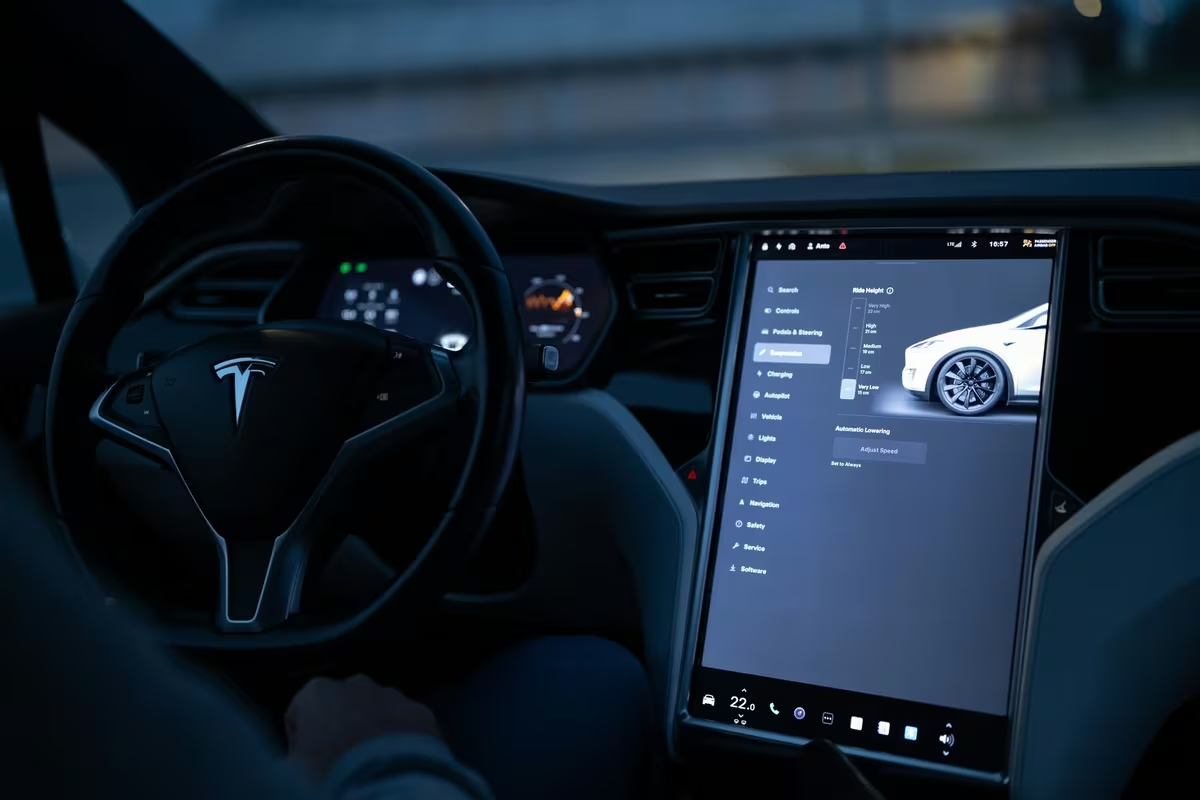
The term has no government certification test. COVESA describes the software-defined vehicle as a vehicle whose features and functions are primarily enabled through software. Tesla fits that operating model because it maintains vehicle software after sale, controls major user interfaces and distributes new functions and improvements over the air.
That does not mean every Tesla function lives in one computer or every vehicle gets every feature. A useful SDV definition describes the product lifecycle and architecture. It is not a claim that hardware has become irrelevant.
What makes a Tesla software-defined?
- Software continues after delivery. The vehicle receives functional releases, not only map or media updates.
- Functions share computing platforms. Infotainment, vehicle control and driver assistance rely on powerful computers plus local controllers.
- Tesla owns important software layers. Its annual report says the company develops most user interfaces used in its vehicles.
- Connectivity closes the loop. Release distribution, diagnostics and service can use the vehicle-cloud connection.
The broader software-defined vehicle architecture explains platform layers, interfaces and lifecycle in vendor-neutral terms.
Tesla software architecture: what is public and what is not
| Layer | What public evidence supports | What remains model-specific |
|---|---|---|
| Interface and infotainment | Tesla develops most user interfaces and updates them | Processor, memory and feature support by generation |
| Vehicle control | Software coordinates many body, energy and thermal functions | Exact controller allocation and network topology |
| ADAS and AI | Tesla designs its AI computer and updates supported capability | Sensor suite, computer version and regulatory availability |
| Connectivity and cloud | Updates and connected services use remote infrastructure | Backend implementation and internal interfaces |
Architecture diagrams circulating online often combine several model years. Treating one diagram as the permanent "Tesla architecture" turns a moving platform into false precision.
How do Tesla software updates work?
Tesla says updates roll out on a rolling basis according to model, configuration and region. The car notifies the driver when a package is available. Download normally uses Wi-Fi. Installation happens while parked, and the vehicle cannot be driven during the process. Tesla also states that a vehicle cannot revert to a previous software version after an update.
This is a controlled release pipeline, not a phone app updating in isolation. A vehicle package must match hardware, configuration, safety dependencies and market approval. Staged rollout limits exposure if a configuration-specific fault appears.
Why one Tesla release is really a configuration matrix
"The fleet" is not one computer. A model can exist with different infotainment processors, driver-assistance computers, battery packs, charging hardware, markets and option codes. A release that behaves correctly on one combination may expose a timing, memory or calibration problem on another. The eligibility rules behind an update are therefore part of the product, not an administrative detail.
A disciplined rollout starts with limited populations, watches diagnostic and behavioural signals, then expands only when the evidence is clean. It also separates absence from failure. A car that has not downloaded a package, a car that rejected it as incompatible and a car that failed during installation require different responses. Tesla does not publish its complete internal release logic, so specific claims about canary groups or rollback mechanisms would be speculation. The observable rolling deployment by configuration and region is consistent with this risk-control problem.
What can and cannot change through software?
| Software can change | Software cannot create |
|---|---|
| User-interface behaviour and supported apps | A missing camera, radar, motor or actuator |
| Energy, charging and thermal-control logic within validated limits | Higher physical cooling or electrical capacity |
| Driver-assistance behaviour supported by installed hardware | A new sensor field of view or mechanical redundancy |
| Diagnostics, calibration and fault handling | Regulatory permission in a market where a feature is not approved |
An 800-volt architecture or a new steering actuator cannot be downloaded. The best SDV engineering treats software and hardware as a planned system, not opposing camps.
Tesla SDV vs connected car
A connected car exchanges data with external services. An SDV uses software as a primary mechanism for defining, maintaining and evolving vehicle functions. Connectivity helps deliver that lifecycle, but connectivity alone is not enough. The distinction is why the automotive E/E architecture matters: software needs computing, networks, power and local input/output that can support the intended change.
Is Tesla's architecture centralized or zonal?
Tesla has pushed shared computing and reduced controller sprawl, but "centralized" and "zonal" are not clean badges. A central computer can coexist with local controllers, power-distribution modules and multiple networks. Public Tesla support material does not disclose enough current topology to label every model and year identically. Compare that engineering problem with Nvidia's automotive computing platform, which supplies a configurable stack to many carmakers rather than one vertically integrated vehicle.
Why software-defined does not mean autonomous
SDV describes how functions are built and updated. Automation level describes who performs the driving task and fallback. Tesla's FSD (Supervised) requires active driver supervision, so it remains Level 2. The boundary is clear in our Level 2 vs Level 3 comparison and the complete SAE Levels 0 to 5 guide.
The benefits and engineering risks
Tesla can correct defects, improve usability and add supported functions without a workshop visit. The same reach raises the standard for configuration management, cybersecurity, release validation and recovery planning. Millions of vehicles are not one test configuration. Processor, sensor, battery, market and option differences create a matrix that must be validated before rollout.
Vertical integration helps when the same organisation controls the interface, vehicle software, telemetry and release decision. It does not abolish systems engineering. Brakes, airbags, battery cells, networks and local controllers still have independent constraints and supplier boundaries. The advantage appears only when ownership shortens diagnosis and change without weakening evidence. Fast software with unclear hardware responsibility is not an SDV strength.
For context, compare the software layer with the mechanical and electrical systems that make a car work, Tesla's current packaging in the Tesla Model 3 engineering guide and the role of AI inside modern cars. The automotive engineering hub connects all four views.
Primary sources, checked July 24, 2026: Tesla's software-update instructions, its AI computer and supervision explanation, the company's 2025 Form 10-K and COVESA's SDV definition.
Tesla software-defined vehicle: frequently asked questions
Is Tesla a software-defined vehicle?
Yes, by the practical industry definition. Tesla uses software, shared onboard computing, connectivity and over-the-air updates to maintain and change vehicle functions after delivery. It is not a formal certification.
What makes a Tesla software-defined?
The vehicle is designed around an updateable software platform rather than treating software as fixed code inside isolated controllers. Tesla develops core interfaces and vehicle software and can improve supported functions over the air.
How do Tesla software updates work?
The vehicle downloads an available package, usually over Wi-Fi, and installs it while parked. Releases roll out by model, configuration and region, so not every car receives the same package at the same time.
Can Tesla update every vehicle function over the air?
No. Software can change only functions supported by the installed sensors, computers, actuators, wiring and regulatory approvals. An update cannot create hardware the vehicle does not have.
Is Tesla's architecture centralized or zonal?
Tesla uses shared computers and numerous local controllers, but public documents do not justify reducing every Tesla generation to one fixed label. The topology changes by platform and model year.
Does a software-defined Tesla drive itself?
No. Software-defined describes how functions are developed and updated. Tesla's FSD (Supervised) remains a driver-assistance system that requires an attentive driver.
Original EV-Global illustration, created for this Tesla software-defined vehicle guide.