The New Tesla Roadster: The Thrusters Got the Headlines, the Engineering Deserves Them
What is the new Tesla Roadster? A two-seat, rear-wheel-drive electric sports car that Tesla revealed on October 15, 2026 at SpaceX's rocket test site in McGregor, Texas. The quick versions pair an 800-volt battery of bespoke 4680 cells with a two-motor rear drive unit rated above one megawatt, pull up to 2 g of downforce with four suction fans, and can add SpaceX cold-gas thrusters that pushed an unoccupied demo car to 60 mph in 0.81 seconds and briefly off the ground. Production is slated for 2028 at Giga Texas, prices are not set, and deposits run from $50,000 to $250,000.
Twenty years after the first Roadster put 6,831 laptop cells under a Lotus chassis, Tesla showed the second one by driving it up a loop, holding it upside down and letting it fall back onto four wheels. The internet saw a flying car. We saw a 200-litre pressure vessel doing a five-second job. The thrusters are real, the physics is honest and the regulatory position is a shrug, but the parts of this car that will matter in 2028 are the ones nobody filmed: a nickel battery built to be emptied at a megawatt, a drive unit that packs a third more power than a Model S Plaid's three motors into half the mass, and a body that is wider than a Model S yet shorter in wheelbase than a Model 3. This is what Tesla's engineers actually said about those parts, where the numbers come from, and which of them are still targets.
What Tesla actually showed in McGregor
The event ran at SpaceX's rocket test site near Waco on the evening of October 15, two weeks late because of high winds. Elon Musk, vehicle engineering chief Lars Moravy and design chief Franz von Holzhausen presented three cars and a plan. The demo car climbed a curved ramp, held itself inverted at the top on fan suction alone, then on a second run left the ramp upside down, fired its thrusters, rolled upright, hovered for a moment and landed. It jumped a line-up of Model 3, Model Y, Cybertruck, Cybercab and Semi, which Moravy christened the kickflip ("Tony Hawk would be proud"). A 0-60 mph run showed 0.81 seconds on the big screen, after a timing glitch and a pre-recorded 1.0-second attempt. Telemetry overlays claimed 4,700 kg of downforce, 170 degrees of pitch some 21 metres up the ramp and a 3.3 g landing.
Three caveats before the engineering. Nobody was in the cars: Musk said the demo was "technically autonomous... to make sure we don't kill anyone", and the figure in the seat was an Optimus robot, so this was also a quiet showcase for the driverless stack. The timing method and rollout behind the 0.81 seconds were not published; Moravy later told Hagerty the best run was 0.55 seconds with rollout. And the "flight" lasted seconds. Von Holzhausen's line, "the first world's best flying car and the last best driver's car", is a tagline, not a spec sheet. The spec sheet is more interesting.
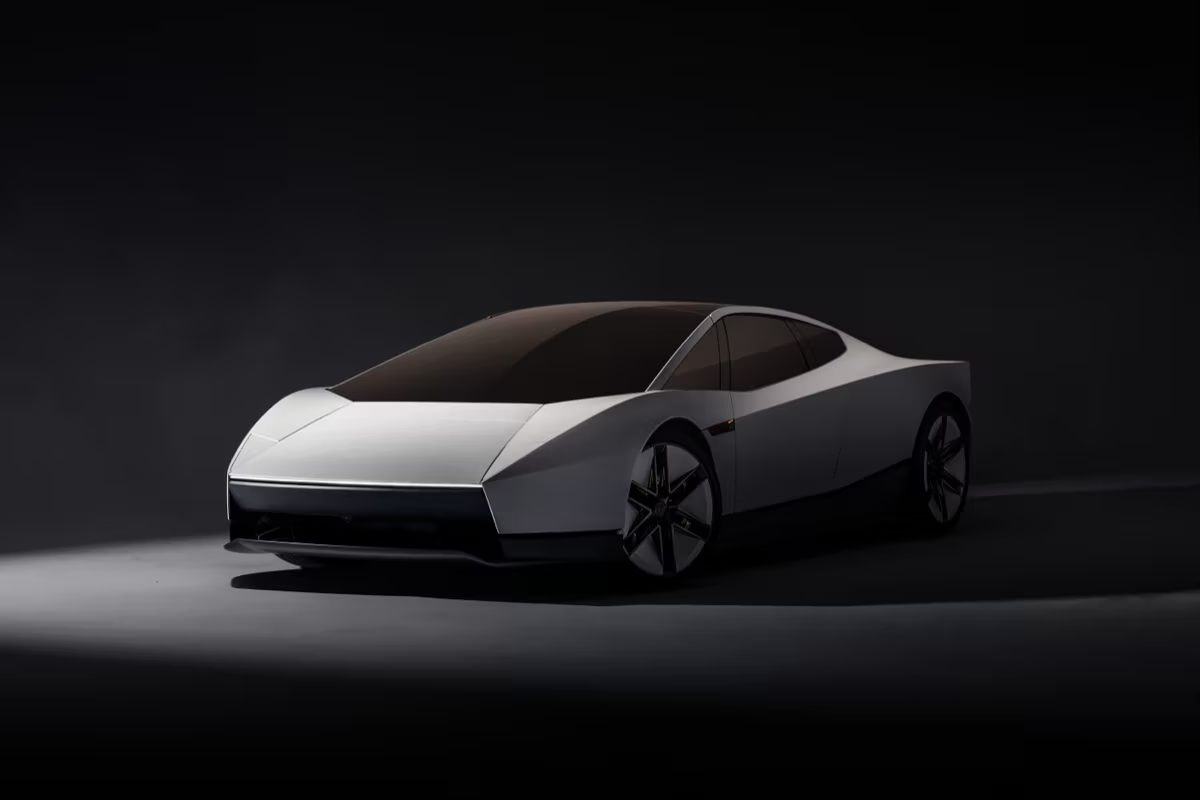
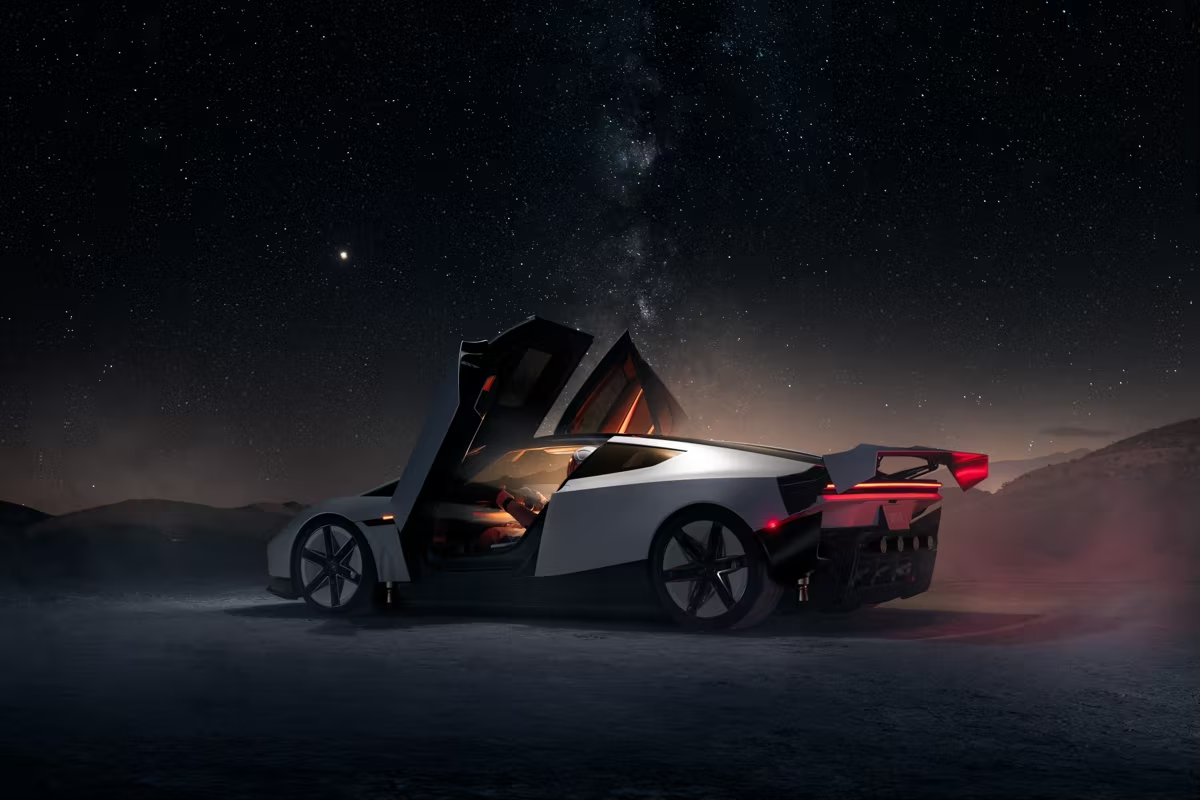
The production car in Tesla's studio: the 2017 prototype's proportions with two seats instead of four, pop-down headlights and a steer-by-wire yoke. Photo: Tesla.
Battery and range: a pack built to be emptied at a megawatt
Start with the number Tesla did not give: the pack's capacity. The 2017 prototype promised 200 kWh and 620 miles; the 2026 car promises "over 300 miles", and Moravy told Top Gear that 310 to 320 miles is what normal driving should see. He also said the big pack was dropped on purpose, because "this car needs to be lightweight". That trade is the whole philosophy of the car: half the energy of the 2017 promise, roughly the range of a Model Y, and a pack designed around power rather than range.
What the engineers did describe is a high-power pack. The cells are a bespoke version of Tesla's 4680 cylindrical format with a nickel-based "high-power" chemistry, packaged in aluminium cans instead of steel so each cell sheds heat faster, and cooled on both faces rather than along the side like the Plaid's 18650 pack. The pack runs in the 800-volt class (Moravy said "800 to 1,000 volts"), with a single-pass coolant path, a tailor-welded titanium upper plate and an aluminium lower plate. It is rated to discharge at one megawatt, to accept 500 kW from a V4 Supercharger and, in Tesla's words, to go from 15 to 85% in about ten minutes; Top Gear's write-up says 15 to 80% in under 15 minutes, so treat ten as the target.
Do the arithmetic on a pack nobody has sized. If it holds 90 to 100 kWh, which is what 300-plus miles in a sub-1,700 kg car implies, then one megawatt is a 10C discharge and 500 kW is a 5C charge. A Model S Plaid draws about 7.6C from its 100 kWh pack at full power and charges at 2.5C. Those C-rates are why the cells need aluminium cans, two cooled faces and a chemistry tuned for power rather than the last watt-hour, and why Moravy talks about 25 to 30 minutes of unlimited track driving per charge rather than lap after lap. Our LFP vs NMC guide explains why nickel chemistry is the only route to these numbers, and our 800-volt explainer shows why doubling the voltage halves the current the cables, connectors and inverters have to carry. The charging time calculator lets you see what a 500 kW peak would do for your own car's pack.
The drive unit: two motors, no differential, one megawatt
The 2017 car had three motors and all-wheel drive. The 2026 car is rear-wheel drive with two motors, and that is a more radical choice than it sounds. Each rear wheel gets its own motor, its own inverter and its own 8.4:1 planetary reduction; there is no differential at all, because torque vectoring is done by telling the two motors different things. The placard at the event called it Tesla's "most powerful and compact rear-wheel drive unit yet" and claimed a third more power than the Model S Plaid's three motors at half the mass. Moravy put the output at more than one megawatt, about 1,341 hp, and more than 1,400 Nm of torque for the Performance, Thrust and Rocket versions; a base car with about 800 kW and 1,200 Nm is still in development.
How do two motors beat three at half the mass? Voltage is half the answer: at 800 volts the inverters and motors move the same power with half the current, so the copper, the busbars and the switching silicon shrink. The rest is motor design. Tesla has not named the topology, but the cobalt-steel laminations fitted from the Performance trim upward are what you specify when you want to push a permanent-magnet rotor to higher flux density and speed without saturating the core, and mounting both units inboard lets each one be short and compact rather than squeezed beside a wheel. Each motor is physically smaller than one Plaid motor. For how a traction motor turns current into torque, and why rotor speed is the lever everyone pulls now, read how an electric car motor works.
Top speed is where the claims fan out. The Performance car is quoted at 210 mph and the megawatt cars at 230 mph in low-drag mode, today's prototypes run 214 mph, and Moravy says a 330 mph version is being engineered ("this one, we're going to build"). Musk wants Mach 0.5. Only the first two numbers are within sight of the hardware described.
Smaller than a Model S, lighter than a Model 3: the packaging
The second Roadster is a small car with a big footprint. Its wheelbase is reported at 2,825 mm, shorter than a Model 3's 2,875 mm, while its width of about 2.0 metres is a touch more than a Model S. The lightest version is to weigh "just under 1,700 kg", not final, against 2,162 kg for a Model S Plaid and about 1,994 kg for a Model Y Long Range. That is where the battery decision and the two-motor layout pay off: less energy, fewer motors, less mass to carry around a lap, and a chassis of aluminium and carbon fibre with magnesium and titanium where they earn their cost.
| Spec | Roadster (2026 reveal) | Model S Plaid | Model Y Long Range AWD |
|---|---|---|---|
| Wheelbase | 2,825 mm (reported) | 2,960 mm | 2,890 mm |
| Width | about 2,000 mm | 1,987 mm | 1,920 mm |
| Kerb weight | under 1,700 kg (target) | 2,162 kg | about 1,994 kg |
| Motors | 2, rear, no differential | 3, all-wheel drive | 2, all-wheel drive |
| Peak power | over 1,000 kW | 760 kW | about 280 kW |
| Pack voltage | 800 V class | 400 V | 400 V |
| Battery | not disclosed, 4680 nickel cells | 100 kWh, 18650 | about 79 kWh, 2170 |
| Peak DC charging | 500 kW (claim) | 250 kW | 250 kW |
| Range | over 300 mi (claim, no cycle) | 348 mi EPA | 327 mi EPA |
| Seats | 2 (Rocket: 1) | 5 | 5 |
The packaging inside is just as uncompromising. Two seats, with the seat shells moulded into the chassis; the pedal box and steering column move instead, as in a racing car, and the backrests recline. The butterfly doors have removable upper glass panels that stow in the boot, where the Thrust trim's 200-litre pressure vessel otherwise lives. The headlights pop down out of the nose because the modules are only about 15 mm tall. The yoke steers by wire with 170 degrees of lock each way and a variable ratio, as the Cybertruck taught Tesla to do; braking is by wire onto carbon-ceramic discs; the tyres are Pirelli P Zero Trofeo RS Elect, 295/30 R20 at the front and 335/30 R21 at the rear.
Then there is the air. Four rear-mounted fans of about 20 kW each, adapted from a heat-pump compressor motor, pull the car onto the road through four independently dropping skirts with wear strips, worth up to 2 g of downforce from a standstill to 50 mph, which is why the car can sit upside down on the ramp. Moravy's number for the tyres alone is 1.26 g. Above that the active aero takes over: a five-element front wing whose leading edges tilt to 80 degrees, pop-out barge boards, an active bonnet vent and a rear wing with road, high-downforce and low-drag positions plus an airbrake, all moved by actuators borrowed from Optimus's legs and held by a brake rated for thousands of newtons. Track Mode drops the car 40 mm and triples the damper stiffness; the suspension is double wishbones with rocker arms up front and a multi-link rear, with active ride height.
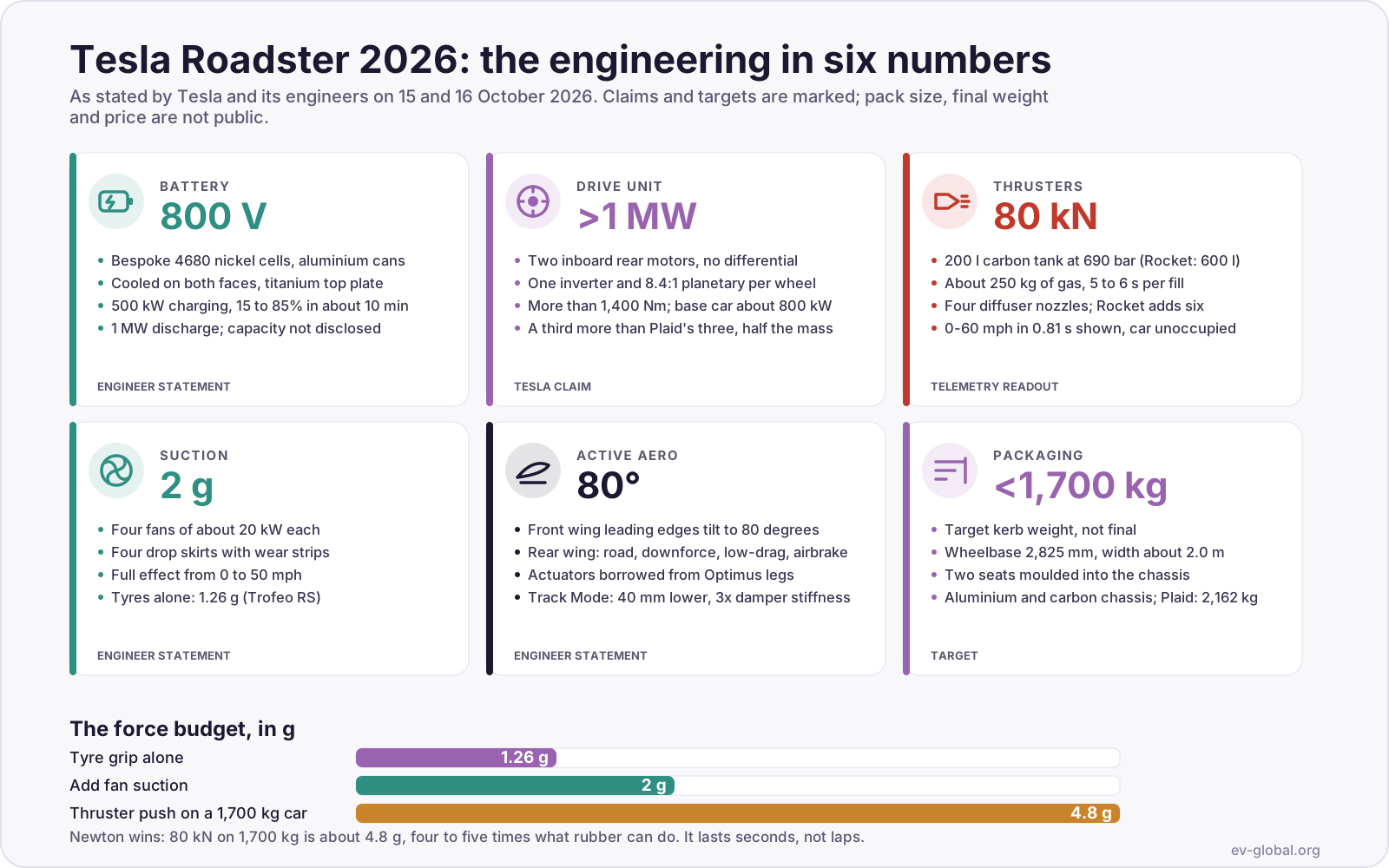
Original EV-Global infographic: the Roadster's engineering in six numbers, from the engineers' descriptions of October 15-16, 2026. Vector version and the comparison dataset in the reference library.
Can the Roadster fly? The thrusters, explained without the hype
The SpaceX package is compressed gas, not rocket fuel. The Thrust trim carries a 200-litre carbon-fibre-overwrapped pressure vessel behind the seats, rated to 690 bar, feeding four nozzles in the rear diffuser. Rocket adds a 400-litre vessel in place of the passenger seat and six more nozzles, one at each corner for lift and attitude and two on the flanks for yaw, ten in all. Moravy's figures: about 250 kg of gas, more than 80 kN of thrust, five to six seconds per fill, released by a single valve driven by an Optimus actuator. Tesla's own post put it at "four to five times the force the tyres can" generate.
Newton does the rest. Eighty kilonewtons on a 1,700 kg car is about 4.8 g, so the thrusters can launch the car far harder than any tyre, which is exactly what the 0.81-second run shows; they also help on corner exit, when the rear tyres are the limit, and barely matter at top speed, where drag rules. Flight is a hop: cold gas leaves a nozzle at roughly 530 to 690 m/s, so 80 kN empties the whole tank in about two seconds at full thrust, and hovering a car of this mass needs a fifth to a third of that. Expect seconds airborne, not minutes, and expect a plume that will move gravel. The open questions are the ones engineers ask: how a 690-bar vessel behaves in a crash, what an occupant feels at 5 g, and how a 400-litre tank gets refilled. On that last point the company disagrees with itself: Musk said on stage that "the car can recharge its air tank", while Moravy told Top Gear the prototypes take external high-pressure nitrogen and two to six hours, with 30 minutes as the target.
Regulation is the other shrug. The Rocket is sold as "not approved for public road use" and by invitation only; the Thrust trim carries no such line and no legal analysis yet; Musk allowed that it is "not necessarily legal in all jurisdictions". The demonstration itself ran under closed airspace. None of this is a reason to dismiss the hardware, but it is a reason to read "flying car" as marketing until a certified one reaches a customer.
Price, trims and release date: the 2028 question
Four cars are on the table. Performance: road-ready, two seats, active aero and suction fans, 0-60 in under 1.6 seconds, $5,000 now plus $45,000 within ten days to reserve (50,000 euros in Germany). Thrust: race-ready, the four rear thrusters, under 0.9 seconds, a $250,000 deposit and a limited run. Rocket: one seat, ten thrusters, under 0.59 seconds, invitation only and not for the road. And a base car Top Gear was told about, around 800 kW, still being developed. No trim has a price; the reservation terms say the purchase price is not finalised, and the 2017 Founders Series, 1,000 cars at $250,000 paid in full, no longer exists as a product.
Timing is Tesla's weakest discipline, and the Roadster is the proof: unveiled in November 2017 for 2020 delivery, then slipped at least eight times through 2021, 2022, 2023, 2024, 2025 and three unveiling dates in 2026. Musk's answer this time was "2028, actually", built at Giga Texas; Moravy says four or five development prototypes exist and a larger build starts early next year. Sam Altman and MKBHD both cancelled their deposits before the reveal; whether the people who paid $250,000 in 2017 get something different for their patience was not addressed.
Tap between power, acceleration and weight. On power the Rimac still rules and the Roadster sits with the Xiaomi; on acceleration nothing without thrusters gets near 0.81 seconds; on weight the Roadster's sub-1,700 kg target would undercut every car here by 450 to 775 kg, which is the number that decides whether the rest is believable.
Context matters. A Xiaomi SU7 Ultra makes 1,138 kW for about $73,000 in China, a Lucid Air Sapphire 920 kW for $249,000, a Rimac Nevera R 1,550 kW for about $2.4 million. A sub-1,700 kg car with more than a megawatt would sit in a class of one, if it is built as described. The market shrugged: Tesla stock rose about 4% before the open on October 16 and gave it back by midday, and Gene Munster called the show "an engineering flex with no commercial value beyond embarrassing traditional car makers". Hagerty's Henry Catchpole, who had the engineers for an hour, landed closer to our view: "for now, it seems like an incredible engineering achievement."
What is demonstrated, what is claimed, what is a target
| Figure | Status | What to know |
|---|---|---|
| 0-60 mph in 0.81 s | Shown on screen | Unoccupied car, thrusters on, timing method and rollout not published; 1.0 s and 0.55 s also quoted |
| Over 80 kN of thrust | Telemetry readout | Roughly 4.8 g on a 1,700 kg car; five to six seconds per fill |
| 2 g of fan downforce | Engineer statement | The inverted-ramp hold supports it; the 4,700 kg overlay does not reconcile with a 1,700 kg car |
| Over 1 MW, 1,400 Nm | Engineer statement | Two inboard motors, no dyno sheet yet; base car about 800 kW still in development |
| 800 V, 500 kW, 15 to 85% in ten minutes | Claim | Pack size, mass and cell supplier not disclosed; Top Gear quotes 15 to 80% in under 15 minutes |
| Under 1,700 kg | Target | Lightest version, explicitly not final |
| Over 300 miles | Claim | No test cycle named; 310 to 320 miles "normal driving" per Top Gear |
| 230 mph, 330 mph, Mach 0.5 | Claim, target, ambition | Prototypes have run 214 mph |
| Production 2028, Giga Texas | Target | Eighth-plus date since 2017; four or five prototypes exist |
| Price | Not announced | Deposits $50,000 (Performance) and $250,000 (Thrust); Rocket by invitation |
The EV-Global verdict
Strip the thrusters off and the Roadster is still the most interesting Tesla since the Model 3: a deliberately small nickel pack built for 10C, a two-motor rear axle with no differential that embarrasses the Plaid's three-motor unit on power density, fan-generated downforce of a kind Formula 1 outlawed after the 1978 Brabham fan car, and a weight target that would undercut every other megawatt EV by half a tonne. Those are the claims to hold Tesla to in 2028, along with the software stack that will have to manage a megawatt through two tyres. The thrusters are the cleverest tyre-limit workaround we have seen, and also a five-second party trick with a 690-bar vessel behind your head and no rulebook. Buy the engineering story. Wait for the EPA label, a kerb weight on a scale and a price before you buy the car, and if you want a Tesla that exists, the Model 3 remains the better business case.
Tesla Roadster: frequently asked questions
Can the new Tesla Roadster really fly?
It can hop. The optional SpaceX package uses cold-gas thrusters fed from a 690-bar carbon-fibre tank: more than 80 kN of push for about five seconds per fill. At the reveal an unoccupied car rolled upright in mid-air and hovered for a moment. Sustained flight is not possible with that much gas, and the ten-thruster Rocket version is not approved for public roads.
How fast is the new Tesla Roadster from 0 to 60 mph?
Tesla showed 0.81 seconds on screen with thrusters, in an unoccupied car and without publishing the timing method; Lars Moravy quoted 0.55 seconds with rollout as the best run. The trims are rated under 1.6 seconds (Performance, no thrusters), under 0.9 seconds (Thrust) and under 0.59 seconds (Rocket).
How much does the Tesla Roadster cost?
No price has been announced for any version. Reserving a Performance takes $5,000 now and $45,000 within ten days; a Thrust takes $250,000; the Rocket is invitation only. The reservation terms state that the purchase price is not finalised. Expect well into six figures.
When will the Tesla Roadster be delivered?
Elon Musk said "2028, actually", built at Giga Texas. Four or five development prototypes exist and a larger build is planned for early 2027. The car was first unveiled in November 2017 for 2020 delivery and has slipped at least eight times since.
What battery does the Tesla Roadster use?
An 800-volt-class pack of bespoke 4680 cylindrical cells with a nickel-based high-power chemistry, aluminium cans and cooling on both faces, under a titanium top plate. Capacity has not been disclosed; Tesla claims over 300 miles of range, 500 kW charging and a one-megawatt discharge rating.
Is the Tesla Roadster rear-wheel drive?
Yes. The 2026 car drops the 2017 prototype's three-motor all-wheel drive for two inboard rear motors, one per wheel with its own inverter and 8.4:1 planetary gear and no differential. Tesla rates the unit above one megawatt and says it has a third more power than the Model S Plaid's three motors at half the mass.
Hero photo: Tesla. Engineering schematic: original EV-Global illustration. Figures as stated by Tesla and its engineers on October 15-16, 2026 (event livestream, Hagerty, Top Gear, InsideEVs, Electrek, TechCrunch); claims are labelled as such.