LFP vs NMC Batteries: Which EV Battery Should You Choose in 2026?
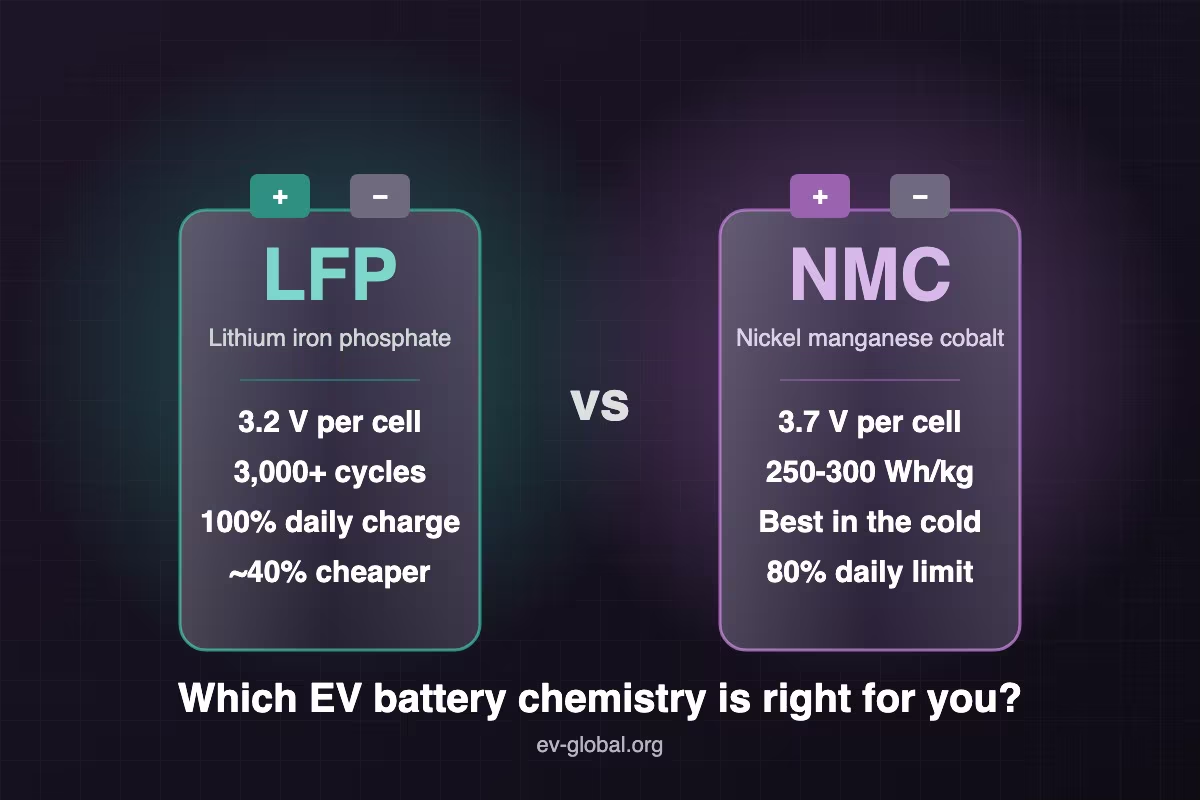
LFP or NMC: which EV battery is better? Neither, because they are tuned for different buyers. LFP (lithium iron phosphate) cells are cheaper, last longer and can be charged to 100% every day, but they store less energy per kilogram and give up more performance in the cold. NMC (nickel manganese cobalt) cells pack more range into the same space and charge well in winter, but they cost more and prefer a daily 80% limit. In 2025 more than half of all new EV batteries worldwide were LFP, mostly in entry and standard-range cars, while long-range and performance versions still run on nickel.
Open the configurator for a Tesla Model 3, a Ford Mustang Mach-E or an MG4 and you are choosing a battery chemistry without being told. The standard-range car gets lithium iron phosphate; the long-range car gets nickel. Each is the right answer for somebody, and the wrong answer costs you either range you will miss on every winter motorway run or money you did not need to spend. This guide explains what the acronyms actually describe, why the physics forces the trade-offs, which cars use which cells in 2026, and how to pick with your climate and commute rather than a spec sheet.
What the letters mean
Both are lithium-ion batteries. In both, lithium ions shuttle between a graphite anode and a metal-oxide cathode through a liquid electrolyte, and the names only describe the cathode. LFP uses lithium iron phosphate, LiFePO4, an olivine crystal in which the phosphorus-oxygen bonds are strong enough that the lattice barely moves when lithium leaves and returns. NMC uses a layered oxide of nickel, manganese and cobalt; the more nickel, the more lithium it can hold per gram and the more energy it stores, which is why premium cells have drifted from NMC 111 to NMC 811 and beyond. NCA, the nickel-cobalt-aluminium cousin that Tesla and Panasonic use, behaves like a high-nickel NMC for every purpose in this article.
That one difference in the cathode explains almost everything that follows. Iron phosphate is cheap, abundant and chemically stable but electrochemically modest. High-nickel oxide is energetic and dense but expensive, reactive and dependent on metals mined in difficult places.
The physics behind the trade-offs
An LFP cell sits at about 3.2 volts and an NMC cell at about 3.7, so even at the same amp-hours the nickel cell stores more watt-hours. Add a cathode that holds more lithium per gram and you get the headline gap: roughly 160 to 200 Wh/kg for production LFP cells against 250 to 300 Wh/kg for high-nickel NMC. Pack engineering narrows it. Because LFP is so stable, BYD's Blade and CATL's cell-to-pack designs can drop most of the module hardware and fire barriers that nickel packs need, so a modern LFP pack lands much closer to an NMC pack per litre than the cell numbers suggest.
Stability is also why LFP lasts. Nickel oxides breathe and crack a little on every cycle and run hotter under fast charging; the phosphate lattice does neither, which is why the iron cell tolerates 3,000 or more full cycles to 80% capacity where a nickel cell manages 1,000 to 2,000, and why LFP owners can sit at 100% without the calendar-ageing penalty that makes nickel owners stop at 80. The same stability makes it safer: LFP needs considerably more heat to tip into thermal runaway and releases far less oxygen when it does.
The bill comes in the cold. Lithium moves more slowly through iron phosphate at low temperatures, so an LFP pack accepts charge and delivers regenerative braking more reluctantly below freezing, and its usable range falls further than a nickel pack's in the same weather. It also has an almost flat voltage curve between 20 and 90% charge, which is elegant for the cells and awkward for the battery computer: the car cannot read your state of charge from voltage alone and drifts until it sees a full charge. That is the real reason Tesla tells LFP owners to charge to 100% at least once a week. It is a recalibration, not a treat.
| Property | LFP (lithium iron phosphate) | NMC / NCA (nickel-based) |
|---|---|---|
| Cell voltage | 3.2 V nominal | 3.6-3.7 V nominal |
| Cell energy density | 160-200 Wh/kg | 250-300 Wh/kg |
| Cycle life to 80% | 3,000 or more | 1,000-2,000 |
| Daily charge limit | 100% is fine, and needed weekly | 80% for daily use, 100% for trips |
| Cold-weather behaviour | Slower charging, weaker regen, larger range loss | Better, with preconditioning still essential |
| Thermal runaway onset | Roughly 270 °C, little oxygen released | Roughly 200-210 °C, more oxygen released |
| Critical materials | Iron, phosphate, lithium | Nickel, cobalt, manganese, lithium |
| Pack cost per kWh, 2025 | About 40% lower | The premium option |
| Typical use in 2026 | Standard-range and entry cars, most Chinese EVs | Long-range, performance and premium cars |
Range, charging and winter: what you feel on the road
On a mild day the difference is simply the number on the window sticker. A rear-drive Model 3 with its 60 kWh LFP pack is rated at 321 miles in the US; the nickel Long Range version with a bigger pack in the same body does 363. Charging curves differ in shape more than in peak: LFP packs often hold a flatter, lower plateau and then taper late, nickel packs spike higher and taper earlier, and both finish a 10 to 80% stop in roughly 25 to 35 minutes on a strong charger. The 800-volt architecture matters more for charging time than the chemistry does.
Winter is where the chemistries separate. Below freezing an LFP pack that has not been warmed may accept half its usual charging power, regenerative braking can be limited for the first miles, and range losses on the order of 25 to 35% are common where a nickel car in the same conditions loses 20 to 30. Preconditioning the battery before a fast charge, which most cars now do automatically when you navigate to a charger, erases most of the charging gap but not the range gap. If you live where winters are long, read our guide to why EVs lose range in the cold before you pick the cheaper battery, and if you want to see your own numbers, the EV range calculator applies the temperature penalty to any rated figure.
Lifespan and the 100% question
The lifespan argument is the strongest case for LFP. Fleet data already shows modern EV packs of both types losing about 1.8% of capacity a year on average, and the LFP cars sit at the durable end of that distribution: an LFP pack cycled daily to 100% typically retains 90% or more after eight years and 100,000 miles in a mild climate. For an owner who charges at home every night, the practical difference is that the iron pack asks nothing of you. Set the limit to 100%, forget it, and the battery will still outlast the car.
Nickel packs reward a little care. Daily charging to 80% and avoiding long stays at 100% can halve calendar ageing compared with keeping the pack full, which is why every nickel-pack EV ships with an 80% default. None of this is a reason to fear NMC: the warranty, 8 years or 100,000 miles at 70% capacity in the US and 8 years or 160,000 km in Europe, covers both chemistries equally, and our degradation calculator lets you project either pack against your own mileage.
Cost, and why LFP is winning the volume game
The economics are blunt. LFP cell prices in China fell to roughly $50 to $60 per kWh in 2025 while nickel cells stayed above $100, and at pack level the IEA puts LFP about 40% cheaper. Iron and phosphate are mined everywhere; nickel and cobalt are not. That gap is why LFP's share of EV batteries deployed worldwide passed 50% in 2024 and 55% in 2025, why more than four in five EVs sold in China carry an iron pack, and why CATL and BYD, the two LFP giants, now ship more battery capacity than every other maker combined.
Western carmakers followed the money. Tesla moved its standard-range cars to CATL iron cells from 2021, Ford did the same with the standard-range Mustang Mach-E in 2023, Volkswagen's unified cell arrives in LFP form with the ID.2 in 2026, and Mercedes pairs a nickel pack with an LFP entry version in the new CLA. In Europe the cheapest credible EVs, from the Citroën ë-C3 to the MG4 and every BYD, are LFP cars by default. The nickel cell has retreated to where its density is worth paying for: long-range crossovers, performance models and anything that has to tow.
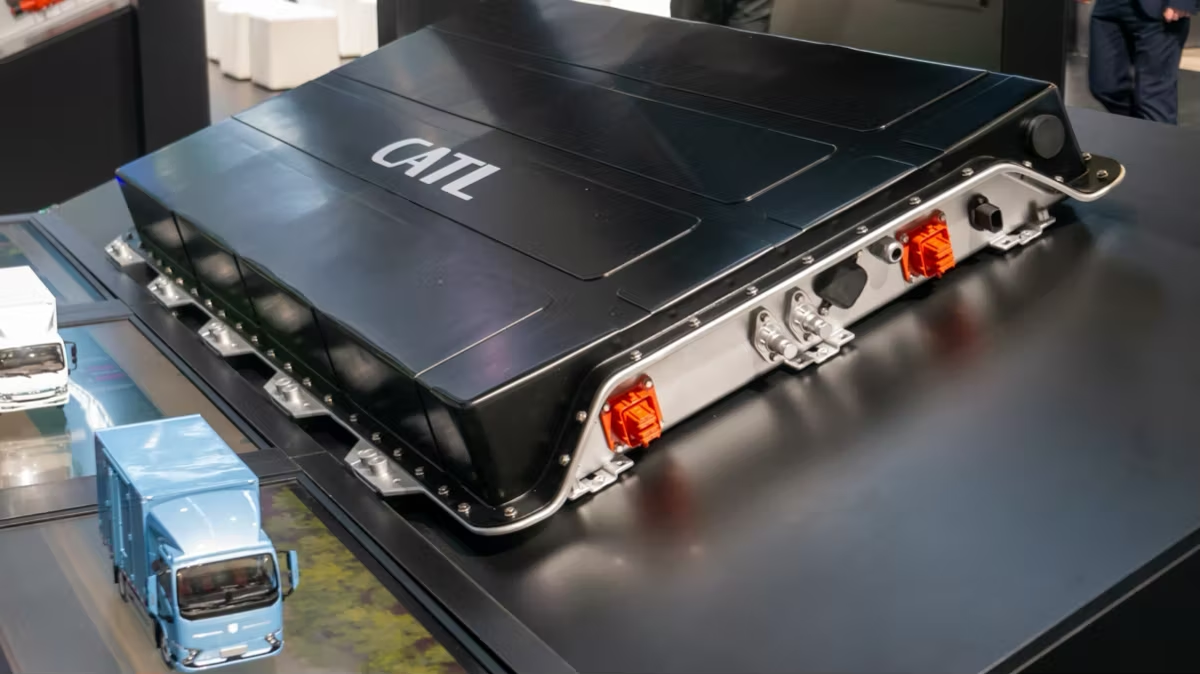
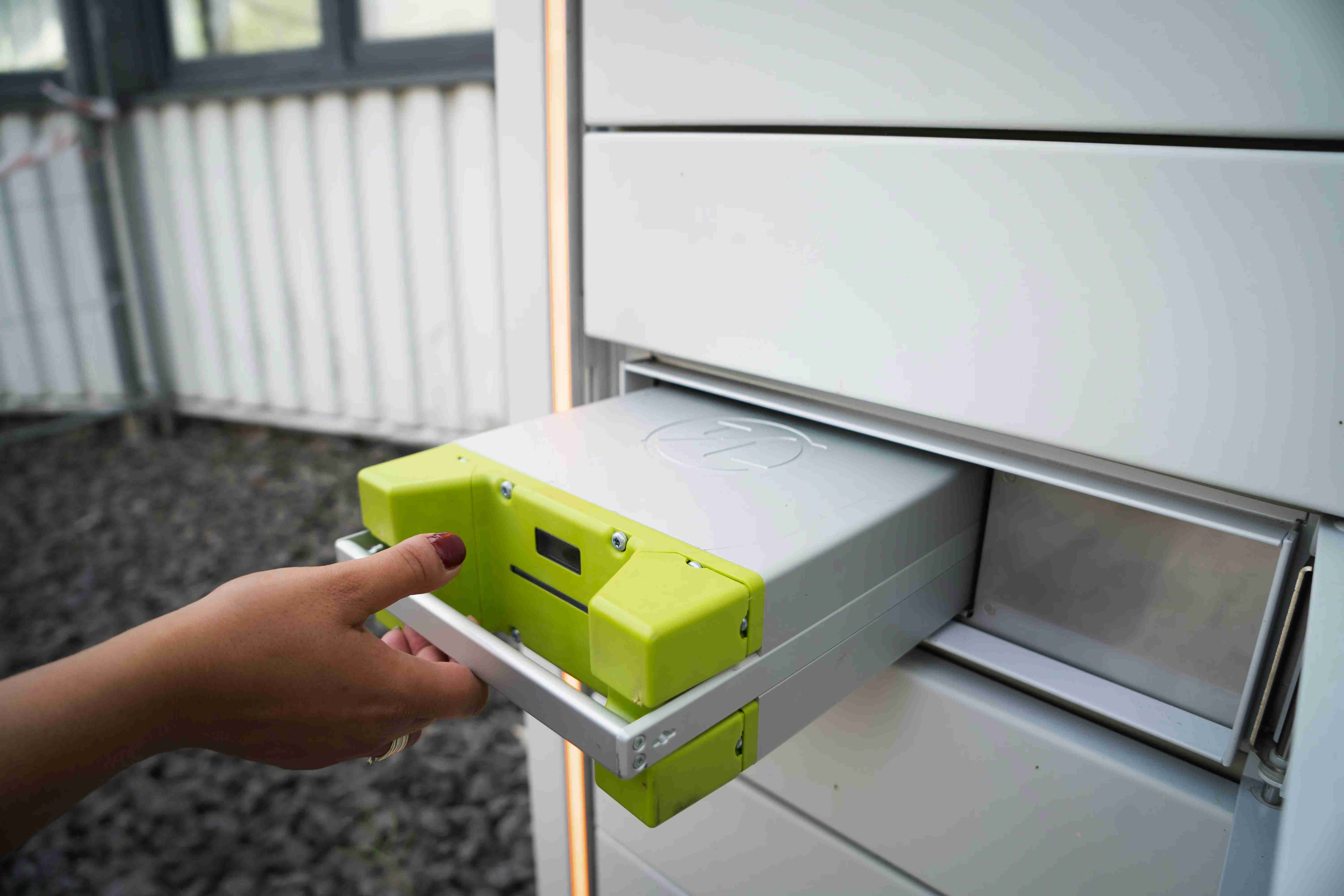
A CATL pack at IAA Transportation 2024: the same housing can hold iron-phosphate or nickel cells, and the chemistry inside decides the price, range and charging behaviour discussed here. Photo: Matti Blume, CC BY-SA 4.0, via Wikimedia Commons. Cropped, resized and converted to AVIF.
| Car | LFP version | Nickel version |
|---|---|---|
| Tesla Model 3 / Model Y | Standard and rear-drive cars (CATL cells) | Premium / Long Range and Performance |
| Ford Mustang Mach-E | Standard Range, since 2023 | Extended Range and GT |
| BYD (all models) | Blade battery across the range | None |
| MG4 | Standard Range | Long Range, Trophy, XPower |
| Citroën ë-C3 / Fiat Grande Panda | All versions | None |
| Volkswagen ID.2 (2026) | Entry versions with the unified cell | Larger packs |
| Mercedes CLA (2025 platform) | Entry version | Main 85 kWh pack |
| Hyundai Ioniq 5, Kia EV6, BMW iX3, Rivian R2 | None | All versions |
Chemistry can change by market and model year; confirm the exact pack on the car you are buying.
Which one should you buy?
Forget the brand war and answer four questions: where you charge, how far you drive, how cold it gets and how long you keep cars. The matrix below is the shortest honest version of the decision.
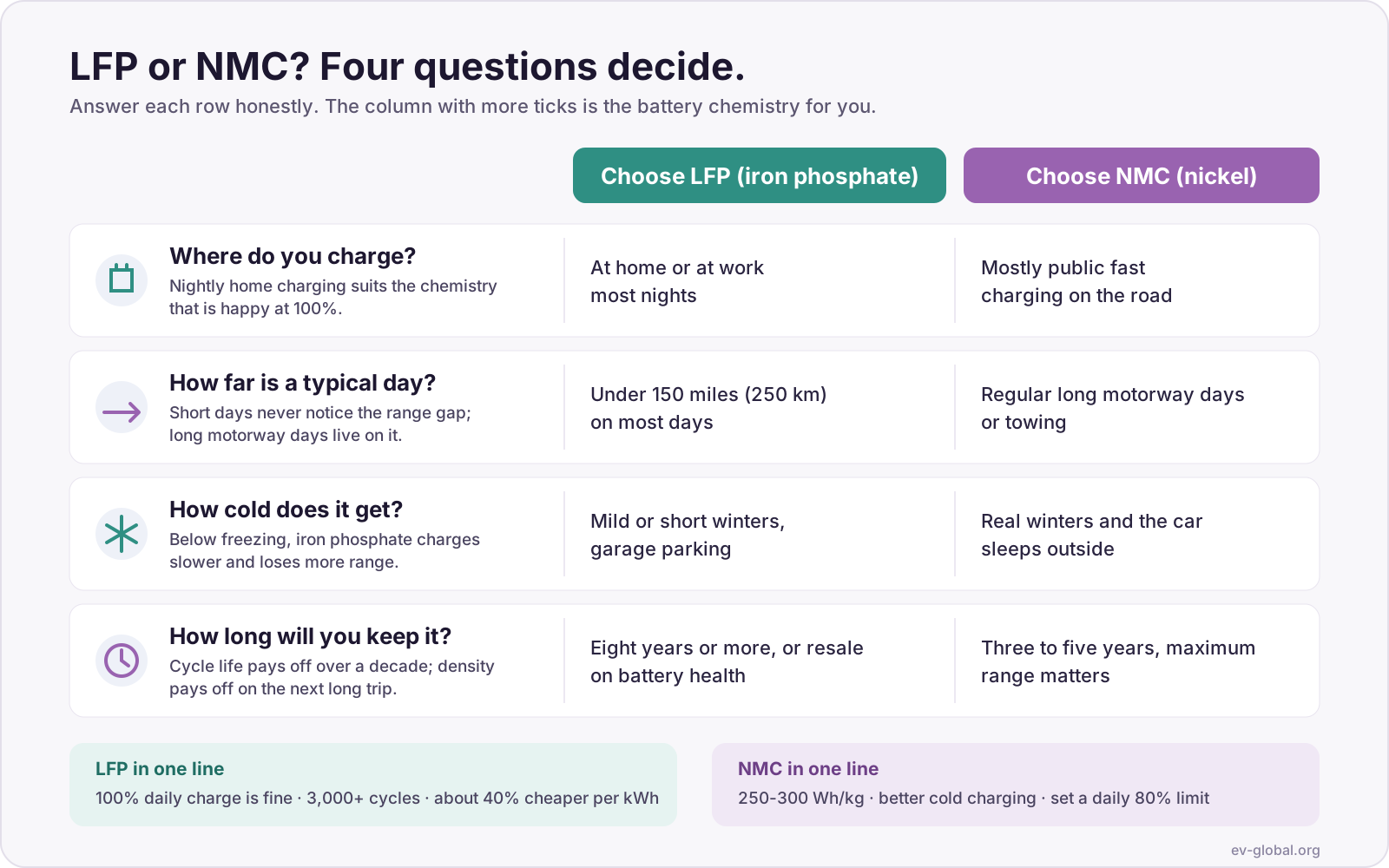
Original EV-Global illustration: the four questions that decide between an LFP and a nickel battery.
- Choose LFP if you charge at home or at work most nights, your typical day is under 150 miles, your winters are mild or short, you plan to keep the car eight years or more, or you simply want the cheapest ticket into a good EV. It is also the better bet for a car that will be resold with a high battery-health score, which is why it features so heavily in our used EV buying guide.
- Choose nickel if you regularly drive long motorway days, you live somewhere with real winters and park outside, you tow or carry heavy loads, or you need the maximum range a given body can offer. Pay for the density where you will actually use it.
- Either works if you are a mixed driver in a temperate climate. Then buy on price, warranty and the car itself, and set the charge limit the chemistry asks for.
How to tell which chemistry your car has
Carmakers rarely print the chemistry on the price list, but the clues are easy. A Tesla that recommends a 100% daily charge limit and lists a 60 kWh or smaller pack is LFP; one that defaults to 80% is nickel. Window stickers, owner's manuals and the energy certificate often state LiFePO4 or LFP outright. An OBD2 reader with a battery app settles it in seconds: resting cell voltages around 3.2 to 3.3 volts mean iron phosphate, 3.6 to 3.9 volts mean nickel. On a used car, ask the seller which charge limit the car shows by default and look at the pack size in the specification.
Recommended gear
Advertising / affiliate links: as an Amazon Associate, EV-Global earns from qualifying purchases. Prices and availability are set by Amazon; links open in a new tab.
Whichever chemistry you own, two tools make it easy to treat the pack right: a Bluetooth OBD2 reader to see cell voltages and real state of health, and a home charger that schedules to a daily limit and to your cheapest hours.
On AmazonBluetooth OBD2 scannersRead cell voltages, chemistry clues and battery health yourself. On AmazonSmart Level 2 home chargersSchedule the 80% or 100% limit and the cheap overnight rate.What comes next: LMFP, sodium and high nickel
Neither chemistry is standing still. Adding manganese to iron phosphate, LMFP, lifts the cell voltage to around 3.8 volts and the energy density by 15 to 20% while keeping most of the stability, and the first LMFP packs are already in Chinese cars. Sodium-ion goes the other way, giving up density for cost and cold tolerance: CATL's Naxtra cells keep 90% of their usable power at -40 °C, promise 10,000-plus cycles and are expected to reach cost parity with LFP by the end of 2026, which makes them a serious option for small city cars and for the storage market. At the top of the range, high-nickel cathodes paired with silicon-rich anodes keep pushing past 300 Wh/kg, and the solid-state cells that Toyota and Nissan target for 2027 and 2028 are nickel chemistries with a different electrolyte, not a replacement for this whole debate.
The practical reading for a buyer in 2026: iron chemistries will keep getting denser and cheaper, nickel will keep owning the long-range flagship, and the car you buy today will not be stranded by either.
The EV-Global verdict
LFP is the better battery for most people most of the time, which is exactly why it now accounts for more than half of the market. It is cheaper, it lasts longer, it is safer and it asks nothing of the owner. Nickel is the better battery for the drives that LFP finds hard: long, fast and cold. Buy the chemistry for your worst regular week, not your average one, charge it the way it wants to be charged, and stop worrying about the acronym. The pack will outlive your interest in it.
LFP vs NMC: frequently asked questions
Is LFP better than NMC?
For most daily drivers, yes: LFP is cheaper, lasts longer, is more stable in a fire and can be charged to 100% every day. NMC is better when you need maximum range, regular long motorway trips, towing or strong cold-weather performance.
Can I charge an LFP battery to 100% every day?
Yes. Lithium iron phosphate cells tolerate a full charge without the calendar-ageing penalty of nickel cells, and because their voltage curve is flat the car needs a regular 100% charge to recalibrate its range estimate. Tesla recommends at least once a week.
Do LFP batteries perform badly in cold weather?
They lose more than nickel packs. Below freezing an unwarmed LFP pack charges more slowly, limits regenerative braking and typically loses 25 to 35% of its range, against 20 to 30% for a nickel pack. Preconditioning before a fast charge removes most of the charging penalty.
Which Teslas have LFP batteries?
The standard and rear-wheel-drive Model 3 and Model Y use LFP cells from CATL, in the US since late 2021 and in Europe and China for the base cars built in Shanghai. Premium, Long Range and Performance versions use nickel-based NMC or NCA cells.
How long do LFP batteries last?
Typically 3,000 or more full cycles to 80% capacity, which at 250 miles per cycle is well over 500,000 miles of driving. Real fleets show LFP cars retaining 90% or more after eight years in mild climates. Calendar ageing, not cycling, is the limit for most owners.
Is NMC or LFP safer?
LFP. Its phosphate cathode needs considerably more heat to enter thermal runaway and releases far less oxygen when it does, which is why LFP packs can use simpler cooling and fire barriers. Modern nickel packs are safe too, but they rely more on the pack engineering around the cells.
Hero: original EV-Global illustration. Decision matrix: original EV-Global illustration. Cell and cost figures from the IEA Global EV Outlook 2026, CATL and manufacturer data.