How Does an Electric Car Motor Work? Permanent-Magnet vs Induction Motors Explained
How does an electric car motor work? The battery's direct current passes through an inverter that turns it into three-phase alternating current. Those three currents, fed into the copper windings of the stator in sequence, create a magnetic field that rotates; the rotor chases that field and spins with it. A single-speed reduction gear of roughly 8:1 to 10:1 multiplies the motor's torque at the wheels. There are no pistons, valves or gearshifts, which is why an EV motor converts 90 to 97% of its electrical energy into motion and delivers full torque from a standstill.
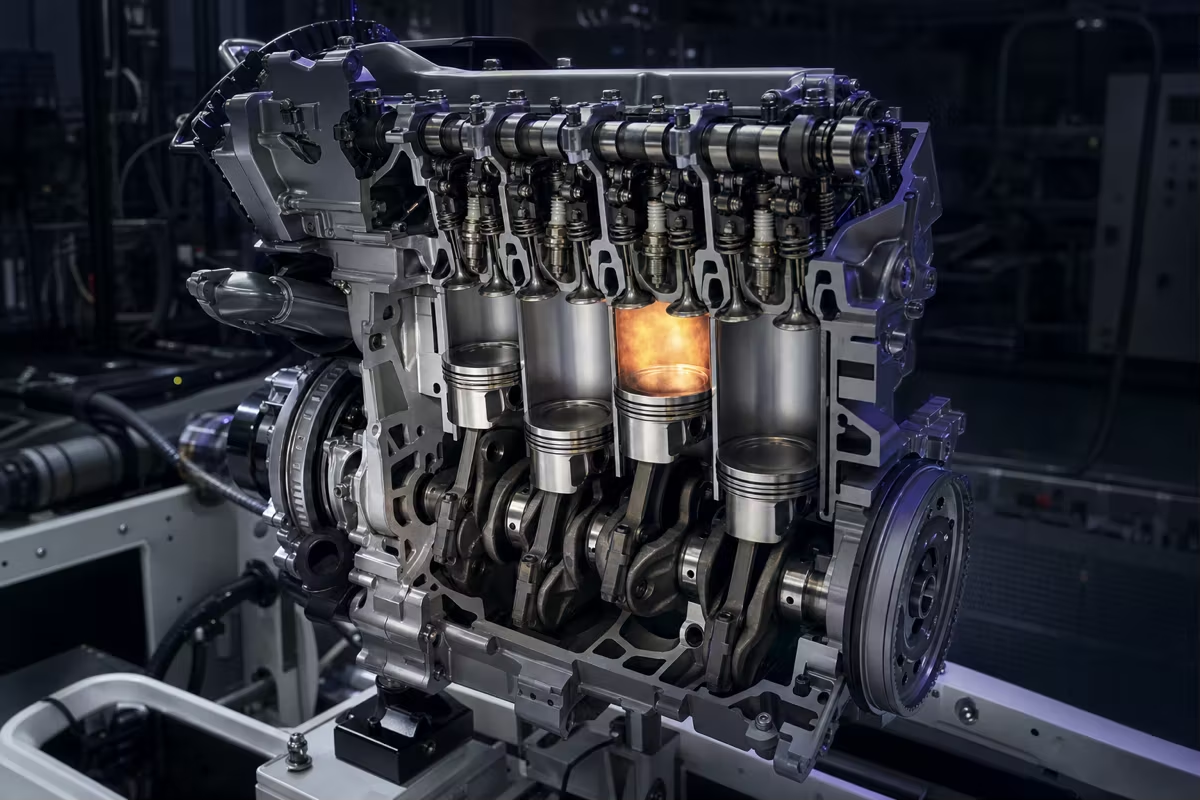
A combustion engine is a controlled explosion machine with hundreds of moving parts that must be fed, cooled, timed and shifted. An electric traction motor has one moving part, the rotor, and it is governed by a few lines of physics that have not changed since Tesla, the man, patented the induction motor in 1888. What has changed is the power electronics around it, the magnets inside it and the manufacturing that lets a 60 kg unit put out 300 kW. This guide follows the current from the battery terminal to the tyre contact patch, explains why the three motor types in today's EVs behave differently, and shows how to read a motor spec sheet without being fooled by it. It is the electric twin of our guide to how a car engine works.
The chain from battery to wheel
The battery delivers direct current at 400 or 800 volts. A motor cannot use that directly, so the first stop is the inverter: a box of power transistors that switches the DC on and off thousands of times a second to synthesise three sine waves of alternating current, 120 degrees apart. The inverter is the real throttle of an electric car. When you press the accelerator, the vehicle controller requests torque over the vehicle network, and the inverter answers by changing the amplitude and frequency of those three waves.
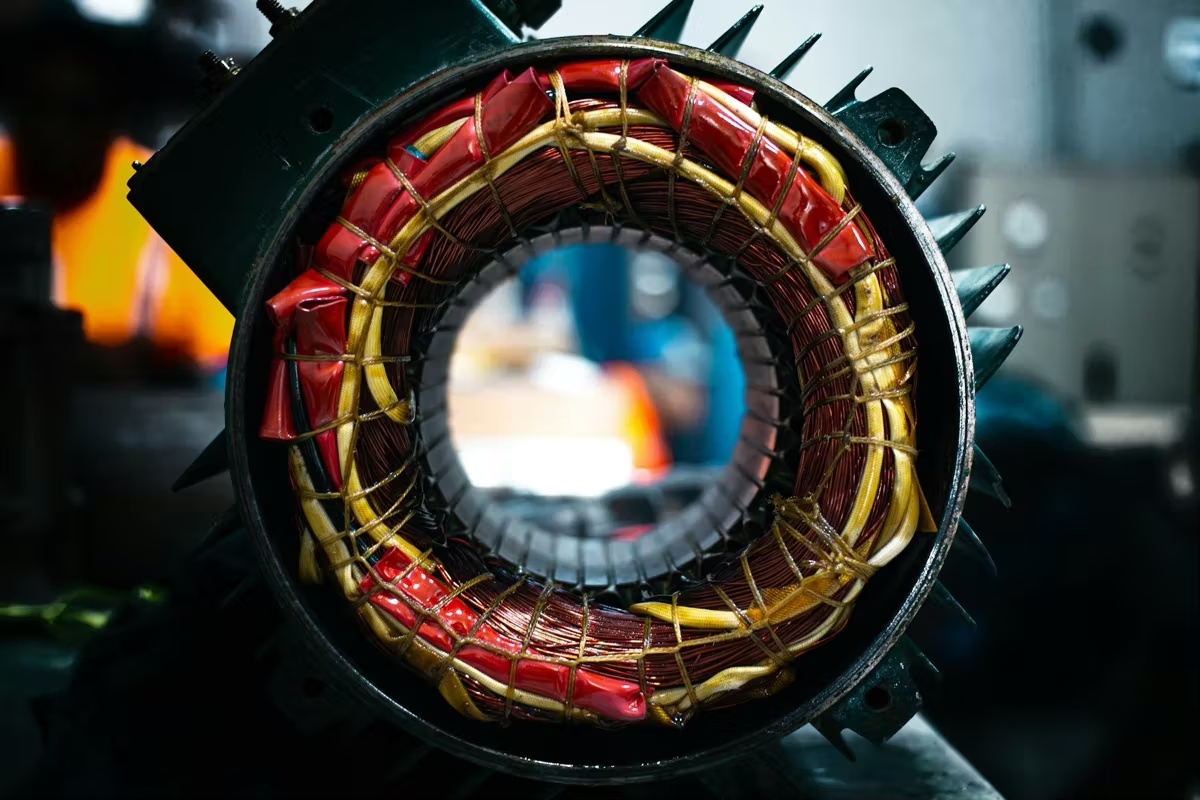
The waves flow into the stator, the stationary ring of steel laminations with copper windings packed into its slots. The rotor sits inside it on bearings, separated by an air gap of a millimetre or less. Torque appears in that gap, flows down the rotor shaft, through a reduction gear and a differential, and out along the driveshafts to the wheels. Everything from the controller software to the gear oil exists to serve the air gap.
Why it spins: the rotating magnetic field
Picture three electromagnets spaced evenly around a ring. Energise them in sequence and the combined magnetic field appears to rotate around the ring, even though nothing physical moves. That is what three-phase current does inside a stator, and the speed of that rotating field is set by the frequency the inverter chooses: raise the frequency and the field spins faster. The rotor is built to follow the field. How it follows is the single biggest design decision in an EV motor, and it splits the market into three families.
In a synchronous motor the rotor carries its own magnetic field, from permanent magnets or from a powered coil, and it locks onto the stator's field, turning at exactly the same speed. In an induction motor the rotor has no field of its own. Instead, the rotating stator field induces currents in a cage of conductor bars inside the rotor, those currents create their own field, and the rotor is dragged along slightly slower than the stator field. That difference in speed, the slip, is where the torque comes from, and it is why an induction motor is also called asynchronous.
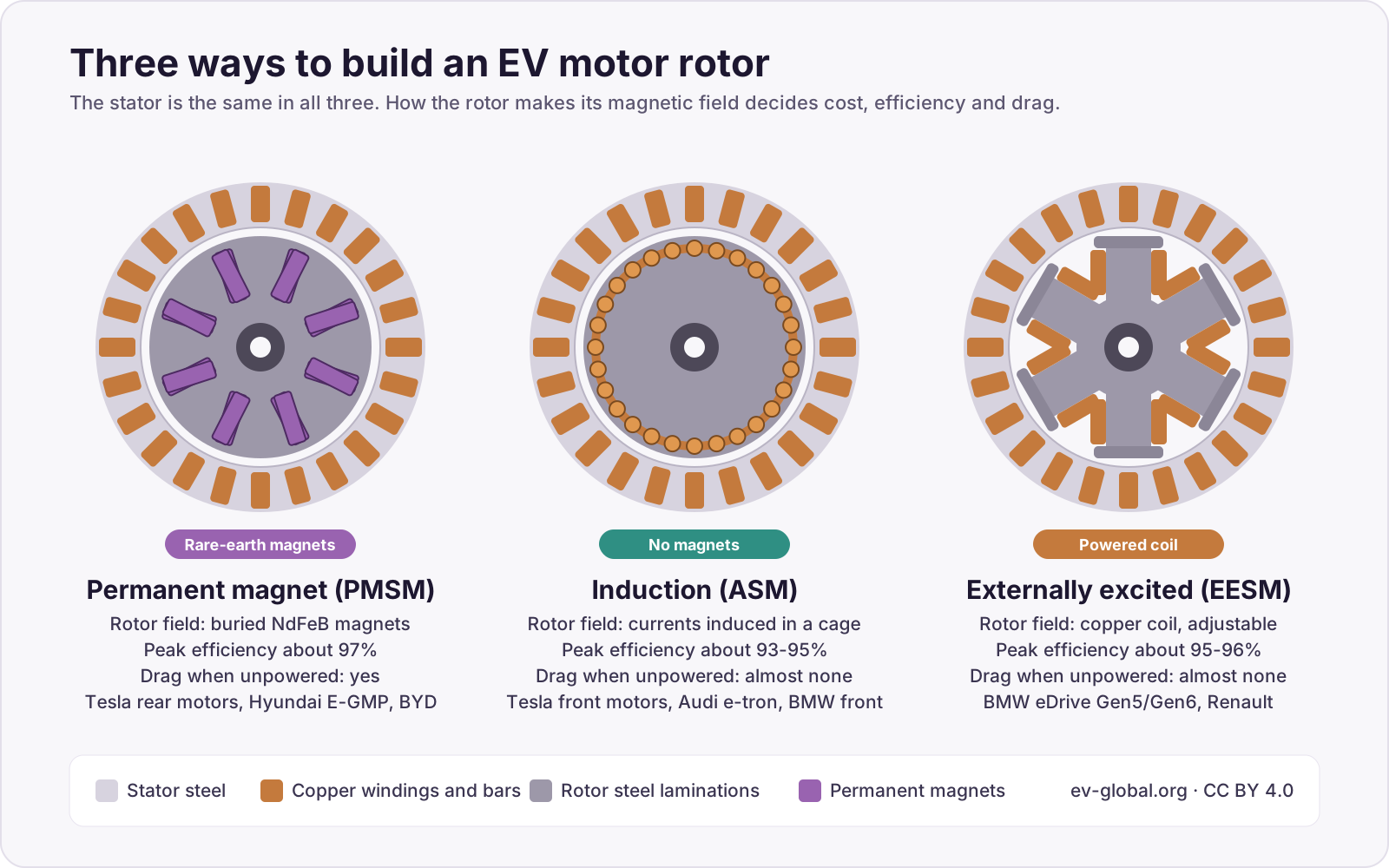
Original EV-Global illustration: how the rotor is built decides how the motor behaves. Vector version in the reference library.
The three motor types in today's electric cars
Permanent-magnet synchronous motors (PMSM) dominate. Neodymium-iron-boron magnets buried in the rotor, usually in a V arrangement that also exploits reluctance torque, give the highest efficiency at the part loads where cars spend most of their time, in a compact and light package. Most EVs use one on the driven axle: Tesla's rear motors since the Model 3, Hyundai and Kia's E-GMP cars, Lucid, every BYD. Their weaknesses are the price and politics of rare-earth magnets, and the fact that the magnets never switch off: spin a PMSM unpowered and it generates a drag voltage, which is why a dual-motor car does not want two of them.
Induction motors (asynchronous) have a rotor of copper or aluminium bars with no magnets at all. They are cheap, rugged, indifferent to heat and can be de-energised to freewheel without drag, so they make an ideal second motor: Tesla puts one on the front axle of its dual-motor Model 3 and Model Y, and BMW uses one on the front axle of its Neue Klasse cars. The original Model S and the Audi e-tron used induction motors on both axles. The cost is a few points of efficiency, because the rotor currents that create the field also create heat.
Externally excited synchronous motors (EESM) replace the magnets with a copper coil in the rotor, fed through slip rings or an inductive coupler. Renault has used them in the Zoe and Mégane for a decade, and BMW's fifth- and sixth-generation eDrive units are EESMs by choice. Because the rotor field can be turned up or down, the motor stays efficient at high speed and on the motorway, where permanent magnets need to be fought with weakening current, and it uses no rare earths. The price is rotor complexity and a little extra mass.
| Property | Permanent magnet (PMSM) | Induction (ASM) | Externally excited (EESM) |
|---|---|---|---|
| Rotor field from | Rare-earth magnets | Currents induced in a conductor cage | A powered copper coil |
| Peak efficiency | Up to about 97% | About 93-95% | About 95-96% |
| Best operating region | Low and medium speed, part load | Tolerant everywhere, best at high load | High speed and motorway cruise |
| Drag when unpowered | Yes, magnets always active | Almost none, can freewheel | Almost none, field switched off |
| Rare earths | Yes, neodymium and dysprosium | None | None |
| Relative cost | Highest magnet cost, simple rotor | Lowest | Medium, complex rotor |
| Typical use | Primary drive motor in most EVs | Secondary front motor, early Teslas, Audi e-tron | BMW eDrive Gen5/Gen6, Renault, some Mercedes |
Why dual-motor cars mix motor types
The cleverest EV drivetrains pair a magnet motor with a magnet-free one. In a dual-motor Tesla the rear permanent-magnet unit does the everyday work at peak efficiency while the front induction motor sleeps, freewheeling with no drag, and wakes up only for hard acceleration, slippery surfaces or regeneration. BMW's Neue Klasse does the same with an EESM at the back and an induction motor at the front, and claims 40% lower energy losses than its previous generation across the drivetrain. The combination buys efficiency when cruising, traction when needed, and a cheaper bill of materials than two magnet motors.
Torque, power and the single gear
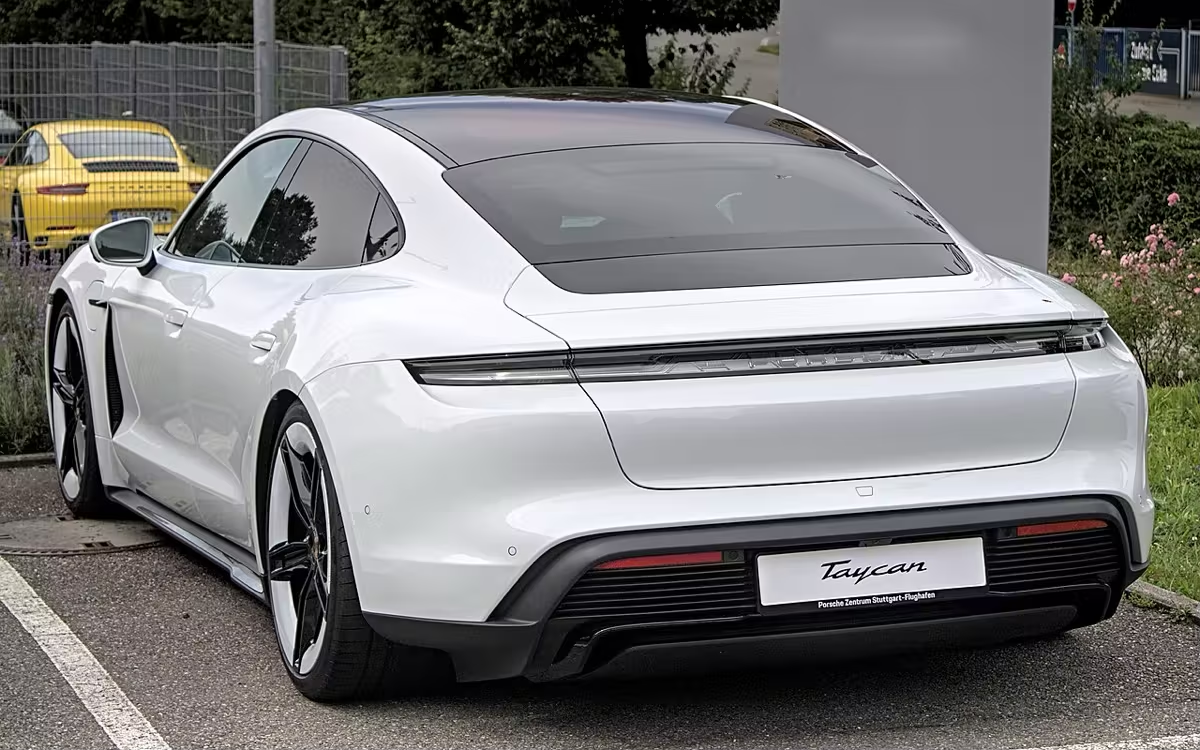
Up to its base speed, a motor's torque is simply proportional to the current the inverter pushes through it, and the current limit is there from zero rpm. That is why an EV launches instantly and why a 2.5-tonne SUV can embarrass a sports car to 60 mph. Above base speed the rotor spins so fast that its own back-voltage approaches the battery voltage, and the inverter must inject field-weakening current just to keep up; torque falls away while power stays roughly constant. The result is a torque curve that is flat, then falls as one over speed, which happens to be exactly what a car needs, so one fixed gear covers everything from a hill start to the top speed. Porsche's two-speed Taycan rear axle is the rare exception, bought for autobahn speeds.
This is also why electric motors do not have an efficiency island in the way a combustion engine does. A good traction motor stays above 90% across most of the map, which is why an EV uses roughly a third of the energy of a petrol car for the same journey even after battery, charging and inverter losses are counted.
The inverter and the 800-volt shift
Inverters used silicon IGBT transistors for two decades. The current generation uses silicon-carbide MOSFETs, which switch faster, waste less energy as heat and survive higher voltages, which is what makes the 800-volt architectures of the Taycan, the Ioniq 5 and the Lucid Air practical. Doubling the voltage halves the current for the same power, so cables, busbars and the motor's own windings can be thinner and lighter and lose less energy as heat. Tesla's Model 3 was the first mass-market car to put silicon carbide in the rear inverter; today it is the default in anything that claims fast charging.
Cooling, windings and the race to higher speed
Power in a motor is torque times speed, and torque costs size and copper, so engineers chase speed instead. A rotor turning at 20,000 rpm lets a smaller, lighter motor make the same power, which is why Lucid's drive units reach record power density and why Xiaomi advertises a 27,200 rpm motor in the SU7 Ultra. The enabling technologies are hairpin stator windings, rectangular copper bars that pack more conductor into each slot than round wire, direct oil cooling sprayed onto the winding ends and the rotor, and carbon-fibre sleeves that stop magnets or rotor bars flying apart at speed. The limits are magnet temperature, bearing life and the gearbox that has to turn 20,000 rpm into 1,500 at the wheel without whining.
Regenerative braking: the motor in reverse
Every traction motor is also a generator. Lift off the accelerator and the inverter reverses the energy flow: the wheels spin the rotor, the rotor induces current in the stator, and that current charges the battery while the drag slows the car. In city driving regeneration recovers 15 to 30% of the energy that friction brakes would have thrown away as heat, and it is what makes one-pedal driving possible. Two things limit it: a battery that is full or very cold cannot accept the current, which is why regen fades on a winter morning, and a motor can only brake the axle it drives, so the friction brakes remain for emergencies and for the undriven wheels.
The rare-earth problem and the engineering answers
A permanent-magnet motor needs about a kilogram of neodymium-iron-boron magnet, doped with dysprosium to survive heat, and China refines roughly 90% of the world's supply. That dependency is why the industry is engineering around the magnet. BMW's route is the externally excited motor already in production in the iX3 and i4; ZF and Mahle have shown EESMs that excite the rotor without slip rings. Tesla announced in 2023 that its next-generation drive unit would use a permanent-magnet motor with no rare earths at all, most likely with ferrite magnets and a cleverer rotor geometry, although as of late 2026 that motor has not been confirmed in a production car. Expect the magnet to stay in premium efficiency-focused motors and to disappear from the cost-sensitive ones.
Reliability: what wears out, and what does not
A traction motor has bearings, seals and coolant, and very little else to wear. Field data from fleets puts drive-unit failure rates far below engine failure rates, and most EV motors are designed to outlast the car. The real failure modes are electrical and peripheral: bearing damage from stray currents induced by the inverter's switching, coolant leaks into the stator, and inverter power stages that fail under heat. Early Model S drive units were replaced in numbers for bearing noise; the lesson travelled through the industry and modern units carry insulated bearings and better grounding. Service life is measured in hundreds of thousands of miles, and the battery chemistry will decide the car's lifespan long before the motor does.
How to read a motor spec sheet
- Peak versus continuous power. The headline kilowatts are a 10 to 30 second figure. The number that matters for repeated hard driving or towing is the 30-minute rating, which can be half the peak.
- Motor torque is not wheel torque. A 420 Nm motor behind a 9:1 reduction puts about 3,800 Nm at the axle, which is why EV torque figures look absurd next to engine figures. Compare cars by acceleration and by power, not by motor torque.
- Two motors do not mean twice the pace. Battery power limits combined output; a dual-motor car's second unit is often there for traction and efficiency rather than speed.
- Efficiency claims need a map. A 97% peak says little; what matters is how wide the region above 90% is, because that is where the car lives.
Where the motor sits in the engineering stack
The motor is one node in a system: the E/E architecture routes the torque request, the software platform can change how it responds with an update, and the whole unit has to survive the development and validation process before start of production. For the mechanical baseline that an electric drivetrain still shares with every other car, read how cars work; for the manufacturer that bet most heavily on magnet-free motors, our BMW Neue Klasse guide has the detail. The automotive engineering hub connects all of it.
Download the EV motor types diagram and comparison CSV from the reference library for a reusable summary of the three architectures.
Primary sources, checked October 15, 2026: the US Department of Energy's explanation of how all-electric cars work, BMW Group's sixth-generation eDrive technical briefing, and Tesla's 2023 Investor Day presentation on its next-generation drive unit.
Electric car motors: frequently asked questions
How does an electric car motor work in simple terms?
The inverter turns the battery's direct current into three-phase alternating current. Fed into the stator windings in sequence, it creates a rotating magnetic field; the rotor follows that field and spins. A fixed reduction gear sends the torque to the wheels.
What type of motor does a Tesla use?
Since the Model 3, Tesla uses a permanent-magnet synchronous motor on the rear axle and, in dual-motor cars, an induction motor on the front axle that can freewheel without drag. The original Model S and X used induction motors on both axles.
Why do electric cars have only one gear?
An electric motor makes full torque from zero rpm and keeps roughly constant power up to very high speeds, so a single reduction gear of about 8:1 to 10:1 covers everything from a hill start to the top speed. The two-speed Porsche Taycan is the rare exception.
What is the difference between a synchronous and an induction motor?
A synchronous rotor has its own magnetic field, from magnets or a powered coil, and turns at exactly the speed of the stator field. An induction rotor has no field of its own; currents induced in its conductor cage create one, and it turns slightly slower than the stator field.
How efficient is an electric car motor?
A modern traction motor peaks at 90 to 97% efficiency and stays above 90% across most of its operating range. A petrol engine peaks near 40% and spends most of its time well below that, which is the main reason an EV uses about a third of the energy per mile.
Do electric car motors wear out?
Rarely. A traction motor has bearings, seals and coolant and little else to wear, and most are designed to outlast the car. Known failure modes are bearing damage from inverter currents, coolant leaks and inverter power stages, all far less common than engine failures.
Hero photo: Troy Winther / Unsplash. Motor cross-sections: original EV-Global illustration, released under CC BY 4.0 in the reference library.