Xiaomi EV: How a Phone Maker Beat Tesla at Its Own Game
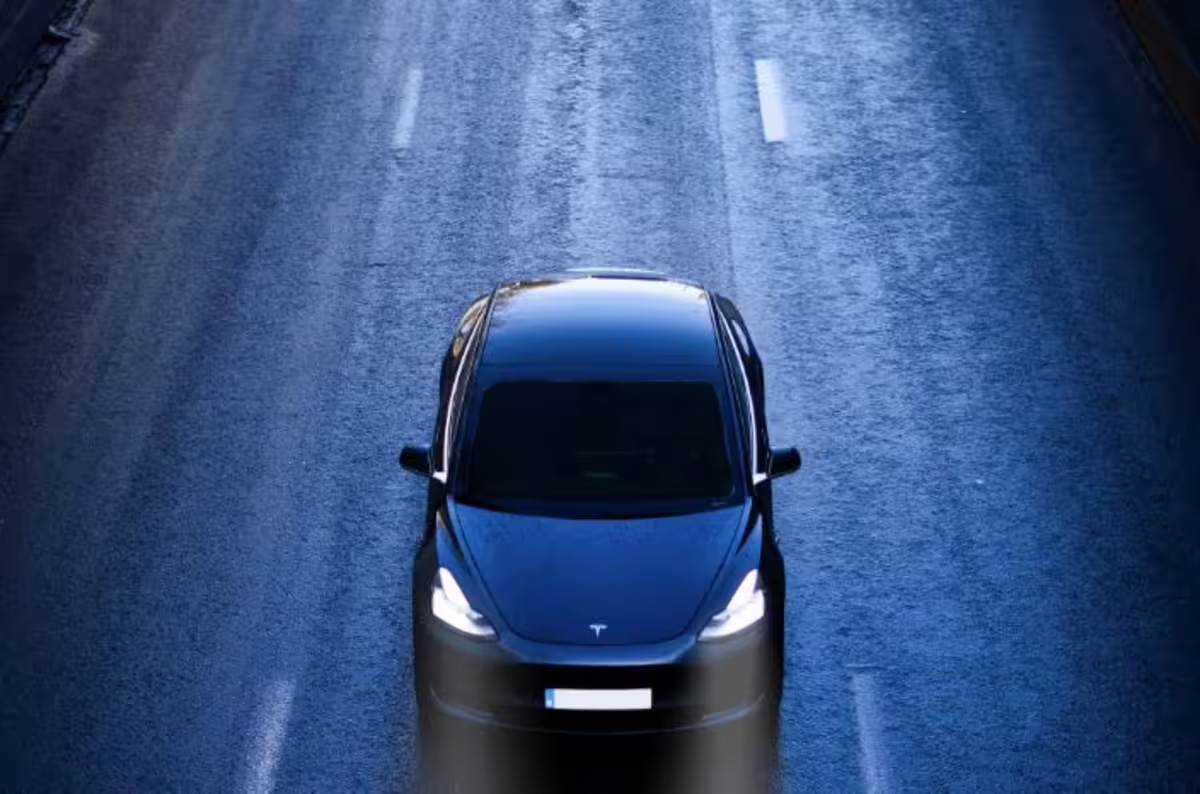
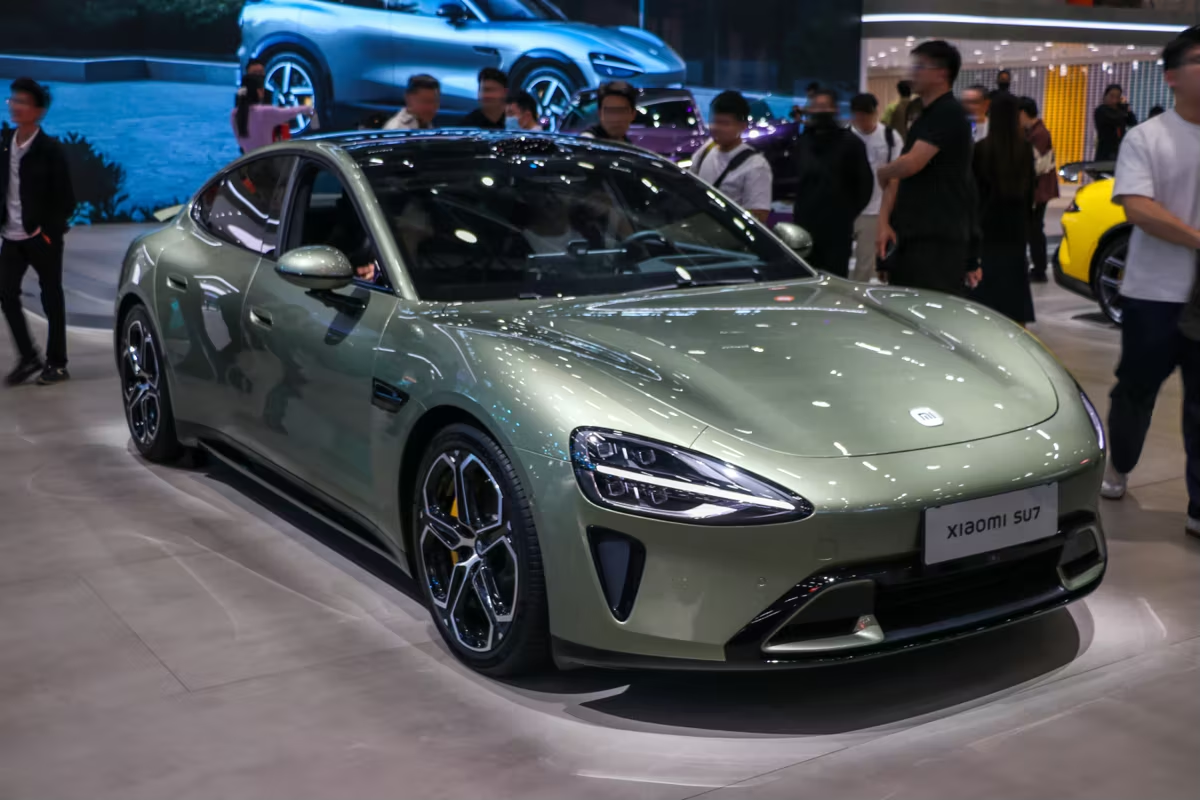
What is the Xiaomi SU7? The SU7 is Xiaomi's first electric car, a sleek sedan that went on sale in China in March 2024. Xiaomi, the company behind your phone and half the gadgets in a Chinese home, built a genuinely good car in about three years and by 2025 was outselling the Tesla Model 3 in China. That speed is exactly why the rest of the car industry is nervous, and why some of them are buying SU7s to take apart.
Three years. That is how long it took Xiaomi, a company most of the world knows for phones and rice cookers, to go from announcing it would build a car to outselling the Tesla Model 3 in its home market. For an industry where a clean-sheet model normally takes four to five years, that timeline is not just impressive, it is unsettling. When Ford's chief executive flies one across the Pacific so he can drive it every day, you know the establishment is paying attention.
October 2026 update. Xiaomi's 2026 target is 550,000 deliveries and it had reached 39% of it by the end of July, with total deliveries up 15% year on year. The mix has flipped: SU7 deliveries fell about 44% over the first seven months as buyers moved to the YU7 SUV, waiting lists have shortened to weeks, and the European launch is now scheduled for the second half of 2027, Germany first. The story below describes how it got here.
From phones to a 1,500 horsepower sedan in three years
In March 2021, Xiaomi founder Lei Jun stood on stage and pledged 10 billion US dollars over ten years to build electric cars, calling it the last big project of his life and staking his personal reputation on it. Xiaomi had the cash, a hardware supply chain honed over a decade of phones, and a brand that millions of people already trusted in their pockets and living rooms. What it did not have was a single day of carmaking experience.
It moved anyway. Xiaomi built its own factory in Beijing rather than contracting the work out, unveiled the SU7 in December 2023, and put it on sale on 28 March 2024. The response broke the script: 88,898 firm orders in the first 24 hours. This was not a phone company dipping a toe in. It was a full assault, the same playbook we have watched from China's EV newcomers, executed with unusual discipline.
Meet the range: SU7, SU7 Ultra and YU7
Xiaomi now sells three cars, and each one targets a nerve in the established lineup.
The SU7 is the sedan that started it all, a low, Porsche-Taycan-shaped four-door that starts at about 215,900 yuan (roughly 30,000 US dollars) in China. Even the entry version claims 700 km on China's CLTC cycle, and the top SU7 Max does 0 to 100 km/h in 2.78 seconds. The SU7 Ultra is the halo: a tri-motor monster making about 1,548 PS, with a 1.98 second sprint and a 350 km/h top speed, sold for around 529,900 yuan (about 73,000 dollars), a fraction of what a European super-saloon with those numbers would cost. Then came the YU7, an SUV aimed squarely at the Tesla Model Y, which it slightly undercuts on price. Its launch in June 2025 produced the most absurd number yet: 200,000 firm orders in the first three minutes.
One honest caveat on the range figures. China's CLTC test is generous, usually 30 to 35 percent rosier than the EPA numbers Americans see and meaningfully above Europe's WLTP. A 700 km CLTC car is a strong 500 km car in the real world, which is still very good, just not the headline. If you want to sanity-check any EV's claim against cold weather and motorway speed, our EV range calculator does exactly that.
| Model | Type | Power | 0-100 km/h | Range (CLTC) | From (China) |
|---|---|---|---|---|---|
| SU7 | Sedan | 299 to 673 PS | 5.3 to 2.78 s | 700 to 830 km | ~215,900 yuan (~$30,000) |
| SU7 Ultra | Performance sedan | 1,548 PS | 1.98 s | 630 km | ~529,900 yuan (~$73,000) |
| YU7 | SUV | 320 to 690 PS | 5.9 to 3.2 s | 760 to 835 km | ~253,500 yuan (~$35,000) |
Launch specs for the 2024 and 2025 cars. Range is China's optimistic CLTC cycle. Prices are approximate and convert at about 7.2 yuan to the dollar.
How the SU7 stacks up against the establishment
Numbers on a page are one thing. Put the SU7 Max next to the cars it is gatecrashing and the picture gets clearer. Tap the metrics to compare.
The SU7 Ultra's 1,138 kW now has a rival on paper: Tesla's 2026 Roadster claims more than a megawatt from two motors in a sub-1,700 kg car, although nothing ships before 2028.
The SU7 figure is China's CLTC cycle, the rivals are WLTP, so read the range bars as indicative rather than exact. On power and price the SU7 Max simply has no peer near its money. Only the Taycan Turbo GT, at roughly four times the price, clearly out-punches it.
Why carmakers are tearing it apart
The clearest sign of how seriously the industry takes Xiaomi came from Dearborn, not Beijing. Ford chief executive Jim Farley admitted he had an SU7 flown from Shanghai to Chicago and had been driving it for six months. "I don't want to give it up," he said, calling Xiaomi "a juggernaut." Farley has gone further elsewhere, describing Chinese cars as an "existential threat" and praising their "far superior in-vehicle technology," the way you get in and "your whole digital life is mirrored in the car" with no phone pairing at all.
He is not alone, he is just the one willing to say it on a podcast. Professional teardown houses that legacy carmakers quietly subscribe to, firms like MarkLines and Yole, have published exhaustive strip-downs of the SU7, photographing every casting and chip. Tearing down a rival is normal. Tearing down a three-year-old phone company's first car, and finding manufacturing tricks you do not have, is not. The thing that rattles a veteran engineer is not that the SU7 is cheap. It is that it is good, and that Xiaomi got there so fast by being ruthlessly vertically integrated: its own motors, its own die-casting, its own battery pack design, its own software, all under one roof.
The tech under the skin
Strip the badges off and the SU7 is a showcase of how a hardware company thinks about a car. A few highlights worth understanding:
- In-house "HyperEngine" motors. Xiaomi designed its own electric motors, and the top V8s unit spins to 27,200 rpm, which it claims is a production record. Higher motor speed means more power from a smaller, lighter unit, the same race other Chinese makers are running.
- Giga-casting on Tesla's scale. Xiaomi built a 9,100-tonne die-casting press, fractionally larger than Tesla's, and uses it to cast the SU7's entire rear floor as one piece. That single casting replaces 72 separate parts and 840 weld points, and it is made in about 100 seconds. This is the manufacturing tech that scares cost accountants.
- Battery built into the body. The pack uses a cell-to-body design and an 800-volt architecture on the Max, with cells from the big names, CATL and BYD. Higher voltage means faster charging and thinner cables, the same logic behind the 800-volt revolution.
- The phone company's home advantage. The cabin runs HyperOS on a Snapdragon flagship chip, connects to your Xiaomi phone and smart home automatically, and even mounts an iPad in the back. Lei Jun said more than half of early SU7 buyers were iPhone users, which tells you the ecosystem, not just the car, is the draw.
It is the clearest example yet of a software-defined vehicle built by a company that already knew how to ship software and hardware together. The 2026 refresh even adds lidar and an Nvidia Thor chip across the range for its assisted-driving stack.
Free calculatorWhat would that CLTC range really be?Adjust any EV's headline figure for cold weather and motorway speed.Xiaomi's EV timeline
From a standing start to a record lap and a Model 3-beating year, in five years flat.
Lei Jun announces Xiaomi will build cars and pledges 10 billion dollars over ten years.
Xiaomi finishes its own Beijing factory and reveals the SU7 in December.
The SU7 goes on sale: 88,898 orders in 24 hours. Deliveries begin within weeks.
The 1,548 PS SU7 Ultra launches, and a prototype later laps the Nurburgring in 6:22.
The YU7 SUV arrives and takes 200,000 orders in three minutes.
Xiaomi outsells the Model 3 in China, delivers over 400,000 cars in a year, and sets its sights on Europe for 2027.
It is not all a fairy tale
A story this fast collects scar tissue, and Xiaomi's first year had two hard lessons. In March 2025 a base SU7 running its assisted-driving system hit a motorway barrier and three people died, a tragedy that put China's whole "smart driving" marketing under the microscope. Within weeks regulators banned carmakers from calling driver aids "autonomous" or "smart," forcing the honest label "assisted driving," a reset that affected everyone, not just Xiaomi. If you are unsure what these systems can and cannot do, our guide to the levels of autonomous driving is the place to start.
Then there was the self-inflicted one. An over-the-air update quietly capped the SU7 Ultra's full power behind a track-lap requirement, so owners who had paid super-saloon money suddenly could not use it on the road. The backlash was loud, Xiaomi apologised, and another update reversed it. A young carmaker learning in public, with hundreds of thousands of customers watching.
What it means if you cannot buy one
For now you cannot, unless you live in China. Xiaomi is targeting Europe, starting with Germany, around 2027, and has opened a Munich design centre staffed with ex-BMW and Porsche engineers. The United States is off the table while tariffs on Chinese-built cars stay punishing. The real brake on exports is almost funny: Xiaomi cannot build them fast enough, with home-market waiting lists running past a year.
But you do not need to buy one for it to matter to you. The SU7 reset what buyers expect for the money, and that pressure flows downhill to every brand you can buy, from Tesla to the Germans. It is the same competitive wave coming from BYD and the other Chinese giants, and it is why your next EV, whatever the badge, will probably be better and cheaper than it would have been five years ago.
The EV-Global Verdict
Xiaomi did not win because it built the cheapest car or the fastest one, though the Ultra is absurdly fast. It won by treating a car like a flagship product: pick a clear target, integrate everything, ship fast, and lean on a brand people already love. That is a hard thing for a century-old carmaker to copy, which is precisely why they are nervous. Whether Xiaomi can repeat the trick outside China, against tariffs and without the home-field ecosystem, is the real open question. But the lesson is already delivered, and the industry has already received it. The newcomer set the pace, and now everyone else is driving to catch up.
Xiaomi EV: frequently asked questions
What is the Xiaomi SU7?
The SU7 is Xiaomi's first electric car, a sleek sedan that went on sale in China in March 2024. It took Xiaomi, best known for phones, about three years to build it, and by 2025 the SU7 was outselling the Tesla Model 3 in China.
Is the Xiaomi SU7 actually any good?
By most accounts, yes. Reviewers and even rival executives rate it highly for its drive, software and build. Ford's CEO imported one and has driven it for months, and the performance SU7 Ultra set lap records at the Nurburgring.
Does the Xiaomi SU7 outsell the Tesla Model 3?
In China, yes. Across 2025 Xiaomi delivered about 258,000 SU7s against roughly 200,000 Tesla Model 3s, the first time anyone had beaten the Model 3 in China's premium sedan segment in years.
Can you buy a Xiaomi car in Europe or the US?
Not yet. Xiaomi sells only in China for now and is targeting Europe, Germany first, around 2027. There are no US plans, where tariffs on Chinese-built cars are steep. Long domestic wait times are the main thing delaying exports.
How fast is the Xiaomi SU7 Ultra?
The tri-motor SU7 Ultra makes about 1,548 PS and does 0 to 100 km/h in 1.98 seconds, with a 350 km/h top speed. A prototype lapped the Nurburgring in 6:22, one of the fastest times ever set round the circuit.
Who makes Xiaomi's batteries?
Xiaomi buys cells from China's biggest suppliers and builds the pack itself. The cheaper SU7 uses BYD blade LFP cells, while the longer-range and performance versions use CATL packs, including the high-density Qilin chemistry.
Photo: Nissangeniss / Wikimedia Commons (CC BY-SA 4.0). Resized and converted to AVIF.