How Does a Car Engine Work? Four-Stroke Engine Explained
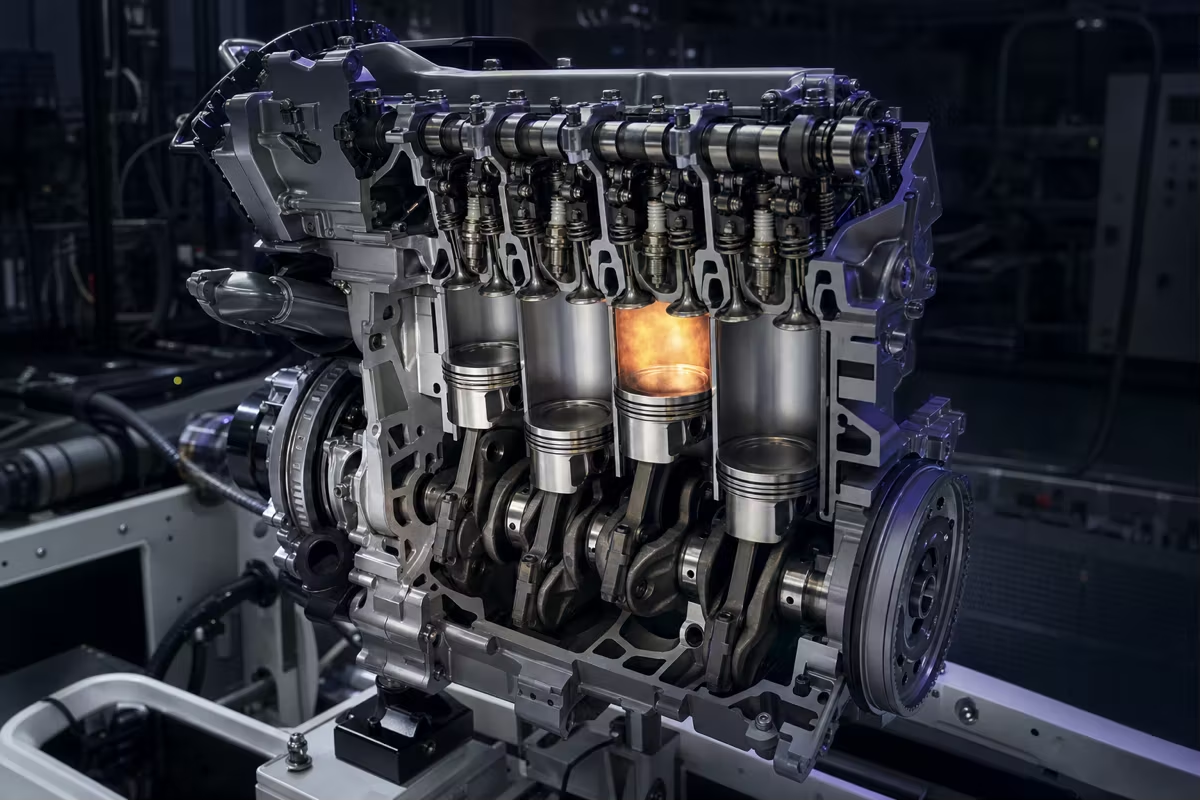
How does a car engine work? An internal-combustion engine burns fuel and air inside cylinders. Expanding gas pushes pistons, connecting rods turn the crankshaft, and the transmission and final drive send that rotation to the wheels. Most car engines use a four-stroke cycle: intake, compression, power and exhaust.
The engine does not push the car forward directly. It turns a shaft. Everything from valves to the differential exists to fill the cylinders, control combustion, survive the heat and convert that rotation into useful wheel torque.
How does a car engine work? The basic chain
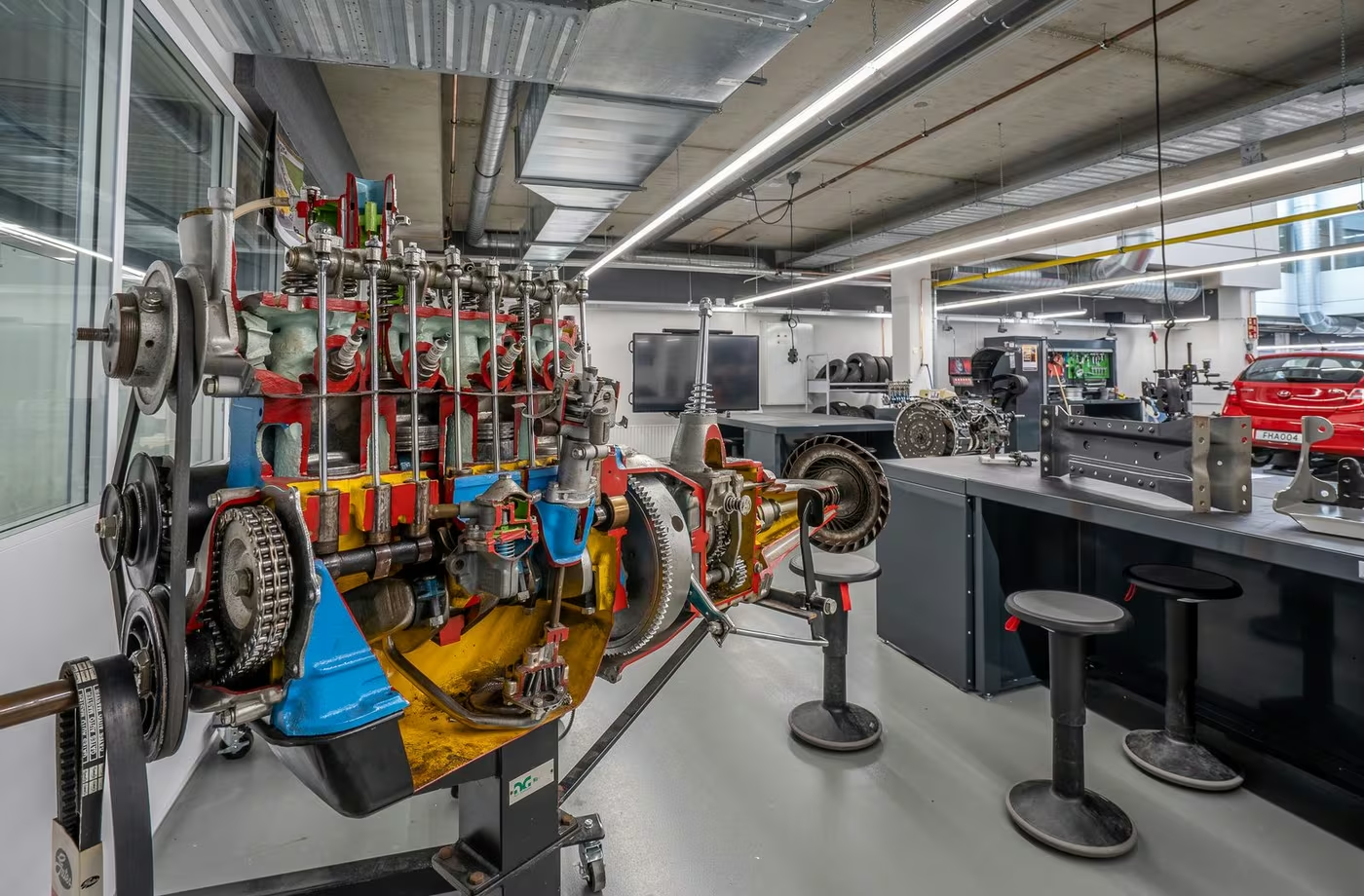
Air enters the cylinder, fuel is added and the mixture is compressed. Combustion raises pressure. That pressure acts on the top of a piston, the connecting rod transfers force to an offset crank journal, and the crankshaft converts the piston's up-and-down motion into rotation. The flywheel smooths separate firing pulses before torque reaches the transmission.
This is the combustion branch of the larger guide to how cars work, which also covers steering, suspension, braking and electric powertrains.
Main car engine parts and what they do
| Part | Job | What failure changes |
|---|---|---|
| Block and cylinders | Guide pistons and contain coolant and oil passages | Compression, sealing and structural integrity |
| Pistons and rings | Receive gas pressure and seal the cylinder | Power, oil use and blow-by |
| Connecting rods and crankshaft | Convert reciprocating force into rotation | Torque and mechanical survival |
| Cylinder head, valves and camshafts | Control gas exchange at the correct time | Airflow, compression and combustion |
| Injectors and spark plugs | Meter fuel and ignite petrol mixtures | Mixture quality, timing and emissions |
| Oil and cooling systems | Control friction and temperature | Bearing life, knock and overheating |
What are the four strokes of a car engine?
| Stroke | Piston movement | What happens |
|---|---|---|
| 1. Intake | Down | Intake valve opens and fresh charge enters |
| 2. Compression | Up | Valves close and the charge is compressed |
| 3. Power | Down | Combustion pressure drives the piston |
| 4. Exhaust | Up | Exhaust valve opens and spent gas leaves |
The four strokes need two crankshaft revolutions, or 720 degrees. In a four-cylinder engine with evenly spaced firing, one cylinder can begin a power stroke every 180 degrees of crank rotation. Valve events usually overlap the simple textbook boundaries to improve gas flow.
How does engine power reach the wheels?
The crankshaft connects to a clutch in a manual car or a torque converter and clutches in a conventional automatic. Gear ratios trade engine speed for wheel torque. The final drive makes another reduction, the differential allows left and right wheels to turn at different speeds, and driveshafts deliver torque to the tyres.
Vehicle acceleration depends on wheel torque, mass, gearing and available grip. Peak engine power alone cannot describe how hard the car launches or pulls at a particular road speed.
Petrol engine vs diesel engine
A petrol engine normally mixes fuel with air and uses a spark plug to start combustion. A diesel compresses air to a much higher pressure and temperature, then injects fuel so it ignites from compression heat. Modern versions of both use electronic injection, turbocharging, exhaust aftertreatment and precise control, but the ignition method remains the clean distinction.
What is torque vs horsepower?
Torque is a twisting moment at the crankshaft. Power is the rate of doing work, calculated from torque and rotational speed. High torque at low rpm can make an engine feel strong without producing huge peak power. Gearing then multiplies torque at the wheels, which is why a lower gear accelerates harder at the same engine output.
Why timing, lubrication and cooling matter
Cam timing decides when the cylinders breathe. Ignition or injection timing decides when pressure rises. Oil keeps bearings and sliding surfaces separated by a film, while coolant carries heat from the head and block to the radiator. A good combustion event at the wrong time can cause knock, lost efficiency or destructive cylinder pressure.
What does the ECU do in a car engine?
The engine control unit reads crank position, airflow or manifold pressure, temperatures, oxygen sensors, knock sensors and driver demand. It commands fuel, spark, throttle, boost and emissions hardware. That closed loop lets one engine start cold, idle smoothly, protect itself under load and meet emissions limits.
The ECU is one node in the broader automotive E/E architecture. New vehicles increasingly coordinate powertrain, brakes, thermal systems and driver assistance through shared computing and software platforms.
What happens when you press the accelerator?
In a modern car the pedal is a torque request, not a cable that directly opens the throttle. The ECU interprets pedal position together with engine speed, gear, temperature, traction limits and emissions constraints. It then coordinates throttle angle, fuel, ignition, valve timing and turbo boost to deliver an allowed torque. The transmission and stability controller may request their own limits during a shift or on a slippery surface.
This is why identical pedal movement can feel different in Sport, Eco or cold-start operation. The hardware has not changed. The request map and protection limits have. It also explains why "throttle response" combines several delays: air filling the intake, turbocharger acceleration, combustion, gearbox response and the software ramp used to protect grip and components.
Why an engine has an efficiency island
An engine does not convert fuel equally well at every speed and load. At light load, a petrol engine loses energy pulling air past a partly closed throttle and friction consumes a larger share of its small output. At very high speed, friction and gas-flow losses rise. The most efficient region usually sits at moderate speed and relatively high load, visible as an island on a brake-specific fuel-consumption map.
Gearing and hybrid control try to keep the engine near that region. A taller gear lowers engine speed at cruise. A hybrid can load the engine efficiently while sending surplus power to the battery, then switch it off when demand is low. Peak thermal efficiency is therefore not the same as average vehicle efficiency. How often the car can operate near the good island matters just as much.
Car engine vs electric motor
| Internal-combustion engine | Electric motor |
|---|---|
| Converts chemical energy through combustion and heat | Converts electrical energy through magnetic fields |
| Needs intake, compression, ignition and exhaust | Produces rotation without a combustion cycle |
| Narrower efficient speed and load region | High efficiency across a broad operating region |
| Multi-ratio gearbox is common | Single-speed reduction is common |
A hybrid powertrain combines both machines so the motor can recover braking energy and move the engine away from inefficient operating points. The EV, hydrogen and combustion comparison follows the full energy chain rather than judging only the device in the car.
Why do car engines waste so much energy?
Combustion creates heat, but only part of it becomes crankshaft work. Energy leaves through the exhaust and cooling system, while friction, pumping air and driving accessories consume more. The US Department of Energy notes that a typical engine loses about 30 percent of its fuel energy through the exhaust alone. Better combustion, turbocharging, hybridisation and heat recovery can reduce losses, not eliminate thermodynamics.
The production challenge is just as physical. See how an engine and thousands of other parts move through automotive product development, APQP and PPAP validation, and the SOP production launch. Our automotive engineering hub connects the complete system.
Primary sources, checked July 24, 2026: US Department of Energy explanations of internal-combustion engine basics and exhaust-energy losses and recovery.
How a car engine works: frequently asked questions
How does a car engine work in simple terms?
Fuel and air burn inside a cylinder. Expanding gas pushes a piston down, a connecting rod turns the crankshaft, and the transmission sends that rotation to the driven wheels.
What are the four strokes of a car engine?
The four strokes are intake, compression, power and exhaust. A complete cycle takes two crankshaft revolutions, or 720 degrees.
How does the engine make the wheels turn?
The crankshaft sends torque through the clutch or torque converter, transmission, final drive and differential. Driveshafts then turn the driven wheels.
What is the difference between a petrol and diesel engine?
A petrol engine normally ignites a compressed air-fuel mixture with a spark plug. A diesel compresses air until it is hot, then injects fuel so it ignites from the heat of compression.
What does the ECU do in a car engine?
The engine control unit calculates fuel, ignition, air and emissions commands from sensor data. It keeps the engine responsive while protecting components and meeting emissions limits.
Is an electric motor an engine?
In everyday speech people may say electric engine, but the precise term is electric motor. It converts electrical energy directly into rotation without an intake, compression, combustion or exhaust stroke.
Original EV-Global illustration, created for this four-stroke engine guide.