How Regenerative Braking Works in an EV: One-Pedal Driving, Blended Brakes, and How Much Range You Really Get Back
How does regenerative braking work in an electric car? The inverter tells the traction motor to produce negative torque, so the motor runs as a generator: the car's kinetic energy spins the rotor, the stator windings turn that into alternating current, the inverter rectifies it and the battery takes the charge. A modern EV handles 90 to 98% of everyday braking this way and gets back about a fifth of the energy it uses over a standard cycle, a third in town and roughly a tenth on the motorway. The friction brakes take over for hard stops, below 5 to 8 km/h, and whenever the battery is too cold or too full to accept the current. One-pedal driving saves energy in stop-and-go traffic; on an open road, coasting wins.
A Porsche Cayenne Electric can brake with up to 600 kW without touching a brake pad, more than twice the peak regeneration of the pre-facelift Taycan, and Porsche says the motors cover about 97% of the braking a driver does in a normal week. The remaining 3% is why the car still carries ten-piston calipers: a full stop from top speed in a loaded car needs more than two megawatts, and no battery on earth will accept that. Regenerative braking is the single feature that most separates an electric drivetrain from a combustion one. It is already baked into every range figure you have ever read, and it is one reason a Tesla fails its first German inspection more often than anything else of its age in the 2026 TÜV report.
The motor runs as a generator, and the inverter decides how hard
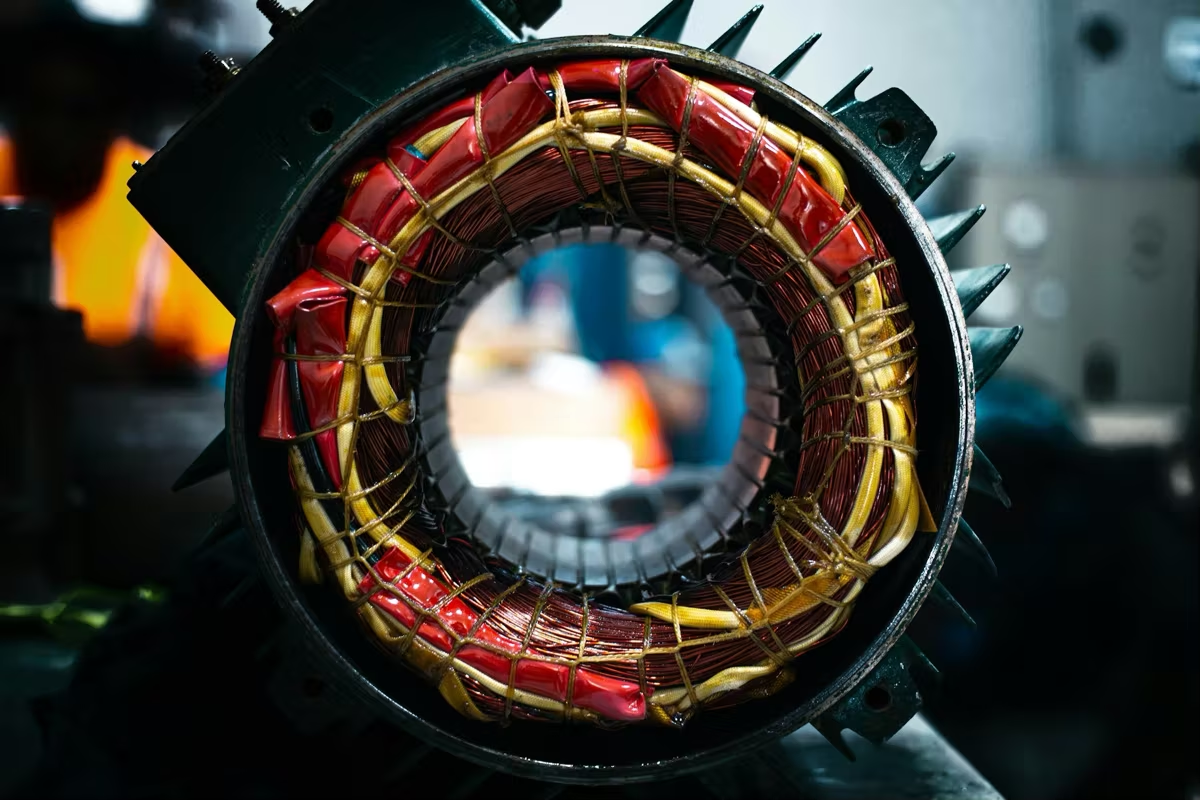
Every traction motor in an EV, permanent-magnet, induction or externally excited, becomes a generator the moment the inverter commands negative torque. The stator field is phased to oppose the rotor's rotation, the mechanical power at the shaft (torque times speed) comes out of the windings as alternating current, the inverter's power electronics rectify it to direct current, and the pack absorbs it. The inverter sets the torque request; the battery management system sets the ceiling on how much current the cells may accept. Porsche describes the split in one sentence: the electronics decide within milliseconds how much braking is electric and how much hydraulic, and the driver's foot never finds out. How an electric car motor works covers the machine itself; this is the same machine run the other way.
Two pieces of physics shape everything downstream. Kinetic energy rises with the square of speed, so stopping from 100 km/h recovers four times the energy of stopping from 50 km/h: a two-tonne car at 100 km/h carries about 0.21 kWh, at 50 km/h about 0.054 kWh. Porsche's illustration is that two seconds of regeneration at 290 kW buys roughly 700 metres of driving. And the power needed to hold a given deceleration also scales with speed: holding 3 m/s² on a 2,050 kg Mercedes CLA takes about 6.2 kN of braking force, which is 220 kW at 130 km/h but only 85 kW at 50 km/h. A 200 kW cap therefore limits regeneration only at motorway speed; in town the limit is torque and tyre grip, and the headline kilowatt figures in the table below are mostly a story about the Autobahn.
At the other end of the speed range the motor gives up. The voltage a generator produces is proportional to rotor speed, so as the car slows the inverter has to boost a shrinking motor voltage up to pack voltage, the power on offer falls with speed and the inverter's own losses eat what is left; near walking pace there is almost no useful braking torque. Porsche hands over to the hydraulic brake below 5 km/h, the Volvo EX30 lets regen fade out at about 8 km/h and leaves the last metres to the driver, and Argonne National Laboratory's 2026 dynamometer study of a Model 3 found the most efficient recovery window at 16 to 48 km/h. Every one-pedal system that brings a car to a full stop finishes the job with friction, whether or not the driver notices.
| Car | Peak regen | Note |
|---|---|---|
| Porsche Cayenne Electric (2026) | up to 600 kW | Porsche figure; about 97% of everyday braking by the motors alone |
| Porsche Taycan (2025 facelift) | up to 400 kW | Up from 290 kW; low-speed regen deceleration also raised 15% |
| Porsche Macan Electric | up to 240 kW | Base Macan about 200 kW |
| Audi e-tron (2018) | 220 kW | Motors alone to 0.3 g, which Audi said covers over 90% of decelerations |
| Mercedes CLA with EQ Technology | up to 200 kW | Regen stays active during ABS intervention |
| BMW i4 M50 (2021) | 195 kW | eDrive40: 116 kW |
| BMW iX3 (Neue Klasse) | not published | BMW says 98% of braking manoeuvres are done by recuperation alone |
| Tesla Model Y Long Range | not published | ADAC measured 52.7 kW peak into the pack on the Kesselberg descent; a test figure; the car's ceiling is unpublished |
| Tesla Model S / Dacia Spring | 65.7 kW / 10.4 kW | Highest and lowest peak recuperation seen in Green NCAP's WLTP tests of 19 EVs |
| Hyundai Ioniq 5 N | not published in kW | Regen to 0.6 g, and 0.2 g kept while ABS works |
Where the limits come from
Four things cap how much a car can regenerate, and the software is negotiating between them every time you lift off. The first is the motor and inverter envelope, the published 600, 400, 240 and 200 kW figures above. Porsche notes that the Taycan's rear motor could recuperate more than it is allowed to; the car keeps roughly the conventional two-thirds front, one-third rear brake split for regeneration to preserve a stability reserve, and calls a variable split "untapped potential" worth a significant gain in range. The second is the battery's charge acceptance, which falls when the pack is cold or nearly full. Tesla's manual puts it plainly: regen may be limited if the battery is cold or already fully charged. Volkswagen's version is that a full battery cannot store more energy. The ADAC turns it into advice: do not charge to 100% at the top of a mountain, because the way down will have nowhere to put the energy. The chemistry behind the cold limit is lithium plating, the reason every EV also charges slowly in winter, which our LFP versus NMC guide explains for both cell types.
The third is traction. Regenerative torque goes through the driven axle only, so a rear-drive car doing all its braking on the rear tyres is a car that can lose the back end on ice. Tesla's manual warns that regen can cause loss of traction on snow and recommends the lower setting and winter tyres; Polestar says One Pedal Drive is not recommended in slippery conditions; Rivian's Snow mode cuts regen; Volkswagen's ID.4 keeps regen on the rear axle "with sufficient grip" by design. The fourth is the stability electronics. The industry default for a decade was to drop regeneration the moment ABS or ESC intervened, because an axle motor cannot deliver the asymmetric left-right torque that stability control needs. The 2025 and 2026 generation changes that: the Mercedes CLA keeps regen active during ABS intervention and on ice, and the Hyundai Ioniq 5 N holds 0.2 g of regeneration while the ABS works, out of a 0.6 g maximum. A Chalmers and Volvo study showed why it is worth the effort: blended regen during ABS shortens stopping distances while keeping the car stable.
Blended brakes: the pedal is a request, not a hydraulic line
For the motor to do 90% of the braking, the brake pedal cannot be connected to the calipers the way it was for a century. In a brake-by-wire system the pedal moves against a simulator, sensors read travel and force, and a controller decides how much of your request becomes regeneration and how much becomes hydraulic pressure at the wheels. Bosch's iBooster, the electromechanical booster that replaced the vacuum servo on many EVs, blends up to 0.3 g of deceleration with the ESP unit, builds pressure three times faster than a conventional system and lets the engineer define the pedal characteristic in software. Continental's MK C2 one-box unit, in production since 2022, builds pressure within 150 milliseconds and, according to the supplier, raises recuperation efficiency by up to 30% compared with a system that lacks a pedal simulator. ZF's Integrated Brake Control is standard on Volkswagen's MEB cars and passed its ten millionth unit in September 2026 at about 6,500 a day. Brembo's Sensify, which drops hydraulic fluid altogether and actuates each wheel electrically, entered series production at an unnamed carmaker in May 2026. Where all this plumbing sits in the vehicle's computing is the subject of our E/E architecture guide.
The published blend thresholds tell you how much of normal driving the motors cover. Audi's 2018 e-tron used the motors alone up to 0.3 g, which Audi said covered more than 90% of decelerations; Volkswagen's ID.4 does it to about 0.25 g; Hyundai's E-GMP cars to about 0.4 g on the pedal; the Ioniq 5 N to 0.6 g. Above those points the wheel brakes join in, and the hard engineering is the handover. Electric braking torque is consistent, but hydraulic torque varies with temperature and humidity, and a mismatch at the transition arrives as a jolt in the pedal. Porsche's answer is to recalibrate the brake's pedal travel against pedal force during every charging session so the blend algorithm knows exactly what the hydraulics will deliver; its stated goal is that the driver must not feel the switch. Mercedes promises the same constant pedal feel whether the CLA is braking electrically or mechanically. Tesla has not gone to a pedal simulator: the Cybertruck steers by wire but brakes through a conventional hydraulic system with a booster, and code strings in Tesla's app suggest the Cybercab will be the company's first brake-by-wire vehicle.

The friction brake still has to be there for the 2 MW stop, the cold morning and the full battery. Its new problem is boredom: discs that rarely work corrode. Photo: Erik Mclean / Pexels.
One-pedal driving: twelve systems, twelve definitions
"One-pedal driving" means anything from a car that stops and holds itself on a 30% grade to a car that merely slows harder than engine braking and expects you to finish with the brake. The lift-off decelerations range from Porsche's optional overrun recuperation at 0.6 m/s², roughly what a petrol engine does on the overrun, through Volkswagen's B mode at 1.3 m/s², Nissan's e-Pedal at 2 m/s² and Hyundai's i-Pedal at about 2.5 m/s², to Mercedes' D- mode at 3 m/s². The table is the 2026 state of play; two patterns in it matter. Paddles, stalks and selector positions let you change the setting without looking at a screen, which the Austrian ÖAMTC recommends on safety grounds, while Tesla, Lucid, Rivian, Polestar, Volvo, BYD and Porsche bury it in menus. And the newest systems stop asking you at all: BMW's adaptive D, Mercedes' D Auto and Hyundai-Kia's Smart Regen read the navigation map and the radar and decide whether to coast or regenerate before a junction, and Volkswagen's Eco Assistance at least tells you when to lift off, which is the kind of unglamorous in-car software that actually saves energy.
| Brand | Lift-off behaviour | How you adjust it |
|---|---|---|
| Tesla | Hold is the only stopping mode on Model 3 and Y built since January 2024; Creep and Roll were removed. The regen strength selector was removed in 2020 and later reinstated as Standard and Reduced deceleration modes. Friction is blended in automatically when regen is limited | Touchscreen only |
| Nissan | e-Pedal (2017 Leaf): up to 0.2 g, stops the car and holds it on grades up to about 30%. e-Pedal Step (Ariya, e-Power): about 0.2 g, creeps, the driver finishes the stop | Button |
| Hyundai, Kia, Genesis | Levels 0 to 3; i-Pedal at about 0.25 g, engaged by pulling the left paddle once more at level 3. Smart Regen uses radar and navigation. Kia EV3 adds i-Pedal 3.0 (one-pedal in every level, works in reverse). Ioniq 5 N: N Brake Regen to 0.6 g | Steering-wheel paddles |
| GM | One-Pedal Driving Normal, High or Off on every current EV; Regen on Demand paddle, variable with squeeze pressure on the newer cars. Bolt EV and EUV do not blend friction when the battery limits regen; the newer cars do | Touchscreen plus one paddle |
| BMW | D is adaptive recuperation that reads navigation and sensor data, brakes harder before a junction and coasts on the open road; High, Medium or Low in iDrive. B is strong fixed regen with one-pedal feel. iX3 Neue Klasse: 98% of braking by regen, "Soft Stop" | iDrive menu and B on the selector |
| Mercedes-Benz | Four modes stored as "last used": D Auto (map, camera and sensors; can stop behind traffic), D+ (coasting), D (up to 1 m/s²), D- (up to 3 m/s², stops the car) | Column stalk: pull for more, push for less |
| Volkswagen | D coasts by priority, B regenerates on lift-off (0.13 g in the ID.4 launch calibration); the brake pedal uses the motor up to about 0.25 g before friction. Eco Assistance prompts you to lift off. No one-pedal stop | B on the selector |
| Porsche | Coast first: lift-off is free coasting with the drivetrain decoupled; an optional "overrun recuperation" gives about 0.6 m/s². Regen comes mainly through the brake pedal, blended with hydraulics; the car brakes hydraulically now and then to clean the discs and recalibrates the brake during every charging session | PCM menu |
| Lucid | Regen on the accelerator only, Standard or High, plus Off since software 2.5; owners report the brake pedal is friction only and Hold applies friction for the last 5 km/h | Touchscreen |
| Rivian | Low, Standard or High; High gives one-pedal to a stop; Snow mode reduces regen; Regenerative Braking Assist blends friction when regen is limited | Touchscreen |
| Polestar, Volvo | Polestar 2: One Pedal Drive Off, Low or Standard. Volvo EX30: High, Low or Off; regen ends at about 8 km/h and the driver finishes the stop | Centre display |
| BYD | Two levels, Standard and Larger, no paddles, no one-pedal stop; reviewers call it weak | Touchscreen, several menu steps deep |
One-pedal or coasting: the answer depends on the road
This argument has two camps: one has the physics, the other has the measurements. Porsche's position is that one-pedal driving incurs "twice the losses", because energy that is stored and then used to re-accelerate passes through the motor, inverter and pack twice, while coasting keeps the kinetic energy in the car; its cars coast by default and regenerate on the brake pedal. Volkswagen says the same in gentler words, that any conversion of energy inevitably leads to loss, and makes B mode opt-in. The other camp went out and measured. InsideEVs drove a Volkswagen ID. Buzz about 400 km around New York in B and in D, metering the energy at the charger, and found that in mixed city and suburban traffic B returned 2.5 miles per kWh against 2.1 for coasting, 16% less energy per mile, while on open suburban roads in good weather coasting matched or beat regeneration. A Teikyo University study on roads around Utsunomiya, published in December 2025, put the urban saving from one-pedal driving at up to about 15%, and attributed it to drivers decelerating more often with the motor instead of coasting into a stop and then using friction. GM's old Bolt figure was up to 5% in heavy stop-and-go. Argonne's 2026 study of a 2020 Model 3 found its Standard setting gave 57% more coast-down deceleration than the Low setting (today's Reduced) and was more stable on grades, while Low did better on a simulated descent.
Put the two camps together and they agree. The energy comes from the deceleration you need anyway; one-pedal driving does not recover more per stop than a well-blended brake pedal. It recovers more only when it changes behaviour, making a driver slow with the motor where they would otherwise have coasted into a friction stop, and it costs energy when lift-off regeneration fires where coasting would have done the job, on a gentle downhill or a motorway lift-off. Stop-and-go traffic: one-pedal. Open road, gentle downhills, Autobahn: coast, and regenerate on the pedal when you must; on a real mountain descent the pack takes everything the motor can give it. The brands that read the map for you are doing exactly this.
The spread is the interesting part. The Nio recovers more than three times the share of the Dacia, and the weakest car in the city phase got back 15% against a 33% average. Phase by phase across all 19 cars: about 33% in town, 21% on rural roads, 12% on the motorway. Pack voltage, motor sizing and software calibration decide the number, and a small cheap motor is the common factor at the bottom.
Brake lights: the 1.3 m/s² rule
A car that brakes without a brake pedal raises an obvious question for the driver behind. UN Regulation 13-H, which governs brakes in the EU, the UK, Japan, Korea and Australia, answers it with numbers. If regenerative or automatic braking decelerates the car by more than 1.3 m/s², the stop lamps shall light; at 1.3 m/s² or less they may light; and they must not light when the car is slowing only through engine braking, air and rolling resistance or a slope. The figures go back to industry proposals from 2008 to 2010 that took 0.7 m/s² as the natural deceleration of a petrol car on the overrun and 1.3 m/s² as a trigger far enough above it to avoid flicker. The United States has no regen clause at all; FMVSS 108 says the lamps light on service-brake application and may not light for other purposes, and the agency's interpretation letters have had to stretch "application" to cover lift-off systems.
The rule had a real-world test in 2023. Consumer Reports and the YouTube channel Technology Connections found that Hyundai's Ioniq 5, and its Kia and Genesis siblings, kept the brake lights off under strong i-Pedal regeneration until the accelerator was fully released, one recording showing a stop from 60 mph with no lamps. Hyundai's dealer software update now lights them above about 0.13 g regardless of pedal position, which is the UN number converted. Tesla's manual says its lamps come on when regen is slowing the car aggressively, such as a full lift-off at highway speed; Nissan's e-Pedal lights them above a fixed deceleration and at standstill. If your car lets you set a regen level above about 1.3 m/s², it had better be wired this way.
What regen does to your brakes and tyres
The German TÜV inspection data is the clearest evidence that friction brakes dislike being ignored. In the 2026 report, drawn from 9.5 million inspections of 216 model types, the Tesla Model Y failed its first inspection at 17.3%, last of 110 types in the two-to-three-year class and the worst result in that class in a decade, with axle suspension, brake discs and lighting above average; the Model 3 sat at 13.1%, after 14.7% in 2024 and 14.2% in 2025. The TÜV association's explanation is that regeneration leaves the brakes under-used, discs corrode and pads glaze, and braking performance can decline. Tesla's own manual says the same: pads wear less with regen, so rust can build up, especially where roads are salted, and it asks owners to brake firmly from time to time; the company fits ferritic nitro-carburised discs as standard and runs a brake-disc wiping function. Its service schedule calls for the calipers to be cleaned and lubricated every year or 20,000 km in salted regions. Polestar and Porsche give the same advice, and Porsche's cars brake hydraulically on their own now and then to scrape the discs clean. The best EVs in the same TÜV report were the Mini Cooper SE, Audi Q4 e-tron, Fiat 500e and Volkswagen's ID.3, ID.4 and ID.5, so this comes down to a maintenance habit.
The upside is pad life. Tesla says pad replacements are rare, owner surveys put 110,000 to 160,000 km on original pads as typical against 50,000 to 110,000 km for a combustion car, and Volkswagen fitted the ID.4 with rear drum brakes and "lifetime" linings because they do so little. The downside is tyres, though the culprit is mass and torque rather than regeneration itself. Fleet data from more than four million vehicles put the first EV tyre change at about 29,000 km against 39,000 for petrol and diesel cars, about a quarter sooner; Tire Rack's rule of thumb is 20% less tyre life. Regenerative torque wears the contact patch exactly as friction braking does for the same deceleration, with one twist: one-pedal driving on a rear-drive car puts all of the braking on the rear axle instead of a two-thirds front split, and the rear tyres pay for it. How cars work has the rest of the chassis story.
Cold, full, towing: when regen disappears without warning
Three situations switch regeneration off or down without asking. A cold pack cannot accept charge current without risking lithium plating on the anode, so the battery management system throttles regen until the cells warm up; Tesla shows a blue snowflake, tells owners to warm the battery with the climate control from the app, and since 2022 applies the friction brakes automatically so the car decelerates the same way whether or not the motor is helping. Rivian added the same blending in late 2023; Chevrolet's Bolt never got it, so a cold Bolt in one-pedal mode simply slows less than its driver expects. A full pack has nowhere to put the energy, which is the ADAC's mountain-top advice again; its Kesselberg test shows the stakes, with a BMW i7 recovering 50% of the energy it spent climbing on the way back down, a Model Y 40% and a Dacia Spring 35%. And a trailer complicates everything: North American trailer brakes are controlled by the brake-pedal circuit and European overrun brakes only act once the trailer pushes, so lift-off regeneration slows the tow car first and the trailer shoves it. Ford disables One-Pedal Drive in the F-150 Lightning's Tow/Haul and Off-Road modes, and Tesla's automatic friction compensation is unavailable in Trailer Mode. If you tow, drive on the brake pedal and let the blending do its work. Winter's other range effects are in why EVs lose range in winter.
Regen is already in the range figure
A common reading of all this is that regeneration adds 20% to an EV's range. It does, and the 20% is already counted. The WLTP, EPA and CLTC cycles are full of decelerations, so the kWh per 100 km on the label includes everything the car recovered during the test; the Green NCAP shares in the chart were measured inside WLTP runs, and the EPA's own energy-flow diagrams put net regeneration at 32% of battery energy on the city cycle, 6% on the highway cycle and 22% combined. That is also why Tesla deleted the Creep and Roll stopping modes from new Model 3s and Ys in January 2024: Hold, the mode with the most regeneration, is now the only one the test can see, and the company said the change was made to display a more accurate, efficient range estimate. What the label does not include is your behaviour, which is where the one-pedal-versus-coasting result and the city-versus-motorway split come from. Our explainer on WLTP, EPA and CLTC has the rest of that story, and the calculator below lets you set the city share yourself.
Free toolEV range calculatorSet your share of city and motorway driving, speed and temperature. Regeneration is why the city number comes out higher than the motorway one; see how much it is worth on your commute.The EV-Global verdict
Regenerative braking is the half of the electric drivetrain nobody sees, and in 2026 it is where the real engineering is happening: 600 kW peaks, regeneration that survives an ABS intervention, brake-by-wire units that blend motor and hydraulics without a jolt, and navigation-aware software that coasts for you. The honest energy figure is about a fifth of what you use, a third in town, a tenth on the motorway, and it is already in the range number on the brochure. Use one-pedal driving in traffic, coast on the open road, never charge to 100% before a long descent, brake firmly with the pedal from time to time so your discs stay clean, and if your car lets you dial in a heavy lift-off, make sure the car behind can see you doing it. The rest of our engineering guides take the drivetrain apart one system at a time.
Regenerative braking: frequently asked questions
What is one-pedal driving and how does it work?
One-pedal driving is a setting in which lifting off the accelerator makes the motor brake the car hard enough, through regeneration, that you rarely need the brake pedal. Nissan's e-Pedal decelerates at up to 0.2 g and stops and holds the car, Mercedes' D- mode at up to 3 m/s², Hyundai's i-Pedal at about 0.25 g; Volkswagen's B mode and Porsche's overrun recuperation are gentler and leave the final stop to you. Below 5 to 8 km/h every system finishes with the friction brakes.
Is one-pedal driving more efficient than coasting?
In stop-and-go traffic, yes: a metered InsideEVs test of a VW ID. Buzz found 16% less energy per mile in B mode than in coasting mode around New York, and a Teikyo University study put the urban saving at up to about 15%. On open roads and gentle descents coasting matches or beats it, because energy stored and reused passes through the motor, inverter and battery twice. Use one-pedal in town and coast on the motorway.
How much range does regenerative braking actually add?
Over the WLTP cycle an EV recovers about 22% of the energy it uses for driving on average, from 9% for a Dacia Spring to 31% for a Nio ET7; the share is about 33% in city driving, 21% on rural roads and 12% on the motorway. The EPA's energy-flow data shows 32% on the city cycle and 6% on the highway cycle. These gains are already included in the official range and consumption figures.
Why is my regenerative braking limited?
The battery cannot accept the current. That happens when the pack is cold, because charging a cold lithium cell risks lithium plating, and when the pack is nearly full. Warming the battery with the climate control or preconditioning restores it, and leaving a charge buffer before a long descent avoids the full-pack case. Tesla, Rivian and GM's newer EVs apply the friction brakes automatically when regen is limited so the car decelerates consistently; the Chevrolet Bolt does not.
Do brake lights come on during regenerative braking?
In the EU, UK, Japan and many other markets they must: UN Regulation 13-H requires the stop lamps to light when regenerative or automatic braking decelerates the car by more than 1.3 m/s², and allows them at lower rates. The US has no regen-specific rule. Hyundai, Kia and Genesis EVs had to be updated in 2023 after tests showed the lights stayed off under strong i-Pedal regeneration; they now light above about 0.13 g.
Is regenerative braking bad for the brakes?
Not for the pads, which last far longer, but under-used discs corrode and pads can glaze. Germany's TÜV-Report 2026 recorded a 17.3% defect rate for the Tesla Model Y at its first inspection, the worst in its class, with brake discs among the causes, and the TÜV association blames brakes that regeneration leaves idle. Tesla, Polestar and Porsche all advise braking firmly with the pedal regularly, and Tesla's schedule calls for caliper cleaning yearly or every 20,000 km where roads are salted.
Hero photo: Christian Wasserfallen / Pexels. Brake photo: Erik Mclean / Pexels. Both resized and converted to AVIF. Data from Porsche (Christophorus 2022, Porsche Engineering 2023, Taycan press kit 2024, Cayenne Electric release November 2025), Mercedes-Benz CLA press kit (March 2025), BMW (June 2021, September 2025), Volkswagen (December 2020), Hyundai and Kia manuals and releases, Nissan, GM, Tesla owner manuals, Bosch, Continental, ZF and Brembo product information, ADAC and ÖAMTC recuperation study (March 2024), Green NCAP, fueleconomy.gov, Argonne National Laboratory (SAE 2026-01-0453), InsideEVs (March 2025), Teikyo University (December 2025), UN Regulation 13-H, TÜV-Verband and ADAC on the TÜV-Report 2026, Epyx fleet data.