EV Depreciation in 2026: Which Electric Cars Hold Their Value, Which Fall Off a Cliff, and Why the Curve Just Turned
Do electric cars depreciate faster than petrol cars? Yes, so far. A five-year-old EV in the US lost 57.2% of its value against 41.8% for the market as a whole in iSeeCars' 2026 study, and a three-year-old EV in Germany retains about 51.5% of its list price against 59.4% for petrol, according to DAT. But the curve turned in 2026: used EV prices rose 6 to 8% year on year in the US and German residuals climbed for four straight months, driven by fuel prices and better battery data. The gap is now about a badge, not a powertrain: Teslas, BMW's iX3 and Skoda's EVs hold value like good petrol cars, while luxury EVs and most Chinese brands still fall hardest.
Depreciation is the largest single cost of owning any car, and for three years it was the argument that beat every spreadsheet about fuel savings. A Tesla Model Y bought in 2021 lost $26,000 in five years while a RAV4 Hybrid lost $8,300; a 2022 Mercedes EQE in Germany is worth 30% of its list price today; Hertz sold 30,000 EVs at a loss and wrote off a quarter of a billion dollars. That story is true, and it is already out of date. In 2026 used EV prices are rising faster than used petrol prices in both the US and Germany, a three-year-old EV costs about what an equivalent petrol car does, and the brands that hold value have separated cleanly from the brands that do not. This is what the data says, model by model, what caused the collapse, why it stopped, and what it means if you are buying, selling or signing a lease.
The headline numbers, and why both of them are right
The backward-looking number is bad. iSeeCars' March 2026 study of 950,000 five-year-old cars sold in the past year put EV depreciation at 57.2%, against 44.9% for SUVs, 41.8% for all vehicles, 35.4% for hybrids and 34.2% for trucks. Karl Brauer's summary: "Electric vehicles continue to lose more value than any other segment, outpacing the industry average by more than 15 percentage points." Black Book had the three-year loss near 60% against 42% for the industry in late 2024. Those figures describe cars bought in 2020 and 2021 at pre-cut prices and sold after the worst of the slide.
The forward-looking number has turned. Cox Automotive's used EV listing price was $36,767 in September 2026, up 6.4% on a year earlier and now $2,137 above the average used petrol car; a year ago used EVs were cheaper than petrol equivalents. Manheim's wholesale index for EVs rose 6.8% year on year in mid-October against 1.3% for everything else. Recurrent puts more than half of used EV listings under $30,000, with Bolts selling in 13 days and Model Ys in 15. Edmunds measured a three-year-old EV at $33,303 in the first half of 2026, up 6%. There is one honest counter-reading: measured from the day the federal used-EV credit expired, September 30, 2025, when buyers rushed to close, asking prices were still 7% lower a year later. Both are true; the spike and the recovery sit on different baselines.
Germany tells the same story with German precision. DAT's monthly barometer puts a three-year-old battery car at 51.5% of its list price in September 2026, against 59.4% for petrol and 58.0% for diesel, after four consecutive monthly rises; a year earlier the gap was about ten points, now it is six to eight. Autoscout24's used EV asking price reached 39,006 euros in September, up 2.1% in a month with a demand index of 167 against 119 a year ago, while the overall used market was flat. Used EVs also sell faster than used petrol cars in Germany now, 74 days against 84. The residual forecasters are more cautious: Autovista and Schwacke, who work from dealer trade values rather than retail prices, still have the German battery-electric residual near 37% at 36 months and 60,000 km, the lowest of any powertrain, and forecast another 1.9% slide in 2026. Those two sets of numbers do not contradict each other; retail and trade are different markets, and the table at the end keeps them apart.
What actually destroyed the value, 2022 to 2025
Six things happened at once, and only one of them was about the cars.
Price cuts on new cars. In January 2023 Tesla cut the Model Y Long Range from $65,990 to $52,990 overnight. Every used Model Y repriced within weeks: Edmunds measured used Teslas down 24.5% between June 2022 and January 2023, twice the market's drop. A new-car price cut is a direct transfer of wealth from existing owners to new buyers, and Tesla, whose pricing power the Model 3 built, did it repeatedly through 2023 and 2024.
Rental dumping. Hertz announced on January 11, 2024 that it would sell 20,000 EVs, a third of its electric fleet and about 80% of them Teslas, and took a $245 million depreciation charge; the number later grew to around 30,000. Thousands of identical two-year-old cars hit the auctions in one quarter.
Incentive whiplash. In the US the $7,500 credit flowed to new leases, so a new EV on lease was often cheaper per month than a two-year-old one, which capped used values from above; then the new and used credits ended on September 30, 2025 and the used market stalled for a quarter. In Germany the Umweltbonus was switched off on December 18, 2023 with eleven days' notice; 2024 registrations fell 27% and used prices followed. DAT notes that the new 2026 bonus, 3,000 to 6,000 euros for new cars only, compresses the gap between new and used again, which is why used prices dipped below 30,000 euros in February before recovering.
A fast technology cycle. A 2020 EV with 250 miles of range and 100 kW charging competes with a 2026 car with 320 miles, 250 kW and a lower price. Carvago's data director blames "rapid technical development"; Arthur D. Little adds expiring subscription features as a new residual risk. No petrol car of 2020 is obsolete in the same way.
Battery fear, mostly unfounded. DAT's 2026 report found only 13% of German used-car buyers would consider a battery EV (37% among people who have driven one), and 72% of owners worry about residuals. In 2024 three of five German buy-back portals refused to quote on a four-year-old ID.3 at all. The data says the fear is misplaced: Geotab's 2026 study of 22,700 EVs puts average capacity loss at 2.3% a year, 1.5% for cars that rarely fast charge, with 81.6% of capacity left after eight years; Recurrent finds 97% of range after three years; Aviloo's 500,000 tests show a median Model Y at 94.5% state of health at 50,000 km and 90.3% at 150,000 km. The detail is in how long EV batteries last.
The luxury collapse. Premium EV residuals in Germany fell from about 70% in early 2023 to 49% at the end of 2024, and Handelsblatt called the stock of returning luxury EVs "a ticking time bomb" for lessors. A 2022 Mercedes EQE has lost 69.7% against 49.3% for an E-Class; the EQS leads the US five-year table at 70.6% lost. Big, heavy, expensive first-generation EVs with 400-volt charging are the cars nobody wants used.
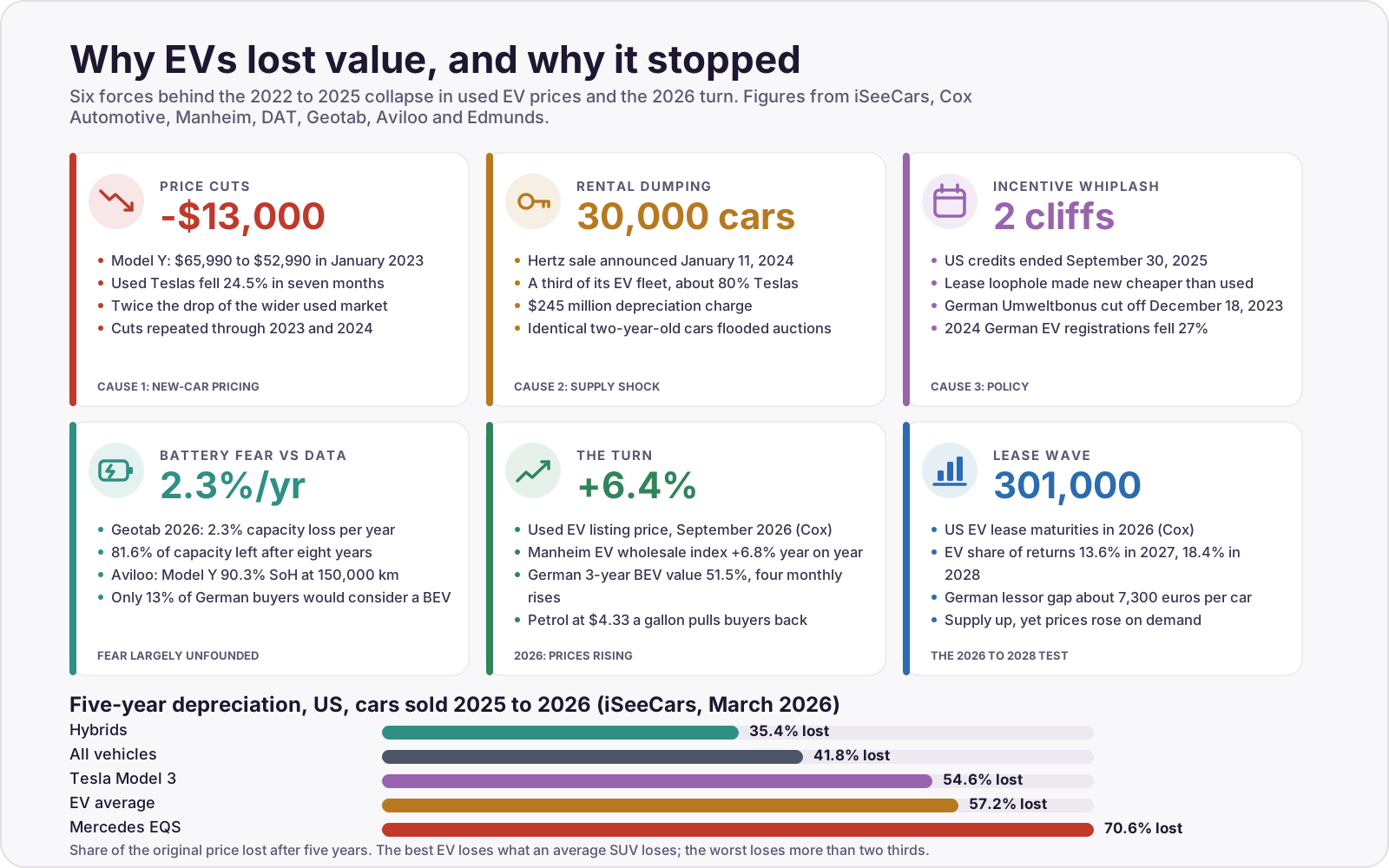
Original EV-Global infographic: the six forces behind the used-EV price collapse and the 2026 turn. Sources: iSeeCars (March 2026), Cox Automotive and Manheim (September and October 2026), DAT, Geotab (April 2026), Aviloo (September 2026), Edmunds, Hertz.
By model: the US numbers
Tap between five and three years. On five years the Taycan and the Model 3 lead and the EQS trails by 16 points; on three years the Taycan (31.7%) and the Mach-E (38.2%) show what happens once a launch premium has been absorbed, while the ID.4, Lucid Air and EQS are still falling.
| Model | 5-year loss | 3-year loss | Dollars lost over 5 years |
|---|---|---|---|
| Tesla Model 3 | 54.6% | 43.2% | $20,213 |
| Porsche Taycan | 54.7% | 31.7% | $54,403 |
| Hyundai Kona Electric | 56.5% | n/a | $18,581 |
| Kia Niro EV | 57.3% | n/a | $22,742 |
| Tesla Model Y | 57.8% | 44.1% | $26,020 |
| Ford Mustang Mach-E | 60.8% | 38.2% | $22,976 |
| Tesla Model X | 61.2% | n/a | $61,216 |
| Tesla Model S | 62.0% | n/a | $58,907 |
| Volkswagen ID.4 | 62.1% | 51.6% | $28,010 |
| Nissan Leaf | 63.1% | 47.3% | $17,743 |
| BMW i4 | 63.2% | 39.2% | n/a |
| Lucid Air | 63.4% | 50.6% | n/a |
| Mercedes EQS | 70.6% | 56.5% | n/a |
| Jaguar I-Pace | about 71% | n/a | n/a |
| EV average | 57.2% | n/a | n/a |
| Hybrid average | 35.4% | n/a | n/a |
| All vehicles | 41.8% | n/a | n/a |
Three readings. First, nothing electric beats the market average yet; the best EVs lose what an average SUV loses. Second, the three-year column is where the newer cars look better: the Taycan (31.7%), F-150 Lightning (33.5%), Rivian R1T (34.0%) and Mach-E (38.2%) have already absorbed their launch-price premiums, while the Lucid Air has not. Third, the badge now matters more than the drivetrain. After the federal credits ended, used Tesla prices rose 4.3% while other EVs fell 3.6%; in the first quarter of 2026 non-Tesla EVs were down 10.3% year on year and Teslas down 0.1%, and a used Tesla sells in 32 days against 60 for other EVs and 54 for petrol cars. Brauer again: "The resilience of Tesla pricing in a post-EV-credit world is remarkable." J.D. Power's 2026 residual value awards went to the Model 3, the Model Y, the Cybertruck and the Subaru Solterra, with Tesla the top premium brand, partly because, in ALG's words, Tesla "avoided the high incentives of other luxury BEV brands in 2025".
The Cybertruck is the paradox worth understanding. It won a residual award, yet iSeeCars shows a 49.5% three-year loss and 2024 trucks list for an average of $72,357 against original prices above $100,000 for the Foundation Series; meanwhile 2026 trucks trade close to the cut $69,990 base price on thin supply. Both are true: the first buyers paid a launch premium that vanished, and the market price of the truck itself has been stable since. The Cybertruck review covers the rest.
By model: Germany
German residual numbers come in two flavours, forecast and observed, and they say different things about the same car.
The forecasts, used by banks and lessors, favour the usual suspects. Bähr & Fess' July 2026 ranking of three-year residuals at 60,000 km: Tesla Model Y 57%, Skoda Epiq 54%, Skoda Peaq 54%, Tesla Model 3 53%, Mini Aceman 53%, with the Renault Twingo E-Tech and Mercedes CLA at 50%. Schwacke's "Wertmeister 2026", published October 15: BMW iX3 40 at 57.7%, Audi A6 Avant e-tron and Mini Aceman at 51.4%. Porsche's own line-up shows the premium problem in one brand: Cayenne Electric 53.9%, Macan Electric 51.5%, Taycan 48.9%, against 69.3% for a 911. Aampere's index of 4,900 dealer auctions in September has the Model 3 at 58% and the Model Y at 56% after 36 months against a market average of 48%; Robin Engelhardt credits "the dense charging network and relatively transparent pricing".
The observed losses are harsher and show the petrol gap car by car. Carvago compared 2022 cars with their late-2025 listings: Kona Electric lost 52.3% against 25.9% for the petrol Kona; Audi e-tron 50.7% against 26.7% for a Q8; Skoda Enyaq 51.7% against 33.0% for a Kodiaq; ID.4 46.1% against 34.5% for a Tiguan; ID.3 51.2% against 41.3% for a Golf; BMW iX3 46.1% against 41.5% for an X3, the smallest gap in the set; Mercedes EQE 69.7% against 49.3% for an E-Class.
Chinese brands are the new bottom of the table. DAT tracks their residuals falling from 61% in early 2024 to 47.2% in April 2026, a 14-point drop against seven for the market; Aampere's auction data puts Chinese EVs at 41% after three years and under 35% after four. Thin dealer networks, unknown parts supply and aggressive new-car discounting all feed that, and it is the one place where a cheap purchase price is clearly not a cheap car; see the China shock for the other side of that story.
The best forecast EVs, the iX3 and the Model Y, sit within two points of the observed petrol average; the observed EV average is eight points below it, and Chinese brands trail by 18. Forecasts (banks) and observed values (DAT, Aampere) are different measurements and should not be read as one ranking.
The lease wave is the 2026 story
About 71% of US EVs were leased in recent years, because the lease loophole captured the full $7,500 credit. Those cars are coming back now. Cox counts 105,653 EV lease maturities in the first half of 2026 and 195,446 in the second, about 301,000 in all, 9.9% of all maturities; J.D. Power counts 215,000, up 230% on 2025; whichever count you take, the EV share of returns rises to 13.6% in 2027 and 18.4% in 2028. Supply is already visible: about 55,000 used EVs listed in August against 42,000 a year earlier and 34,000 in 2024, and Manheim describes the price momentum as "fading as more off-lease EVs come to market". The reason prices rose anyway is demand: petrol at $4.33 a gallon in October and 2.15 euros a litre in Germany pulled private buyers into used EVs, and German private registrations exceeded company registrations in May and June for the first time.
For lessors the bill is real. Rödl & Partner's German example: a car listed at 52,000 euros in 2023 with a contractual residual of 33,800 euros at 36 months now fetches about 26,500, a 7,300-euro gap per car, 3.6 million euros across a 500-car fleet. Trade sources say 2022 and 2023 leases assumed residuals around 50% against market values of 35 to 40%. That gap was priced into the cheap EV leases of 2023; it is being paid now by captive banks, and it is why 2026 lease offers are stingier even as the cars got cheaper.
Battery health is becoming the second odometer
The thing that will close the EV gap for good is a number a buyer can trust. Three developments in 2026 point that way. Aviloo passed 500,000 battery tests and published medians by model: a Model Y at 94.5% state of health at 50,000 km and 90.3% at 150,000; an Ioniq 5 at 97.2% and 92.8%; an ID.4 at 95.3% and 90.6%; a first-generation Leaf at 91.1% and 86.3%; with a spread of up to 13.5 points between the best and worst car of the same model, which is exactly why a certificate changes the price. ADAC adopted thresholds (at least 92% at 50,000 km, 88% at 100,000, 84% at 150,000, 80% at 200,000) and offers the Aviloo check to members since April; DAT builds state of health into its valuations. From February 18, 2027 every EV battery sold in the EU needs a battery passport that records state of health. Combine that with the eight-year, 160,000 km warranty that transfers to the next owner and the single biggest reason for the used-EV discount loses its footing. Read how to check a used EV's battery before you negotiate.
Free toolBattery health and range calculatorEstimate a used EV's remaining capacity and real range from its age, mileage and charging habits before you negotiate.What to do, depending on which side of the deal you are on
If you are buying. Buy the depreciation someone else paid for. A three-year-old EV costs about $33,000 in the US, more than half of listings are under $30,000, and the steepest part of the curve is behind the car by year two or three. Prefer models with proven residuals (Model 3 and Y, iX3, Ioniq 5, Taycan in the US; our ranking of the best EVs flags them) and avoid the first-generation luxury cars unless you want to keep them until they die, in which case a 70% discount on an EQS is a lot of car. Get a state-of-health report; pay for it if the seller will not.
If you are leasing new. Leasing moves the residual risk to the lender, which is exactly where you want it on a car whose value depends on next year's price cuts and software. The numbers that make a lease good or bad are the residual the bank assumes and the money factor, not the monthly payment; our buy or lease guide walks through both.
If you are selling. Timing beats polish. Sell before a model refresh or a price cut, not after; sell with a battery certificate and the charging and service history in hand; and know that a Tesla sells in a month while most other EVs take two.
If you are counting total cost. Depreciation is the biggest line for every powertrain, and EVs can still win on the total. ADAC's five-year, 15,000 km-a-year comparison at 1.92 euros a litre has a Cupra Born at 61.9 to 67.9 cents per kilometre against 64.7 for a petrol Leon, an Astra Electric at 57.7 to 64.0 against 61.9, and a BMW iX2 at 74 to 80 against 81.1 for an X2, with energy costs roughly halved. The counter-example is real too: a Model Y that loses $26,020 against a RAV4 Hybrid's $8,319 does not get the difference back from about $2,000 a year of fuel savings. The EV savings calculator and the charging cost breakdown let you run your own case, and why hybrids are surging explains why the RAV4 buyer is not wrong either.
What each number measures
| Figure | What it measures | Basis and timing |
|---|---|---|
| iSeeCars 57.2% | five-year loss of cars sold March 2025 to February 2026 against original MSRP | retail transactions, backward-looking |
| Cox $36,767, +6.4% | average used EV listing price | dealer listings, September 2026 |
| Manheim EV +6.8% | wholesale auction prices | mix-adjusted index, mid-October 2026 |
| Edmunds -7% | asking price versus September 30, 2025 | baseline is the credit-expiry spike |
| DAT 51.5% | retail value of three-year-old cars as a share of list price | German dealer retail, September 2026 |
| Autovista and Schwacke about 37% | dealer trade value at 36 months and 60,000 km | forecast basis, lowest of all powertrains |
| Bähr & Fess, Schwacke rankings | forecast residual at 36 months | used by banks for leasing |
| Carvago, Aampere | observed listing or auction prices | actual cars, 2022 build year |
The EV-Global verdict
The worst of EV depreciation was a one-off: a price war, a rental dump and two incentive cliffs landing on a first generation of cars that aged quickly. That phase is over, and 2026 is the first year in which used EVs appreciated against used petrol cars on both sides of the Atlantic. What remains is a brand problem and a segment problem. Buy a Tesla, a BMW iX3, a Skoda or a Hyundai-Kia and you are taking roughly the residual risk of a petrol car; buy a first-generation luxury EV or a Chinese newcomer and you are not. The lease wave of 2027 and 2028 will test that split, and the battery passport will settle the other half of the argument. Until then: buy used at three years, lease new if you must have new, and treat a state-of-health certificate as part of the price. The rest of our buying guides take it from there.
EV depreciation: frequently asked questions
Do electric cars depreciate faster than petrol cars?
On average, yes: a five-year-old US EV has lost 57.2% against 41.8% for all vehicles (iSeeCars, March 2026), and a three-year-old German EV retains 51.5% against 59.4% for petrol (DAT, September 2026). The gap has narrowed through 2026 and is now mainly a question of brand.
Which electric cars hold their value best?
In the US the Tesla Model 3 and Model Y, Porsche Taycan and Hyundai Kona Electric lead the five-year table, and the Taycan, F-150 Lightning and Rivian R1T lead on three years. In Germany the forecasts favour the BMW iX3, Tesla Model Y and Model 3, Skoda's new EVs and the Mini Aceman, all above 53% after three years.
Why are used EVs so cheap?
New-car price cuts, incentives that made new leases cheaper than used cars, Hertz's sale of 30,000 EVs, a fast technology cycle and buyers' fear of battery wear all pushed prices down between 2023 and 2025. Battery data has since shown the fear is largely unfounded, and used EV prices rose 6 to 8% in 2026.
Is 2026 a good time to buy a used EV?
Yes for buyers: a three-year-old EV costs about $33,000 in the US, more than half of listings are under $30,000, and about 300,000 cars are coming off lease this year. Get a battery state-of-health report and prefer models with proven residuals.
Should I lease or buy an electric car?
Lease if you want someone else to carry the residual risk, which is still higher for EVs than for petrol cars and nearly impossible to predict two years out. Buy if you plan to keep the car eight years or more, in which case depreciation per year falls and fuel and maintenance savings accumulate.
Does battery health affect resale value?
Increasingly, yes. Valuers such as DAT now price state of health into their estimates, ADAC publishes thresholds, Aviloo and Recurrent reports are becoming standard in listings, and from February 2027 every EV sold in the EU must carry a battery passport recording state of health.
Hero photo: Ben Elliott / Unsplash. Infographic: original EV-Global illustration. Data from iSeeCars (March 2026), Cox Automotive and Manheim (September and October 2026), Recurrent, Edmunds, DAT, Autovista, Schwacke, Bähr & Fess, Carvago, Aampere, Rödl & Partner, Geotab, Aviloo and ADAC; quotes as attributed in the text.